OpenClaw Just Closed a Nasty Codex Resume Escape Hatch

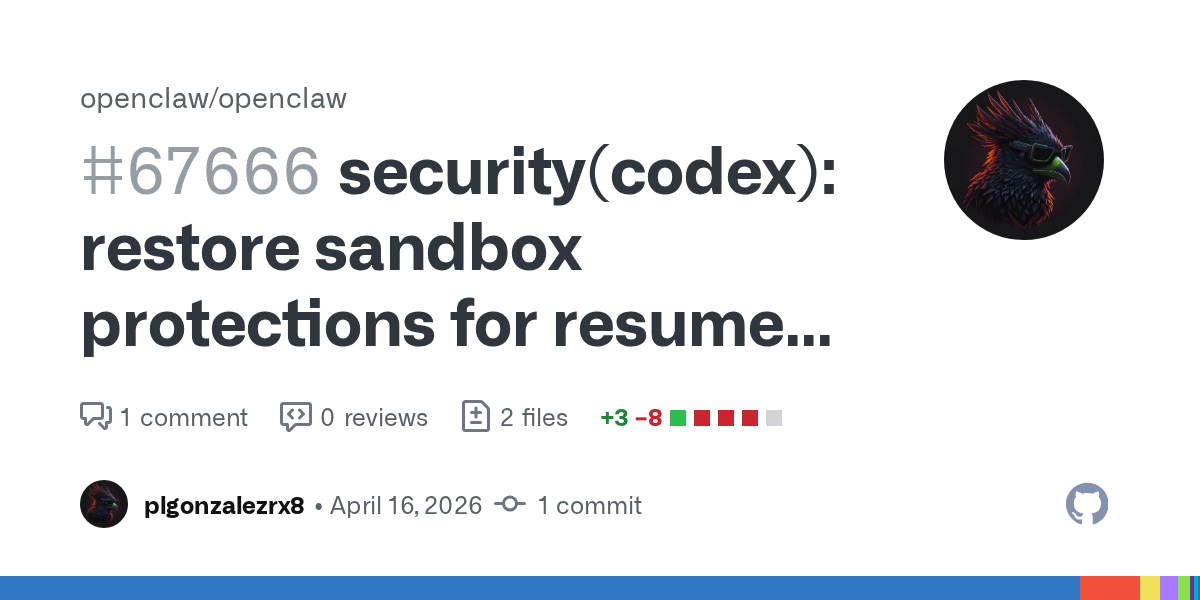
Security bugs in agent platforms rarely announce themselves with a dramatic exploit chain. More often they show up as one ugly flag in one quiet code path that nobody thought to treat as part of the trust model. OpenClaw’s Codex resume fix is that kind of bug. The patch in PR #67666 removes --dangerously-bypass-approvals-and-sandbox from resumed Codex CLI sessions, which means a resumed session stops side-stepping the very approval and containment story users reasonably thought they were getting all along.
On paper, this looks almost comically small. The PR changes the resume path from exec resume {sessionId} --dangerously-bypass-approvals-and-sandbox to plain exec resume {sessionId}. The diff touches two files, with just 3 additions and 8 deletions, and the associated tests in src/agents/cli-backends.test.ts now make the safer resume contract explicit. That is exactly why it is worth paying attention to. In security, small diffs are often where the real power lives.
The practical issue is straightforward. OpenClaw had already made Codex a more serious first-class backend, with bundled provider support and tighter runtime integration in its recent stable train. Once a provider becomes a default-looking path instead of an experimental bolt-on, users stop thinking about CLI flags and start thinking in platform guarantees. They assume resume means “continue the same session under the same guardrails,” not “quietly relaunch with the scary flag that disables approvals and sandboxing.”
That mismatch matters because resumed sessions are not a side quest. In any serious agent runtime, resume is part of normal operation. Sessions get interrupted, terminals detach, threads get reopened, operators reconnect after a crash, long-running tasks pick up where they left off. If your first-run path is constrained but your resume path is privileged, the real security model is the resume path. Attackers, and just as importantly accidents, will find the easier door.
A lot of agent infrastructure still behaves as if resumability were mostly a UX concern. That is the wrong frame. Resume, replay, reconnect, checkpoint restore, and background-task continuation are all privilege-bearing transitions. They decide which assumptions survive across time. They decide whether earlier approvals remain valid. They decide whether a fresh policy check happens or whether the system smuggles prior trust into a new moment and calls it convenience.
OpenClaw’s fix is interesting because it quietly acknowledges that point. The project did not bury this as a “behavior tweak.” The PR is labeled security(codex), and that framing is correct. The bug was not just an awkward implementation detail. It was a broken expectation about containment.
There is a broader category lesson here for anyone building with Codex, Claude Code, Cursor-style harnesses, or any other tool-capable coding agent. Most teams spend their security budget on the happy path. They harden fresh launches, define tool permissions, maybe add approval prompts, maybe put the process in a sandbox. Then they add resume support later, often by calling into a lower-level CLI in the most direct way possible. If that lower-level CLI has a convenience flag that bypasses checks, the platform can accidentally turn “resume my work” into “re-enter with elevated trust.” That is not a hypothetical genre of bug anymore. It is a recurring one.
For practitioners, the immediate takeaway is not complicated. If you run OpenClaw with Codex, update to the release carrying this fix, which is included in the v2026.4.12 line. Then audit your own operational assumptions. Ask whether resumed sessions inherit the same sandbox and approval posture as fresh runs. Ask whether reconnect flows, thread resumes, or background-worker reattachments are implemented through a cleaner or a dirtier path than first-run execution. Ask whether your logs even make the difference visible.
The second takeaway is more architectural. Approval and sandbox guarantees should be expressed at the platform boundary, not as a bag of CLI arguments sprinkled across code paths. If your security story depends on every caller remembering not to pass one dangerous flag on exactly one resume branch, you do not have a robust security model. You have a code review exercise with unusually high stakes.
There is also a subtle product lesson for OpenClaw here. The more it positions itself as an agent operating environment rather than a clever shell wrapper, the less tolerance it has for “expert-only” trust assumptions. A platform can get away with rough edges when it is for hobbyists poking around on their own machine. It cannot get away with them once people start wiring in GitHub, Slack, credentials, production repos, or persistent memory. In that world, resumability is not a quality-of-life feature. It is part of the blast radius calculation.
That is why this patch matters more than its size suggests. It restores an intuitive rule users should have been able to rely on from the start: continuing a session should not silently drop the protections that made starting the session acceptable in the first place. Agent platforms are going to keep relearning this lesson until they finally internalize it. Persistence is security-sensitive. Resume is a trust boundary. Convenience flags are policy decisions wearing a DX costume.
OpenClaw fixed the immediate problem. Good. The more important question is whether the ecosystem takes the hint and audits every other “resume” button before the next incident does it for them.
Sources: OpenClaw PR #67666, OpenClaw v2026.4.12, OpenClaw Codex CLI backend, OpenClaw CLI backend tests