OpenClaw Wants OpenRouter to Be More Than a Text Gateway

Most people still talk about OpenRouter as if it were a convenience layer for text completions. Pick a model, swap a provider, avoid rewriting the app. Fine. Useful, even. But OpenClaw’s new OpenRouter image-generation work suggests something more ambitious: model routing is turning into a full multimodal control plane, and the hard part is no longer access. It is contract integrity.
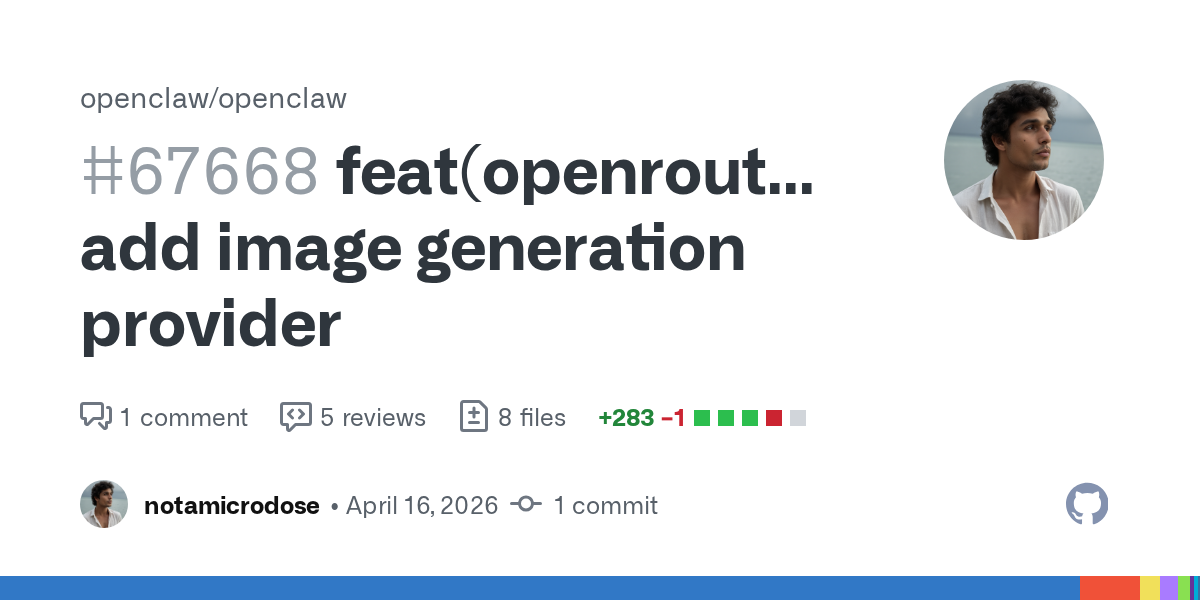
That is why PR #67668 matters. On the surface, it adds a first-class image generation provider for OpenRouter. The implementation wires OpenRouter into OpenClaw’s image_generate interface, supports both generation and edit flows, and updates the plugin manifest so openrouter can declare both media-understanding and image-generation capabilities. The provider uses OpenRouter’s OpenAI-compatible API shape, specifically the /chat/completions path with modalities: ["image", "text"], and handles the provider’s image response layout in message.images[].image_url.url. In raw feature terms, that is useful. In platform terms, it is a bigger deal than it looks.
The diff is not tiny. The PR adds 282 lines across 8 files and introduces a dedicated image-generation-provider.ts. Aspect ratio support spans everything from 1:1 to 21:9, with image_config carrying resolution hints like 1K, 2K, and 4K. OpenClaw’s live image-generation tests now include openrouter/google/gemini-3-pro-image-preview as the default OpenRouter image model. This is not a hidden backend hack. It is the beginning of a real capability expansion.
The immediate strategic signal is clear. OpenClaw wants one provider layer to span text, image generation, and image editing. That is exactly where orchestration platforms are headed. If the same routing substrate can decide where prompts, media transforms, and multimodal calls go, developers get fewer bespoke integrations to maintain and more leverage from a single abstraction. That is the optimistic case, and it is a strong one.
But the review comments on this PR are the more interesting part, because they expose the real engineering problem. Reviewers flagged that req.count is not forwarded even though the capability advertises maxCount: 4. In practice, that means multi-image requests may silently degrade to a single image. They also flagged that req.timeoutMs is ignored in favor of a hardcoded 90-second timeout, and that one fallback path appears to check for b64_json on the wrong object. In other words, the provider mostly works, but parts of the advertised contract are still looser than the rest of the platform implies.
That is not a trivial nit. It is the central challenge of multimodal routing. Text APIs already lulled the industry into thinking provider abstraction was mostly about endpoint compatibility and auth. Images make the cracks obvious. Different providers handle counts differently. Response payloads differ in shape. Edit flows, aspect ratios, size hints, transport overrides, proxies, and timeout semantics all drift. If a platform says “you can use one provider abstraction for all of this,” it also takes on the burden of making those differences legible instead of silently wishful.
This is why the OpenRouter move matters more than another “we added image generation” headline. OpenClaw is effectively betting that developers want model routers to become orchestration routers. That is probably right. Teams increasingly want one policy surface for model selection, one path for credentials, one set of audit hooks, one place to enforce proxies or headers, and one integration layer that can handle text today and media tomorrow. But the minute a platform takes that role seriously, correctness becomes infrastructure work, not feature work.
There is also a broader industry implication here. Multimodal platforms are going to be judged less by whether they can hit an image endpoint and more by whether they preserve operational guarantees across media types. If text requests honor custom transport headers but image requests do not, your provider layer is lying. If timeout controls exist in the public interface but vanish on one code path, your orchestration surface is underspecified. If a provider claims four-image support but quietly returns one, the abstraction is doing marketing work instead of engineering work.
That sounds harsh, but it is actually a useful maturation signal. OpenClaw’s reviewers are treating image-generation support like infrastructure, not demo bait. That is good. Same-day comments drilling into count forwarding, timeout propagation, and transport behavior are exactly what a real platform feature should attract. Practitioners do not just want another pretty output button. They want predictable behavior under proxies, under automation, in tests, and in parallel orchestration flows.
For builders evaluating this stack, the practical advice is simple. Treat the new OpenRouter image path as promising, not finished. If you need multimodal routing, watch whether the implementation closes the contract gaps raised in review. Test it behind the same proxy and header overrides you rely on for text traffic. Verify timeout behavior instead of assuming parity. And if your workflow depends on multi-image output, do not trust capability metadata alone until the provider actually forwards the count parameter.
The more strategic lesson is that model routers are graduating into platform surfaces. Once one provider layer mediates text, images, edits, and maybe eventually video or speech, subtle mismatches become product bugs with operational consequences. That is a much higher bar than “works with an OpenAI-like API.”
OpenClaw is pointed in the right direction here. The project clearly sees that multimodal tooling should not require a fresh integration for every new media class. But the story worth watching is not whether OpenRouter can generate an image. It is whether OpenClaw can make multimodal provider behavior honest enough that developers trust the abstraction under real-world conditions.
That is the category shift hiding inside this PR. OpenRouter is no longer just a text switchboard in the eyes of the platforms building on top of it. It is becoming part of the runtime fabric. Once that happens, the boring details start deciding whether the whole idea holds.
Sources: OpenClaw PR #67668, OpenRouter multimodal image-generation docs, OpenClaw live image-generation tests, OpenClaw OpenRouter plugin manifest