OpenClaw’s Codex App-Server Fix Is the Multi-Agent Concurrency Patch the Runtime Needed

Singletons are where multi-agent platforms go to lie to themselves.
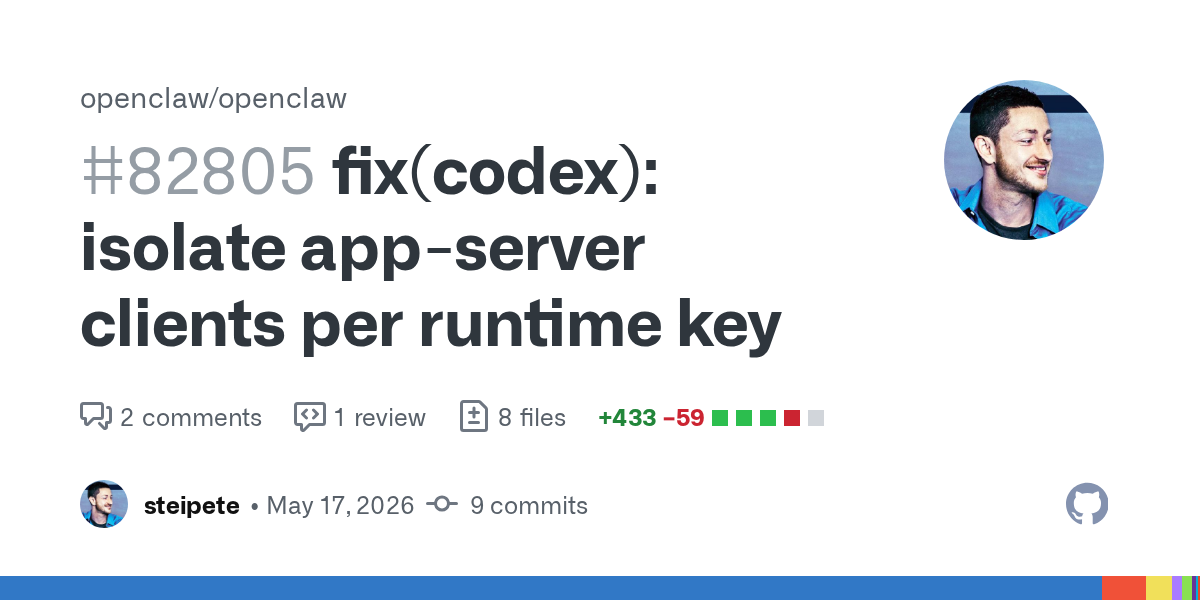
OpenClaw merged PR #82805 on May 17 with the sort of fix that looks small from a changelog and enormous from an operator’s chair: the native Codex app-server path no longer relies on one shared client slot for every active agent. It now uses a keyed client registry so different agent directories, auth profiles, and runtime-derived environments stop evicting each other mid-turn.
That sounds like plumbing because it is. It is also the difference between “Codex works in a demo” and “Codex can be used as a backend for an orchestrator that may have multiple agents running at once.” The bug report behind the patch described two Telegram agents running concurrently against the native Codex app-server path. One agent started work; another agent with a different runtime key came in; the first agent received a <turn_aborted> marker after roughly six seconds, then stayed wedged until the gateway was restarted. That is not a model-quality failure. That is tenancy leaking through the runtime.
The fix moved fast. The PR was opened at 2026-05-17T00:24:29Z and merged at 00:46:40Z, landing via merge commit 89532d3a92a8bec0121ce954b682e052c3be2f42 after land commit eacf1ab5fa6a8ded6e75bcbd7f8e7b74b966381b. It changed eight files with 433 additions and 59 deletions. The verification notes are not cosmetic either: 196 focused tests passed across config.test.ts, shared-client.test.ts, and run-attempt.test.ts, with maintainer landing also reporting pnpm tsgo:prod, pnpm check:test-types, pnpm lint --threads=8, and green regular CI.
The bug was a runtime-tenancy failure, not an app-server quirk
The old shape had one shared Codex app-server client, one promise, and one key. When a second agent computed a different key, the singleton could be cleared or replaced while another turn was still active. The new shape introduces a keyed registry, preserving reuse where the runtime identity matches and preventing unrelated agents from stomping each other when it does not.
That is the right abstraction because OpenClaw is not merely launching Codex as a local helper. It is routing channel traffic, agent configuration, workspace directories, auth profiles, model settings, sandbox policy, and environment scopes into a backend that was originally easy to reason about as a single-user local assistant. Once Codex becomes a shared runtime backend, client identity stops being an implementation detail. It becomes a boundary.
The subtle part is that sharing is still valuable. A naive fix would be “never share app-server clients,” which avoids cross-agent interference but gives up warm-state efficiency and increases startup churn. A singleton fix would be “share everything,” which is exactly how this failed. A keyed registry is the practical middle: share only when the things that define runtime identity are equivalent. Different workspace? Different auth profile? Different environment-derived key? Different client.
This is the same design pressure every coding-agent platform is about to hit. Remote agents, background agents, and channel-bound agents are not just UI affordances. They imply schedulers, isolation semantics, cancellation rules, failure domains, and observability. If one agent’s key mismatch can abort another agent’s active turn, the product may feel multi-agent at the surface while still being single-tenant underneath.
Clean failure beats silent wedging
The PR also tightens close handling. Mid-turn app-server client closes now surface as prompt errors while in-flight tool work is still aborted. Already-terminal queued completions are preserved. That second sentence matters: throwing away a valid final completion because cleanup raced with delivery is how runtimes manufacture phantom failures.
For practitioners, the test plan should change. Do not validate Codex integration by running one clean app-server session in one workspace. Run two agents at once. Use different agent directories. Use different auth profiles. Trigger overlapping tool calls. Restart or kill the app-server mid-turn. Confirm one failure does not corrupt the other session, does not misclassify the event as a user abort, and does not wedge delivery until a gateway restart.
If you are comparing OpenClaw’s Codex path with Claude Code, Gemini CLI, Cursor, or OpenCode, this is the tier of comparison that matters more than another benchmark screenshot. How are runtime identities keyed? What gets shared? What gets isolated? What happens to terminal completions when the backend dies? Can operators tell whether a turn failed because of rate limits, app-server closure, tool abort, user cancellation, or transcript parsing?
There is also a product lesson hiding here. Users do not care that two agents had different runtime keys; they care that one conversation died because another conversation started. Good orchestration is the art of making those internal boundaries invisible by making them real.
The fast merge is encouraging, but the broader lesson is sharper: agent orchestration turns every global cache into a possible isolation bug. The next generation of coding-agent infrastructure will be won less by “supports model X” and more by boring correctness around runtime keys, cancellation, and queue ownership. That is where multi-agent systems either become dependable or become a pile of haunted singletons.
Sources: OpenClaw PR #82805, OpenClaw issue #82758, land commit eacf1ab5, merge commit 89532d3