OpenClaw’s Workspace Plugin Patch Shows Why Agent Extension Systems Need Defense in Depth

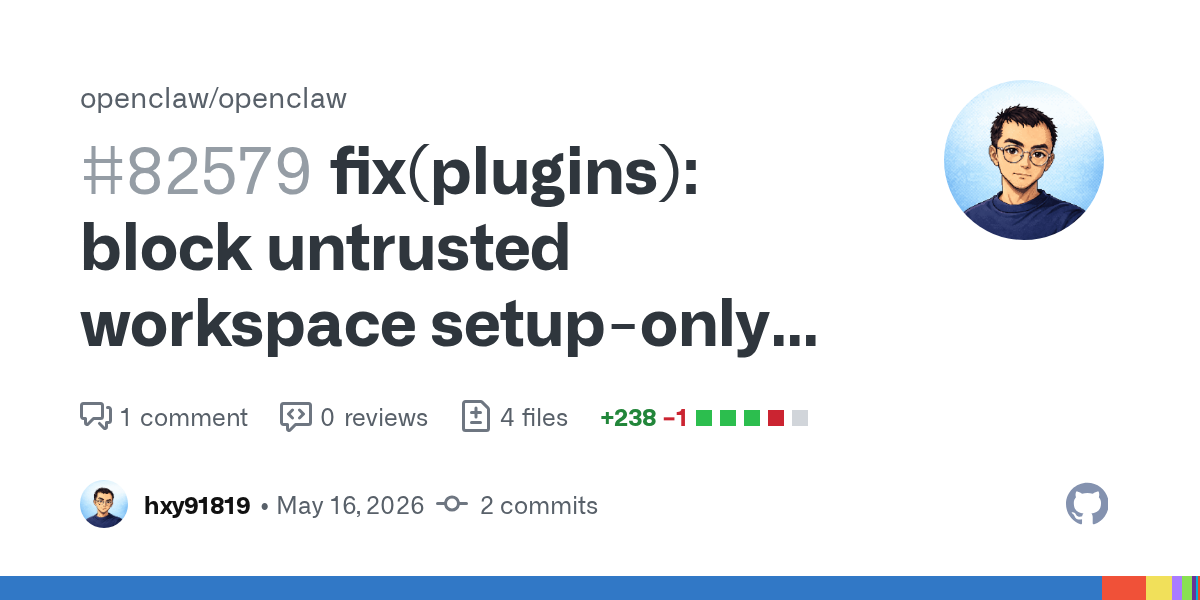
OpenClaw’s PR #82579 is the kind of security patch that almost nobody will tweet about and every serious agent platform needs. It does not add a model. It does not make an agent smarter. It tightens a loader seam where a disabled workspace channel plugin could still execute through a setup-only scoped load when the caller passed explicit onlyPluginIds.
That is a mouthful. It is also the whole problem with extension systems: the dangerous path is rarely the one the UI labels “install.” It is the helper, the bootstrap route, the setup probe, the registry callback, the “this only loads metadata” path that quietly imports code.
The pull request, opened May 16 by hxy91819, describes the root cause plainly. Higher-level paths such as channels add and trusted-catalog flows had already been hardened on main. But the lower-level scoped setup-only loader still treated an explicit plugin ID as sufficient authority to import a disabled workspace channel plugin. The patch rejects disabled workspace channel plugins from scoped setup-only loader paths and adds a registry backstop so disabled workspace plugins cannot register channels even if a lower-level caller imports them.
“Disabled” has to mean disabled below the UI
This is exactly where plugin ecosystems tend to fail. Product code enforces trust at the visible entry point. Security review signs off on that path. Then a separate internal path exists for discovery, setup, validation, migration, previews, tests, or scoped loading. Someone passes a plugin ID because they are not trying to “install” anything; they are only trying to inspect setup metadata. But in JavaScript and TypeScript plugin ecosystems, inspection often means import, and import often means code execution.
That difference matters more for agent platforms than it does for ordinary apps. A normal plugin might add a UI panel. An agent plugin can register channels, tools, memory providers, lifecycle hooks, MCP surfaces, or transport integrations. It can influence what the model sees and what the runtime can do. Once plugin import becomes execution, a trust bypass is not a bookkeeping bug. It is a capability boundary bug.
PR #82579’s before-and-after proof is useful. On current origin/main, the minimal repro created a marker file during scoped setup-only load, proving the disabled workspace plugin executed. After the fix, the marker file remains absent and the plugin stays disabled. That is the right test because it validates behavior, not just a config flag. Security boundaries should be tested by trying to cross them.
The registry backstop is the important part
The patch does two things: it blocks disabled workspace channel plugins from setup-only scoped loads, and it prevents disabled workspace plugins from registering channels even if a lower-level caller imports them. The second half is where the design gets more serious.
Call-site checks are necessary and insufficient. They are necessary because the user-facing path should reject unsafe operations early and clearly. They are insufficient because codebases grow new call sites. If the invariant is “disabled workspace plugins cannot register channels,” that invariant should live as close as possible to channel registration. Otherwise every future setup helper, migration function, or test harness has to remember the same security rule perfectly.
Agent extension systems need this kind of defense in depth because the trust model is layered. A plugin might be trusted because it comes from a catalog, because an operator explicitly enabled it, because it lives in a workspace, because a channel setup requested it, or because a scoped loader was asked for it by ID. Those are not equivalent signals. A string matching a plugin ID is not consent to execute code from an untrusted workspace.
That distinction will matter more as agent runtimes adopt richer plugin formats. OpenClaw already deals with channels, tools, memory, providers, browser and media surfaces, plus external package metadata. Across the broader ecosystem, Codex plugins, Claude Code skills, MCP servers, lifecycle hooks, and repo-local instructions are all converging into portable bundles of authority. The industry keeps calling this “configuration,” but a lot of it is executable infrastructure.
Workspace trust is a supply-chain problem with a local accent
The word “workspace” can make this feel local and therefore safe. It is not. Developers clone repositories, check out branches, open customer projects, run automation in CI, mount shared folders, and let agents inspect unfamiliar trees. A workspace plugin is still code supplied by the workspace. If the runtime can load disabled workspace plugins during setup probes, then “do not trust this workspace” has a footnote big enough to drive a package manager through.
For operators, the immediate guidance is straightforward. If you allow workspace plugins, track this fix and be conservative with shared repos or automated setup flows. Treat workspace plugin trust as an explicit operator decision. Do not assume that because a plugin is disabled in one UI path it is impossible for another runtime path to import it. If you maintain internal OpenClaw plugins, add tests that prove disabled plugins cannot register channels, tools, or hooks through scoped loading, discovery, and setup-only modes.
For platform builders, the lesson is more general: make the dangerous operation enforce the rule. If registering a channel is sensitive, the channel registry should know whether the plugin is trusted. If exposing a tool is sensitive, the tool registry should enforce policy before the model sees the schema. If importing workspace code is sensitive, the loader should carry trust metadata all the way down. Security reviews that only inspect the high-level command path will miss the seam that actually executes.
The annoying truth is that this work does not feel like product velocity. Nobody buys an agent platform because its setup-only scoped loader preserves disabled workspace trust invariants. But people abandon agent platforms when plugin marketplaces become malware delivery mechanisms or repo-local extensions execute in places they should not. This is what earning trust looks like before the incident report.
OpenClaw’s patch is narrow, but the category lesson is not. Plugin marketplaces fail at the seams, not the slogans. “Disabled” has to mean disabled at every loader layer, every registry layer, and every setup path — especially the ones nobody thought were security-sensitive until they were.
Sources: OpenClaw PR #82579, PR #64154, issue #82581