Prepaid Gemini API Credits Fix a Very Real Developer Pain: Billing Anxiety

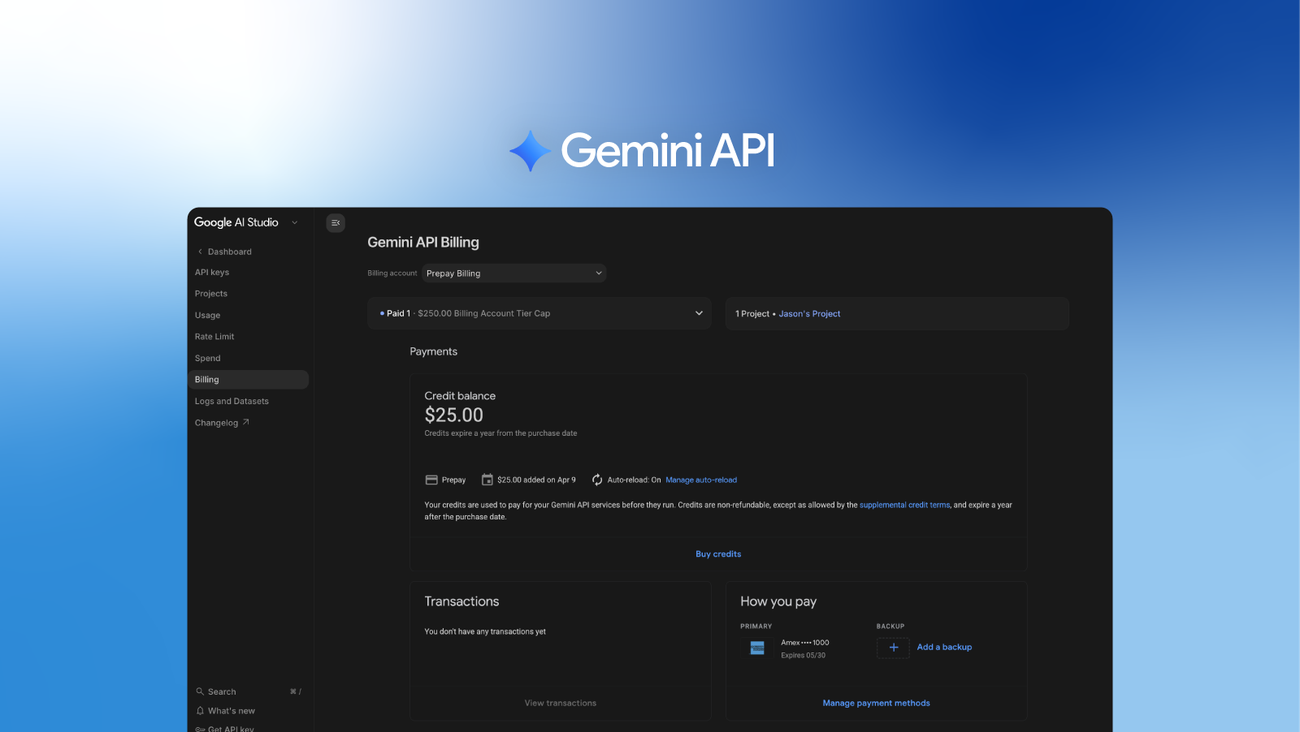
The most revealing Google AI announcement of the day might be the least glamorous one. Not a frontier benchmark, not a new agent demo, not another lifestyle video about how AI will transform everything. Just billing. Specifically, prepaid Gemini API credits in Google AI Studio. That sounds like bookkeeping. It is actually product strategy.
Google says developers can now buy Gemini API credits up front inside AI Studio, spend against that balance, and optionally enable auto-reload when the balance gets low. For now the feature is limited to new U.S. Google Cloud Billing accounts that enable the Gemini API, with a broader rollout promised in the coming weeks. The company frames this as a way to add predictability and simplify the path from prototyping to scale. That is true, but it is also a polite way of admitting something many developers have been saying for months: usage-based AI pricing still feels vaguely dangerous when the platform wrapping it is a Google Cloud account.
This is not a small issue. Billing fear quietly kills experimentation. Developers will tolerate missing features longer than they will tolerate the possibility of a surprise invoice they cannot explain to themselves, much less to a finance team. That matters even more in AI than in traditional cloud products because token usage is abstract, traffic can spike unpredictably, and one careless loop can turn a cheap prototype into a stressful lesson in unit economics. When builders say they want “developer-friendly AI platforms,” they often mean model docs and SDKs. What they really mean is: make the first month emotionally safe.
Google’s announcement is notable because it links prepay to two earlier changes, Spend Caps and revamped Usage Tiers. Put together, that is a coherent message. The company is trying to sand down one of the biggest sharp edges in its developer stack: the feeling that Gemini access lives inside a billing and quota system designed for grown-up cloud procurement rather than for experimentation. Prepay is not just a payment option. It is an onboarding device.
The real product is budget confidence
There is a reason prepaid credits remain popular across consumer software, gaming, ads, and creator platforms. People like bounded risk. The psychological difference between “I spent $50” and “I might owe something later” is enormous, even when the numeric exposure is similar. AI providers sometimes forget this because they think like infrastructure vendors. But the fastest-growing segment of their user base often behaves more like startup builders, indie hackers, agency teams, and internal skunkworks groups. Those users optimize for velocity, yes, but they also optimize for not getting ambushed by the bill.
That is why Google’s wording about surprise charges matters. The company says prepay lets developers begin building “without the risk of surprise charges at the end of the month.” Translation: yes, we know this has been a trust problem. And it has. Community complaints around AI billing rarely sound ideological. They sound tired. Unclear free-versus-paid behavior. Confusing quota ladders. Difficulty predicting spend. Cloud-console complexity for what should feel like a simple API relationship. None of that makes headlines, but all of it affects conversion.
The bigger implication is competitive. OpenAI and Anthropic have benefited, at different times, from feeling simpler than the broader public-cloud experience. Google has often had the opposite problem: strong models, uneven packaging. AI Studio has improved a lot, but it still sometimes feels like a nicer front door attached to the same large, complicated house. Prepay helps because it narrows the gap between experimentation and intent. If a developer can set a budget, see the balance clearly, and top up when needed, Gemini becomes easier to choose for a prototype. And the provider that wins the prototype frequently wins the future production workload too.
This is also a quota story disguised as a billing story
Google is not hiding the second half of the plan. The company says prepay is designed to evolve with the application. Once customers establish payment history and move into higher usage tiers, they can switch future Gemini API usage to standard postpaid billing, consolidate cloud charges, and unlock higher rate limits. That is a very recognizable platform move. Lower the anxiety barrier at the front, then graduate successful users deeper into the main commercial system.
In other words, prepay is not just about convenience. It is a funnel. Google wants AI Studio to be a serious on-ramp rather than a sandbox people use briefly before moving elsewhere. That matters because the active battle in AI platforms is not just over which model tops a benchmark. It is over where developers start, where they stay, and how painful it feels to go from experiment to product.
There is a lesson here for every company building AI products, not just model vendors. Cost controls are feature work. Visibility is feature work. Simple billing language is feature work. If users cannot predict spend, they will underuse the system or avoid integrating it deeply. The same is true inside enterprises. Finance-friendly AI products do not win because accountants are exciting. They win because the budget conversation happens earlier and more often than the model-quality conversation once a project tries to scale.
Of course, prepay does not fix everything. Initial availability is narrow. It excludes invoiced or offline accounts. It does nothing by itself to resolve whether Gemini’s higher usage tiers and quotas are intuitive enough, or whether Google’s wider cloud identity and project model remains more complex than many developers want. And prepaid credits can sometimes mask a different problem: if the metering is opaque, “top up and pray” is not meaningfully better than postpaid confusion. The value comes from pairing prepay with transparent reporting, sane defaults, and reliable limit controls.
Still, this is the right boring move at the right time. The AI market is entering a phase where operational trust will matter more than launch-day novelty. Teams are no longer just trying models for fun. They are deciding which APIs deserve real workloads. In that environment, the vendor that makes cost feel legible has a real advantage over the vendor that merely sounds impressive on a stage.
If you are a builder, the practical takeaway is simple. If Gemini has been on your maybe list but billing uncertainty made it feel annoying or risky, this update removes a real objection. If you are already using Gemini, prepay may give you a cleaner way to ring-fence prototype budgets and keep finance comfortable. And if you run an AI product team, pay attention to the deeper lesson: users do not separate platform trust from billing trust. They are the same thing.
Nobody brags about payment flows in a keynote. They should. In AI, pricing clarity is increasingly part of the product. Google just shipped a fix for one of the least cinematic, most conversion-critical problems in its stack, and that is more important than it looks.
Sources: Google Blog, Gemini API billing docs, Gemini API changelog