Rubin’s 45°C Liquid Loop Is NVIDIA Turning Cooling Into Token Economics

NVIDIA’s new Rubin cooling story looks, at first glance, like facilities plumbing: warmer coolant, fewer chillers, less water, cleaner racks. That undersells it. The real announcement is that NVIDIA is trying to make the physical data center part of the AI runtime, because at agent scale the cost of a token is no longer decided only by the GPU.
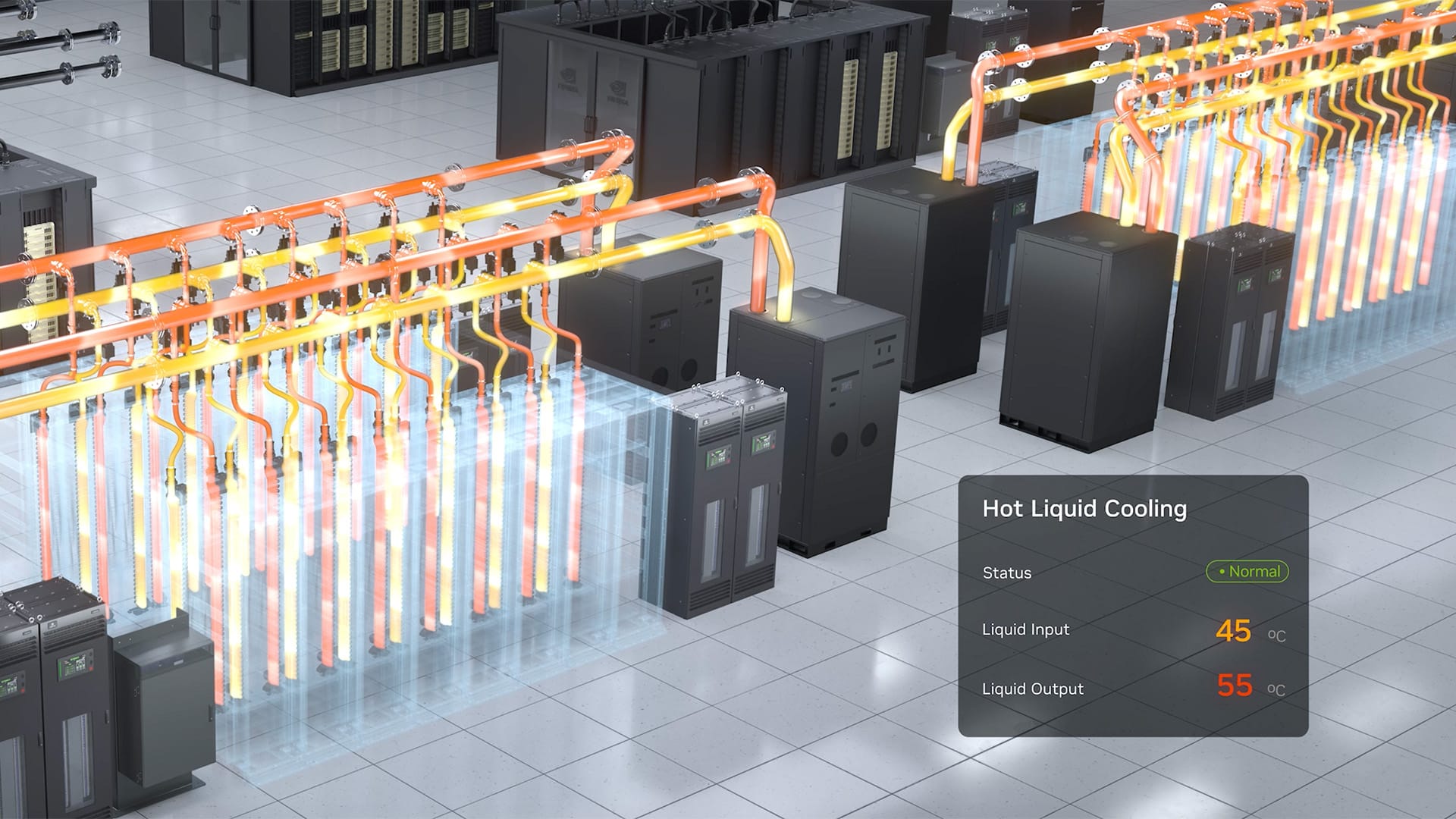
The company says its Rubin-generation AI infrastructure is its first platform designed for 100% liquid cooling: every chip and networking component cooled by liquid in a closed loop, with no fans anywhere in the system. The headline number is counterintuitive enough to be useful: coolant can enter the rack at up to 45°C / 113°F and leave around 55°C, while cold plates keep processors inside validated operating limits. In normal human terms, the liquid going into the server is hotter than a hot tub. In data-center terms, that is exactly the point.
Traditional data centers spent decades worshipping cold air. Hot aisles, cold aisles, perforated tiles, fan walls, chiller plants, and rooms that felt like someone put a server rack inside a grocery-store freezer. That model becomes increasingly fragile as AI racks move from old 20 kW-class densities toward 100 kW-plus territory and beyond. Air is a bad medium for moving that much heat. Liquid is better. Capturing heat directly at the chip and moving it through a closed loop changes the engineering envelope.
Warm coolant is the feature, not the compromise
NVIDIA’s claim is that higher coolant temperature enables dry-cooler-heavy, chiller-light, and in favorable climates chiller-less operation. The coolant mix is described as 75% water and 25% propylene glycol, flowing through cold plates, coolant distribution units, and outdoor dry coolers. Because the loop can reject heat outdoors at a higher temperature, the facility does not need to spend as much energy manufacturing cold water or cold air before sending it through the building.
The savings are not rounding error. NVIDIA cites the industry rule of thumb that cooling can account for up to 40% of data-center electricity consumption, and that raising chiller plant temperature by 1°C can cut cooling energy costs by roughly 4%. For a 50 MW hyperscale facility, the company says moving to liquid-cooled infrastructure can save more than $4 million annually in cooling-related energy and water costs.
The water story may matter even more than the power story. NVIDIA says facility cooling water consumption can fall from roughly 2.6 million gallons per MW per year for conventional cooling-tower systems to near zero in favorable dry-cooler designs. Ali Heydari, NVIDIA’s director of data center cooling and infrastructure, put it bluntly: “The NVIDIA DSX reference design for AI factories has zero water consumption — we have eliminated massive amounts of power usage and pretty much all water usage,” adding that dry-cooler-based designs may need chillers only around 1% of the year in some climates.
That caveat matters. Phoenix is not the Scottish Highlands, and liquid cooling does not repeal thermodynamics. But it does widen the list of places where high-density AI infrastructure can be permitted, powered, and operated without turning local water politics into the deployment bottleneck. Engineers tend to treat permitting, substations, and cooling plants as someone else’s problem until those constraints show up as quota limits, higher reserved-capacity prices, or an inference endpoint that cannot burst when the product finally gets traction.
DSX is NVIDIA’s attempt to make the building schedulable
The more interesting frame is NVIDIA DSX, the company’s AI factory reference design and platform. NVIDIA describes DSX as spanning chips, systems, infrastructure software, facilities, power, cooling, simulation, and partner technologies, all optimized for lowest token cost. That phrase should not be dismissed as marketing garnish. It is the closest thing to the actual product strategy.
For years, GPU infrastructure was sold mostly as hardware plus software stack: CUDA, networking, libraries, schedulers, containers, clusters. DSX expands the boundary. It treats power availability, cooling behavior, grid events, telemetry, digital twins, and operations agents as part of the same system that determines tokens per watt and time to first token. DSX MaxLPS is positioned around dynamic power management. DSX Flex connects AI factories to grid signals such as demand response or pricing events. DSX Exchange connects compute, network, energy, power, and cooling plant signals across IT, operational technology, and operations systems.
That is not just a facilities dashboard with a nicer acronym. If an AI factory is power-limited, thermally constrained, or responding to a grid event, the workload scheduler should know. If a cooling spike will force throttling, an operations agent should not discover it after latency graphs turn red. If a liquid loop has a service event, capacity planning should understand the failure domain. NVIDIA is effectively saying the data center has become a coordinated machine, not a room that happens to contain machines.
This is especially relevant for agentic workloads. A training job can often absorb some scheduling awkwardness. Interactive agents, coding systems, multimodal pipelines, retrieval-heavy assistants, and test-time compute loops expose infrastructure jitter directly to users. The user does not care whether the slowdown came from a GPU bottleneck, a thermal cap, a chiller constraint, or a cluster waiting on available power. They just see the agent get expensive, slow, or unreliable.
The rack gets denser, and the pager gets sharper
NVIDIA says fully liquid-cooled Rubin servers also change the physical shape of the rack: a system that previously occupied six rack units can fit into two. That improves tokens per square foot, cabling density, and data-hall utilization. It also concentrates risk. Higher density is great right up until one manifold, connector, pump, distribution unit, or monitoring blind spot turns a localized problem into a larger capacity event.
That is the practitioner takeaway: liquid cooling is not “set and forget” magic. It shifts the operational burden. Teams need telemetry on inlet and outlet temperatures, flow rates, pressure, coolant chemistry, leak detection, pump health, CDU redundancy, service procedures, and how thermal events map to workload placement. A fanless rack without serious observability is not modern infrastructure. It is an expensive aquarium with a root password.
For engineering leaders buying cloud or colocation capacity, the vendor questions should get more specific. Do not stop at GPU count and advertised accelerator generation. Ask about effective tokens per watt, rack power density, cooling topology, water usage effectiveness, dry-cooler versus chiller assumptions, liquid-loop redundancy, thermal telemetry exposed to customers, scheduler behavior under power or cooling constraints, and how burst capacity is priced when the facility is the bottleneck. If the answer is only “we have Rubin,” keep reviewing the PR.
For platform teams building on top of this capacity, the lesson is similar. Instrument cost and latency by workload shape, not just by model. Agent loops, long-context inference, video generation, synthetic-data pipelines, and retrieval-heavy systems stress infrastructure differently. If the underlying provider is optimizing around tokens per watt, your own scheduler and budget controls should understand when to batch, when to degrade gracefully, when to move work to cheaper capacity, and when not to launch a 10,000-step agent run because someone clicked the shiny button.
The quiet strategic move here is that NVIDIA is tying its GPU roadmap to the building roadmap. Rubin’s 45°C liquid loop is not about making servers comfortable. It is about making AI factories denser, more permit-able, less water-hungry, and cheaper per token. That matters because the next phase of AI competition will not be won only by who has the fastest chip. It will be won by who can keep useful tokens flowing under real-world constraints: power, heat, water, grid politics, maintenance windows, and the pager at 3 a.m.
Cooling used to be the thing developers ignored until the rack screamed. In AI infrastructure, cooling is becoming product behavior. NVIDIA appears to understand that. The rest of the stack now has to catch up.
Sources: NVIDIA Blog, NVIDIA DSX platform, NVIDIA Newsroom