The Agent Scaffold Trap: `npx` Can Succeed While Quietly Installing 2020

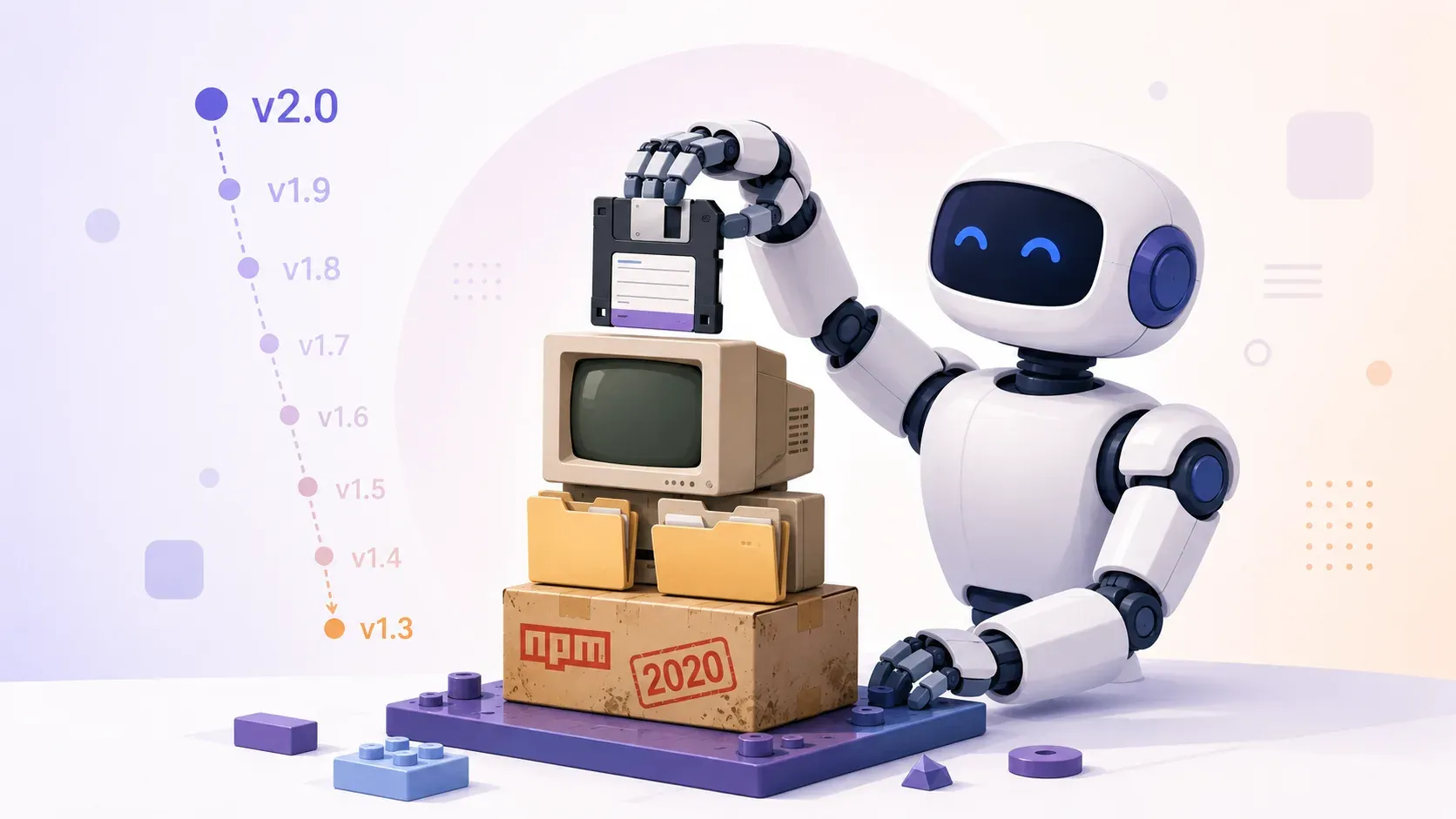
The most dangerous failure mode in agentic coding is not the spectacular one where the model deletes production or invents an API. It is the quiet one where every command succeeds, files appear on disk, the agent reports progress, and the project starts six years in the past.
Microsoft Developer published a useful post on exactly that class of failure: an AI coding agent runs a scaffold command with npx, npm resolves an old compatible package instead of the latest one, the command exits successfully, and the agent continues as if the foundation is current. In Microsoft’s SharePoint Framework evaluation, the agent ended up with SPFx v1.11.0, published in July 2020, instead of the latest v1.23.0. That is not a small miss. It is twelve versions and six years of ecosystem drift hidden behind a zero exit code.
This is the kind of bug that should bother anyone evaluating coding agents, because it does not look like a model hallucination. It looks like normal tooling behavior. That makes it harder to detect, easier to ship, and much more likely to survive until a human notices the generated app feels suspiciously antique.
A successful scaffold is not proof of the right scaffold
The mechanic is subtle but defensible. When npx runs without an explicit version, npm resolves a package version compatible with the current Node runtime. Since npm-pick-manifest v9.1.0, shipped in 2024 and present in npm behavior since 10.8.2, npm prioritizes versions whose engines field matches the active runtime over the package’s latest tag when compatibility conflicts exist.
That means a package can have a newer release marked latest, but if that latest release says it supports Node >=22.14.0 <23.0.0 and the agent is running on Node 24, npm may walk backward to an older version that appears compatible. If an older release has no engines field, npm can treat it as compatible with everything. The result is both logical and surprising: the command succeeds by selecting a fossil.
npm is not simply being foolish here. Respecting engine constraints is usually the safer default. If a package author says the newest scaffold does not support your runtime, a package manager should not pretend otherwise. The agent failure is different: the agent treats “command completed” as equivalent to “the intended version was installed.” Humans make that mistake too, but humans often catch the smell. The CLI banner looks old. The file layout does not match memory. The generated dependencies are stale. An agent sees success-shaped terminal output and moves on.
The related npm issue trail shows this was not invented for the AI era. In 2024, users saw npx @pkgjs/support validate resolve @pkgjs/[email protected] instead of 0.0.6 under Node.js 22.5.1 with npm 10.8.2, causing an executable resolution failure. npm’s resolver behavior changed for reasonable compatibility reasons. Agents are now exposing the edge case because they automate through it faster and with less suspicion.
Agents inherit every invisible environment assumption
The broader lesson is not “never use npx.” The broader lesson is that coding agents are bad at invisible environment assumptions unless we force those assumptions into the workflow.
Node version, npm version, package-manager cache, registry authentication, shell initialization, PATH order, feature flags, environment variables, architecture, version-manager state, and corporate proxy behavior can all change what a command actually does. None of those are in the prompt by default. Many agents do not inspect them before acting. They run the command, observe files, and start building on whatever appeared.
That is tolerable when the task is small and a human is watching every step. It is not tolerable when the agent is expected to scaffold, install, configure, test, and commit with minimal supervision. A bad scaffold poisons everything downstream. The agent writes code against old APIs, suggests obsolete patterns, inherits known vulnerabilities, produces docs for the wrong major version, and may still pass enough tests to look productive. You do not get an explosion. You get technical debt with a green checkmark.
This is also not a JavaScript-only problem. Python project generators can select templates based on interpreter constraints. Docker base-image tags can drift or resolve to unexpected architectures. Terraform providers follow version ranges that may be too loose or too stale. Helm charts, Gradle plugins, NuGet templates, SDK generators, and cloud CLIs all have “latest compatible” behavior somewhere in the stack. Agentic workflows amplify every one of those cases because they remove the person who usually asks, “Wait, why did it install that?”
That is why scaffold commands should be treated as supply-chain operations, not convenience macros. A project generator defines the starting architecture, dependency graph, security posture, framework version, test harness, and upgrade path. Letting an agent invoke it without version pins is the software equivalent of letting a contractor pour the foundation from whatever concrete truck happened to arrive.
The fix is versioned, inspectable tooling
Microsoft’s recommended mitigations are refreshingly practical: pin versions in prompts, pin versions in agent extensions, MCP servers, and tools, control Node with .node-version or .nvmrc, avoid unnecessary upper engine bounds if newer runtimes actually work, and verify the generated package.json after scaffolding. That is the right checklist, but teams should go further if agents are becoming part of the normal development path.
Prompts should not say “create a new app.” They should say which generator, which version, which runtime, and which package manager are expected. Tool definitions should prefer commands like npx package@version or npm create package@version over bare invocations. Repositories should include runtime pins through .nvmrc, .node-version, Volta, asdf, dev containers, or whatever mechanism the team actually uses. Agents should read those pins before running setup commands.
More importantly, scaffold tools and MCP servers should return the resolved generator version as structured output. Do not bury the most important fact in terminal text and hope the model notices. A good agent-safe scaffold tool should report: requested version, resolved version, runtime, package-manager version, compatibility warnings, generated framework version, and the path to the file that proves it. If the requested and resolved versions differ, the tool should make that a first-class warning or fail closed depending on policy.
After generation, verification should be mandatory. Inspect package.json, lockfiles, framework config, generated CLI output, and dependency versions before writing application code. If the scaffolded version disagrees with the known latest or the requested version, the agent should stop and explain the mismatch. This is exactly the kind of mechanical checklist agents can do well if the workflow asks for it explicitly.
Package authors have responsibility too. Tight upper engine bounds are responsible when the tool truly has not been tested on future runtimes. But they create a trap when older unconstrained versions remain installable and silently win resolution. If the current scaffold works on newer Node versions, prefer lower-bound-only ranges or update the range quickly. If it does not work, fail loudly with a useful runtime error rather than allowing npx to walk back to an ancient release. Enterprise scaffolds in particular should add preflight checks that detect unsupported runtimes and exit non-zero before package resolution picks a “compatible” antique.
For teams evaluating coding agents, this should become a benchmark case. Put the agent in an intentionally wrong runtime and ask it to scaffold a project. Does it check Node first? Does it pin the generator? Does it notice the resolved package version? Does it compare generated dependencies against the requested framework? Does it stop when the foundation is wrong, or does it charge ahead and produce six-year-old code with modern confidence?
Most coding-agent benchmarks still over-index on editing ability: can the model fix a bug, implement a feature, or pass a test suite. Those are useful measures, but they miss a large part of real engineering work. The operational question is whether the agent can create a correct starting state, detect toolchain mismatch, and avoid success-shaped failures. In practice, that may matter more than another point on a code benchmark.
The Azure and Microsoft angle is subtle but important. Microsoft is increasingly publishing “Agent Experience” work for its own platforms, and this is the level of detail developers need. Agent-safe documentation cannot just tell a human to run a command. It needs pinned invocation patterns, supported runtime checks, expected machine-readable outputs, validation steps, and recovery paths. Humans can improvise around a bad scaffold. Agents need rails.
The editorial takeaway is simple: a zero exit code is not a truth signal. In the agent era, every successful tool call still needs provenance: what version ran, why that version was selected, what it generated, and whether the result matches the intent. Smarter models will help, but this problem is not solved by vibes or larger context windows. It is solved by making tool invocation explicit, versioned, inspectable, and hostile to silent fallback.
Sources: Microsoft Developer, npm-pick-manifest PR #33, npm CLI issue #7704