Tokens per Watt Is Becoming the AI Factory’s Real P&L Metric

“Tokens per watt” sounds like a facilities metric until you have to run a real AI product under real capacity limits. Then it becomes the P&L. NVIDIA’s latest AI factory energy-efficiency post is easy to misread as green-computing content. It is really a margin story: every watt in a power-capped site either becomes useful training, sellable inference, or overhead pretending to be infrastructure.
NVIDIA argues that AI factories should be optimized as full-stack systems, not as piles of expensive accelerators. Power can account for 40% of AI factory operating expense, and most sites are constrained by regional power availability. That means the practical question is not just “how many GPUs can we buy?” It is how much useful work the facility can produce per megawatt after cooling, scheduling, precision, runtime behavior, workload placement, and grid interaction have taken their cut.
The factory metaphor is annoying because it is useful
NVIDIA keeps pushing the phrase “AI factory,” and yes, branding departments are going to brand. But the analogy works better than “data center” for the current moment. Factories have throughput, yield, utilization, bottlenecks, defects, energy costs, maintenance windows, and margins. If tokens are the output, then idle GPUs, inefficient precision, poor batching, excessive cooling, bad placement, and retry-heavy agent loops are all production losses.
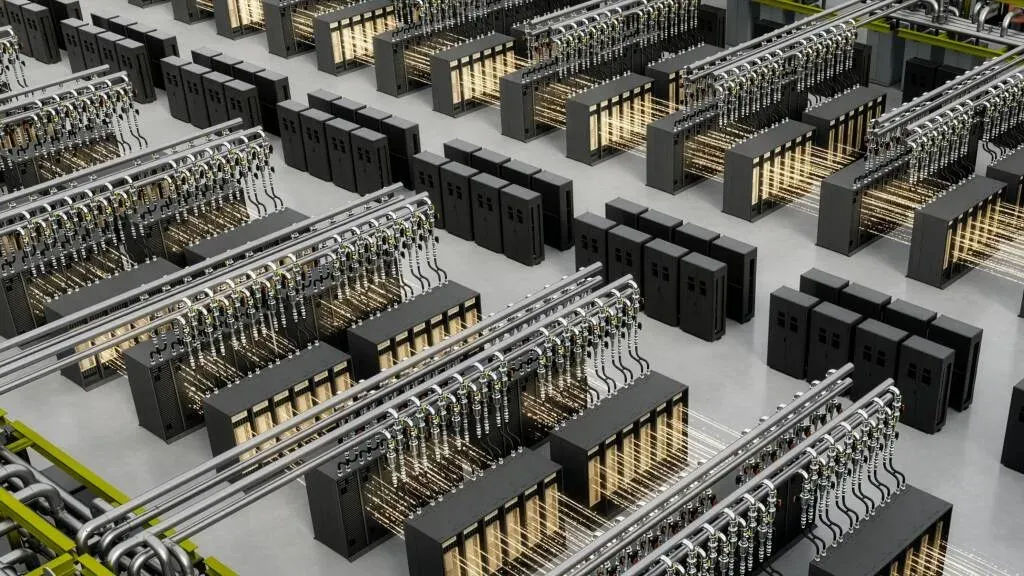
The numbers NVIDIA cites are deliberately large. It claims inference throughput per megawatt has improved by 1,000,000x across six architecture generations. It frames GB200 NVL72 as a rack-scale, direct-to-chip liquid-cooled system with in-rack power smoothing to flatten peak current spikes. It points to DSX as the platform for telemetry, rack-level controls, dynamic power allocation, and recovering stranded power. It says a performance-per-megawatt optimized AI factory can deliver up to 2.6x more tokens per second per megawatt than an unoptimized factory at the target interactivity level.
That 2.6x number is the right kind of claim and the wrong kind of thing to believe blindly. “Optimized versus unoptimized” depends on model architecture, latency target, cooling plant, workload mix, quantization quality, scheduler discipline, and whether the application is doing useful inference or asking a model to think in circles. Tokens per watt is a north star. It is not a constant.
The full-stack point is the part worth keeping. Model architecture matters: mixture-of-experts can activate fewer parameters per token than dense models. Precision matters: NVIDIA highlights NVFP4 as a path to better tokens/sec/watt than FP8 when accuracy holds. Runtime matters: TensorRT-LLM and Dynamo decide whether theoretical accelerator throughput turns into served tokens. Scheduling matters: training jobs waste energy when some GPUs sprint to a barrier and then sit idle waiting for the slowest path. Facilities matter: cooling and power delivery decide how much of the fixed site envelope becomes useful compute. Grid integration matters because the cheapest watt may be the one you can shift, smooth, or avoid.
The quiet lesson from training: fastest is not always most efficient
The training section is more interesting than it first looks. NVIDIA cites ML.ENERGY and University of Michigan work showing coordinated GPU speed tuning can reduce energy bloat while keeping end-to-end training time effectively unchanged, with energy-aware scheduling saving roughly 25% at similar iteration step time. That pushes against a common engineering reflex: run everything flat out and call it optimal.
Distributed systems rarely work that way. If part of a training job is off the critical path, maxing it out just produces idle time at a synchronization point. Slowing non-critical work can save power without increasing wall-clock time. That is a systems insight, not a sustainability slogan. The same logic will likely show up in inference fleets: run the user-visible hot path fast, avoid wasting power on work that does not improve latency, and stop treating average throughput as the only number that matters.
This is where coding agents and multi-step AI workflows enter the picture. Agentic systems multiply inference calls through planning, tool use, retries, reflection, context compaction, summarization, and evaluation. A sloppy agent loop can burn the efficiency gains of an excellent GPU cluster by making unnecessary calls, using oversized models, or retrying failed tool paths without learning. Infrastructure efficiency and application design are not separate conversations. The agent loop starts the cost problem; megawatts finish it.
For practitioners, the vendor questions need to get sharper. Do not ask only for GPU-hour pricing. Ask for tokens per second at your latency SLO, tokens per watt if the provider can expose it, sustained utilization, batch-size sensitivity, precision support, power-cap behavior, thermal throttling behavior, and scheduler behavior under contention. For training, ask whether the platform exposes critical-path and energy metrics. For inference, ask whether placement and runtime optimization are aware of interactivity targets, not just aggregate throughput.
Inside your own stack, instrument the loop before buying more hardware. Measure power, latency, throughput, queue time, batch size, precision, cache hit rate, retry rate, tool-call count, context length, acceptance rate for speculative decoding, and cost per successful task. Then make the product earn its tokens. A reasoning model that spends ten calls rediscovering an obvious tool error is not “agentic”; it is an energy leak with a chat interface.
The caveat is that energy optimization can become dashboard theater. A beautiful DSX view does not recover stranded power if the model is memory-bound, the workload is badly quantized, the cooling loop is poorly tuned, or the scheduler treats every request like the same request. The useful teams will connect telemetry to decisions. The weak teams will screenshot the graph.
NVIDIA is right about the direction. AI cost control starts in model and product design, but it ends in megawatts, cooling, and scheduler behavior. Tokens per watt is becoming the metric that connects the two. Builders who ignore it will experience the constraint anyway — as rate limits, quota denials, latency cliffs, capacity scarcity, and bills that look like someone left a furnace running under the API.
Sources: NVIDIA Developer Blog, NVIDIA DSX, NVIDIA DSX reference design announcement, ML.ENERGY leaderboard, Kareus paper