World-Action Models Are NVIDIA’s Practical Bet on Robots That Can Predict Consequences

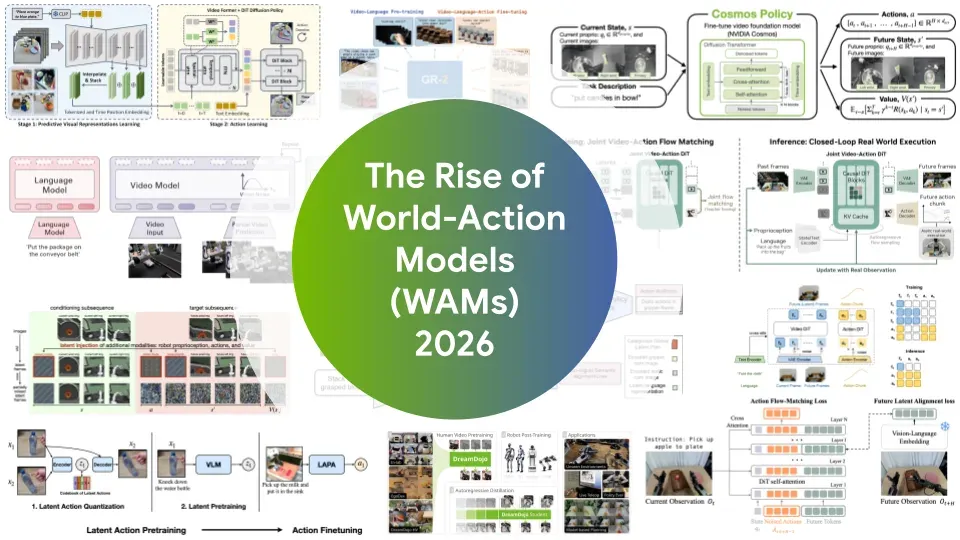
Robotics does not need another demo reel where a robot delicately moves one object in a lab while everyone pretends the lighting, table height, object geometry, and recovery behavior are minor details. It needs models that understand consequences. NVIDIA’s new deep dive on World-Action Models is useful because it frames the next physical-AI fight around exactly that: not whether a model can describe a scene, but whether it can predict how the scene should change and produce actions that make that change happen.
The terminology matters. A Vision-Language-Action model starts from a vision-language backbone and adapts it to emit robot actions from pixels plus instructions. A World-Action Model, or WAM, starts from a pretrained video or world-model backbone and adapts it to predict future observations, latent states, or actions. That sounds like architecture trivia until you look at the failure mode. “Pick up the red mug” is not a language problem after the first second. It is contact geometry, occlusion, gripper state, object pose, retry behavior, and a target world state. Language gives you the intent. Physics decides whether you actually did the job.
NVIDIA’s argument is not that WAMs have won. The post is refreshingly careful: the author calls the core claims hypotheses, not conclusions. The more grounded claim is that video models have already learned something useful about how scenes evolve under language-conditioned intent. If that prior transfers into robot control, the robot-specific learning problem may be smaller than asking a VLM to learn language-to-action grounding mostly from limited demonstration data.
The useful shift: from understanding requests to modeling transitions
That distinction is the whole story. VLA systems inherit strong semantic priors from VLMs: object categories, language following, visual recognition, and some common-sense structure. But the adaptation step has to bridge a brutal domain gap between internet-scale vision-language pretraining and embodied manipulation. NVIDIA’s glossary calls this the “grounding gap”: connecting symbols such as words to the perceptual and motor referents that satisfy them. The gap between “the model understands the instruction” and “the robot safely causes the requested state” is where many robotics demos go to die.
WAMs attack the problem through state transitions. Instead of making the policy jump directly from instruction and current frame to motor commands, the model can use future visual states as an intermediate representation. NVIDIA organizes the current design space into three broad recipes: inverse dynamics, where a model generates or predicts a future observation and another component infers the action; joint prediction, where the model predicts future observations and actions together; and representation-only approaches, where video-model features help training but explicit video generation is skipped at inference.
That last bucket may end up being more important than the flashier “imagine the future” versions. Fast-WAM, cited by NVIDIA and described in its arXiv abstract, keeps video co-training during training but skips future prediction at test time. It reports 190ms latency, more than 4x faster than imagine-then-execute WAMs, while remaining competitive on LIBERO, RoboTwin, and real-world tasks. If that line of work holds up, the deployable lesson is sharp: maybe video prediction is most valuable as a representation-learning pressure, not as a runtime ritual where the robot hallucinates a tiny movie before every action.
The numbers are promising, and still not a permission slip
The strongest signal in NVIDIA’s survey is DreamZero. The DreamZero paper describes a WAM built on a pretrained video diffusion backbone and claims more than 2x improvement in generalization to new tasks and environments compared with state-of-the-art VLAs in real-robot experiments. It also says a 14B autoregressive video diffusion model can run closed-loop control at 7Hz after system optimization, and reports cross-embodiment transfer from video-only human or robot demonstrations with more than 42% relative improvement using just 10-20 minutes of data.
Those are the kinds of numbers robotics people should care about: generalization, closed-loop rate, and data efficiency under embodiment shifts. Benchmark wins are nice. A model that can adapt from sparse demonstrations without collapsing when the environment changes is the actual prize.
NVIDIA’s own Cosmos Policy points in the same direction. The research page describes adapting Cosmos-Predict2 into a robot policy with no architectural modifications by encoding actions, future states, and values as latent frames inside the video model’s diffusion process. It reports 98.5% average success on LIBERO and 67.1% on RoboCasa. The RoboCasa comparison is especially interesting because Cosmos Policy used 50 demonstrations per task, while several listed baselines used 300 and DP-VLA used 3000. That is the right kind of result if the pitch is “video/world priors reduce robot-data hunger.”
But none of this means teams should swap every VLA roadmap for a WAM roadmap by Friday. NVIDIA’s article includes the cold shower: the video prior is expensive. The research brief estimates DreamZero-style action tuning at roughly 8.6-9.0 ZFLOPs for 100k steps with batch 128 and about 8.0k-8.4k tokens per sequence, excluding the cost of producing the video backbone and other overhead. It also frames a Wan-scale full WAM stack at roughly 51 ZFLOPs versus 6.9 ZFLOPs for an efficient VLA Foundry recipe — about a 7.4x gap.
That cost delta is not a footnote. It is the deployment strategy. WAMs may reduce robot-specific data requirements, but they move the bill into video pretraining, long-sequence diffusion infrastructure, memory bandwidth, and inference latency. NVIDIA is not hiding the trade. It is practically drawing a map to the GPU aisle.
Builders should test failure modes, not demo aesthetics
The most honest part of NVIDIA’s post is the Veo 3.1 toaster-task experiment. Given a RoboArena frame from the DROID setup, the model generated plausible manipulation motion, but the gripper morphed into a four-fingered hand, the robot embodiment changed, and the toaster lever was not consistently modeled correctly. That is not a cute generative artifact. In robotics, changing the hardware in your imagined future is a control liability.
So the practitioner takeaway is not “use WAMs because video models look physically aware.” It is: build evaluation suites that punish physically convenient hallucinations. Test new object instances, clutter, lighting changes, background shifts, slightly different robot embodiments, ambiguous instructions, and tasks that require recovery after a partial failure. Measure success rate, wall-clock time per episode, action-chunk latency, GPU memory, retry behavior, and whether predicted futures preserve hardware constraints. A model that imagines a successful outcome by silently changing the gripper has not solved manipulation. It has written fan fiction with joints.
Teams evaluating WAMs should also compare against disciplined hybrids, not strawman VLAs. The likely winning system is not pure VLA or pure WAM. It is a stack: VLM-style components for semantics and instruction interpretation; world/video components for visual subgoals, counterfactual rollouts, and transition priors; action experts optimized for real-time control; and safety/evaluation layers that reject physically impossible plans. This is less glamorous than “one robot brain,” which is usually a sign that it might work.
For autonomous vehicles, warehouse robots, surgical systems, and industrial inspection, the WAM direction is worth watching because it centers the representation closer to the thing operators actually need: consequences under constraints. But the engineering bar is brutal. If explicit future generation adds 590ms-800ms per action chunk while a representation-only variant can get closer to 190ms, the beautiful model may lose to the boring one. Real robots do not care how elegant the intermediate video is. They care whether the cup ends up in the right place without breaking anything.
NVIDIA’s post is best read as a map of convergence, not a coronation. World-Action Models are becoming a serious second recipe for robot foundation models because they attack the grounding gap from the physical side: model how the world changes, then learn how to cause useful changes. That is a better bet than pretending language understanding is enough. The catch is that WAMs will only matter where they buy enough generalization, data efficiency, or planning ability to justify their latency and compute bill. Physical AI is not waiting for prettier generated futures. It is waiting for systems that can turn plausible futures into reliable action.
Sources: NVIDIA Developer Blog, NVIDIA Cosmos Policy, DreamZero, Fast-WAM