A Spoofable HTTP Session-Kill Path Is Exactly the Kind of Agent Control-Plane Bug Enterprises Should Hunt

“Kill session” sounds like a convenience endpoint until the session belongs to someone else.
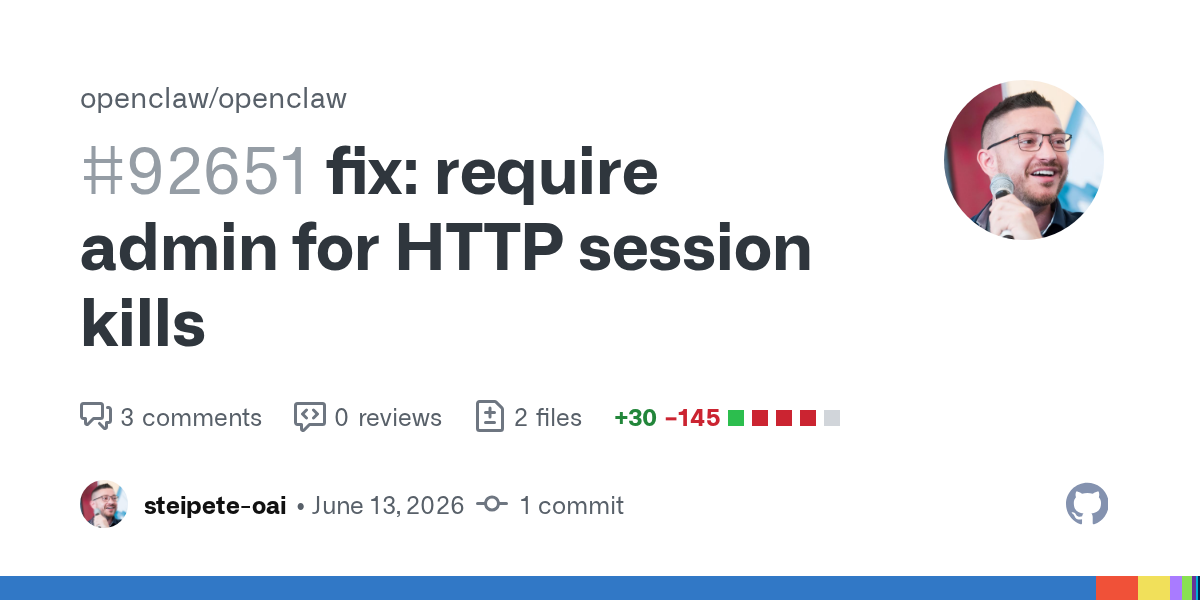
OpenClaw PR #92651 closes an HTTP authorization gap in POST /sessions/:sessionKey/kill. The old path allowed trusted HTTP callers with only operator.write to provide an x-openclaw-requester-session-key header and ask the gateway to kill a child session allegedly owned by that requester. The problem is in the word “allegedly.” The gateway was treating a client-declared header as ownership proof.
The fix removes the requester-owned HTTP kill branch, requires sessions.delete / operator.admin before session lookup, and routes authorized calls through the established admin kill helper. That is a compatibility break for any caller depending on write-scoped session kills. Good. If your control plane depends on spoofable ownership claims, compatibility is the bug wearing a nicer shirt.
Client-declared ownership is not ownership
The patch is notable for what it deletes: 30 additions, 145 deletions, and two changed files. Security fixes that remove stale branches are often the best kind because they shrink the number of stories the runtime has to tell itself. In this case, the old story was: “If the caller says this requester session owns that child, let the kill proceed.” The new story is simpler: HTTP session kills require admin-grade scope. The requester header is ignored for authorization and the canonical admin path handles the action.
The regression proof is concrete: node scripts/run-vitest.mjs src/gateway/session-kill-http.test.ts, with four test files and 52 tests passed. The fixed behavior returns 403 with missing scope: operator.admin for write-scoped requester-session HTTP kills. Admin-scoped requests still return 200 and call killSubagentRunAdmin. That is the right split: operational tooling can still stop work, but only when it holds authority the server can verify.
This is not merely an OpenClaw detail. It is a common control-plane failure mode: confusing identifiers with authorization. Session keys, requester IDs, channel IDs, conversation IDs, tenant IDs, and headers are useful routing facts. They are not proof that the caller is allowed to act on the thing they reference. Unless the server binds the caller to that identity through authenticated state, signed claims, or a trusted session relationship, the client is just filling out a form.
Agent sessions are now production objects
The security stakes rise because an OpenClaw session is no longer “some chat.” It may represent a background coding task, a delegated subagent, a channel-bound assistant, a cron workflow, a customer automation, or an operator’s live investigation. Killing that session can discard work, interrupt a remediation, stop a scheduled task, or terminate someone else’s active control loop. In a multi-user gateway, “kill” belongs in the same mental bucket as delete, cancel, revoke, and override.
That is why the related same-morning PR #92646 matters as context. It requires admin for HTTP model overrides, another gateway control endpoint where client-declared authority could become dangerous. Taken together, these look like a maintainers’ sweep of control-plane surfaces: where can a trusted HTTP caller mutate lifecycle or runtime state without server-side proof that it owns the target?
That sweep is exactly what enterprise agent platforms need. Prompt injection gets the conference talks. Gateway authorization gets the incident report after a harmless internal dashboard kills the wrong task or flips a model override for a session it should not reach. The boring APIs around sessions, models, restarts, route mutation, and cancellation are the skeleton of the agent platform. If those bones are weak, tool-level permissions are not enough.
For teams operating OpenClaw, the action item is not theoretical. Audit any internal dashboards, proxies, scripts, or bots that call session kill endpoints. If they relied on operator.write plus forwarded requester headers, that pattern should stop. Promote only genuinely trusted automation to admin scope, and prefer narrow server-side capabilities once OpenClaw offers a properly bound non-admin kill path. Do not “fix” this by forwarding requester headers from user-controlled surfaces. That recreates the bug outside the gateway.
The MCP security checklist needs a gateway chapter
The same lesson applies to MCP governance. A lot of current MCP security discussion focuses on tool scopes, OAuth flows, server identity, and prompt injection. Those are real concerns. But an MCP server with well-scoped GitHub access does not protect you if the orchestration gateway lets a different caller kill its session, mutate its runtime, or impersonate requester ownership through headers. The agent platform is the authority broker. Its own APIs need the same rigor as the tools it invokes.
Practically, enterprises should ask agent-platform vendors and internal teams a few pointed questions: which lifecycle actions require admin scope? Are requester and tenant identifiers server-bound or client-declared? Are destructive control-plane calls audited? Are headers from chat plugins, webhooks, or proxies treated as context or as authorization? Can non-admin callers cancel only their own work, and how is “own” proven?
The correct answer is rarely “trust the header.” The correct answer is usually server-side state, explicit scopes, auditable decisions, and fail-closed defaults. That sounds like cloud-console security because that is what agent platforms are becoming: cloud consoles for autonomous work.
The editorial take: this PR is not glamorous, and that is precisely why it is important. The agent-security conversation is too focused on clever prompt attacks. The gateway APIs that control agent lifecycles are just as exposed to ordinary authorization bugs. OpenClaw choosing admin-only over spoofable convenience is the boring call. Boring is how control planes survive contact with users.
Sources: OpenClaw PR #92651, OpenClaw PR #92646, GitHub App permissions reference, Secure Code Warrior analysis of NSA MCP guidance