Memory Search Should Not Keep Your CLI Alive: OpenClaw’s QMD Fix Is Boring Runtime Hygiene With Big Automation Consequences

An agent that prints the right JSON and then refuses to exit is not successful. It is a daemon wearing a CLI costume.
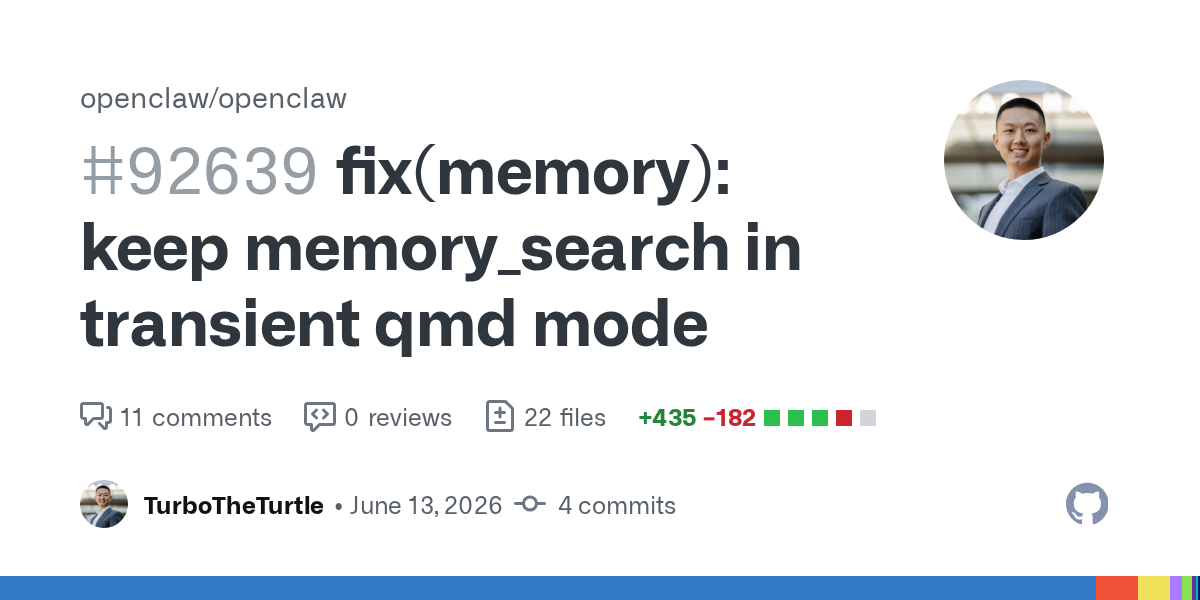
OpenClaw PR #92639 fixes exactly that class of failure by routing memory_search through QMD’s transient CLI manager mode instead of the default full manager. The bug, tracked in issue #92464, showed up when openclaw agent --local --json could emit a correct final answer and still keep the CLI process alive under memory-heavy workloads. For interactive users, that is annoying. For cron, CI, batch evaluation, and worker pools, it is a production bug.
This is the kind of runtime hygiene that does not trend well but matters enormously. Once agents become infrastructure, “answered correctly” is not the full contract. The process has to close handles, stop children, release slots, and exit with a useful status. Otherwise every successful run leaves a little ghost behind.
Memory search should not wake the whole house
The PR is substantial: 435 additions, 182 deletions, and 22 changed files. It is labeled around memory-core, commands, agents, P1 severity, sufficient proof, and automerge. The core change is easy to understand: when memory_search is used from a one-shot CLI path, request the memory runtime with purpose: "cli". That uses QMD’s one-shot mode rather than the full lifecycle manager with watchers, boot updates, embed/update timers, and other resources meant for persistent service behavior.
The original repro is a useful stress case. It used OpenClaw image 2026.6.1 on Docker/Linux, openclaw agent --local --json, a generated 10,000-entry memory corpus imported in 100-entry chunks, and model openai/gpt-5.4-mini. A 10k one-probe diagnostic emitted final JSON at around 29.4 seconds, then failed to exit within a 15-second post-JSON grace window and required termination. Smaller 1k diagnostics exited normally, which is exactly the sort of scale-sensitive behavior that slips past happy-path tests.
The PR proof did not rerun the exact 10k Docker/OpenAI repro because the local host lacked the external qmd binary. That is worth stating plainly. The proof instead targets the source-level lifecycle path: extensions/memory-core passed 64 test files and 895 tests, and test:extensions:memory completed 120 profile entries with 120 ok, zero failures, and zero timeouts. That is good evidence for the intended lifecycle fix, even if operators should still want an end-to-end container repro before declaring the entire class dead.
Knowledge layers are infrastructure, not vibes
Memory has moved from nice-to-have feature to platform core. Agents need recall across turns, indexed local context, project knowledge, and sometimes shared corpora. The market is moving in the same direction with products like Stack Overflow for Agents, which positions validated developer knowledge as something agents can query instead of hallucinating or rediscovering. That direction is correct. It also means memory systems inherit the responsibilities of infrastructure: modes, cleanup, resource bounds, observability, and failure isolation.
The bug in #92464 is a clean example of mode confusion. A read-only search during a one-shot CLI run should serve the query and leave. It should not behave like an interactive persistent agent starting background lifecycle machinery. Databases, queues, HTTP clients, and test runners all learned this lesson already: library code that opens resources must close them, and CLIs must not keep event-loop handles alive unless explicitly asked to. Agents do not get a waiver because the subsystem is called “memory.”
There is also an economic angle. Memory-heavy workloads are exactly the kind of workloads teams will batch: evaluation harnesses, nightly knowledge checks, local repo indexing probes, regression tests, and cron jobs that emit JSON into another system. If each successful invocation can leave workers behind or keep a slot occupied, the cost is not just a stuck terminal. It is exhausted runners, inflated memory usage, cascading timeouts, and misleading dashboards that show the task finished while the process remains alive.
What practitioners should test
If you run OpenClaw in automation, add lifecycle assertions to your tests. Do not merely check that the final JSON is correct. Check that the process exits within a grace window, child processes are gone, file watchers are closed, and repeated invocations do not accumulate workers or memory. This is especially important for local-agent modes, memory-heavy corpora, and CI jobs where the runner has strict time and resource limits.
Separate interactive and batch profiles where possible. Interactive agents benefit from persistent memory managers, warm indexes, and background update machinery. One-shot commands need short-lived clients and deterministic cleanup. Those are different operating modes, and platforms should expose them explicitly. PR #92639 is moving in that direction by reusing QMD’s transient manager rather than trying to bolt cleanup onto the full lifecycle path.
Also watch for the same smell in other knowledge subsystems. Embedding queues, vector indexes, file watchers, browser contexts, MCP servers, and local model workers can all accidentally outlive their unit of work. The symptom is often the same: the answer appears, logs look successful, and the parent process never quite dies. That is not an LLM quality issue. It is resource lifecycle debt.
The editorial take: agent memory is valuable only when it behaves like boring infrastructure. OpenClaw’s QMD fix is not a headline feature, but it points at the right maturity model. Knowledge layers need modes. CLIs need exit discipline. Automation needs completion to mean more than “the model said something.” Ship the answer, close the handles, go home.
Sources: OpenClaw PR #92639, OpenClaw issue #92464, Stack Overflow for Agents, Hermes Agent architecture docs