Qwen Code Is Turning Agent Loops Into Scheduled Infrastructure

The interesting part of Qwen Code this week is not that Alibaba’s coding agent learned another trick. It is that the project is starting to treat agent autonomy like infrastructure: persisted schedules, overload contracts, ownership election, and configuration approvals that survive contact with restarts and multiple clients.
That sounds less exciting than a benchmark chart. Good. Benchmark charts do not wake up after a laptop reboot and decide whether to run a missed deployment check. Agent runtimes do. The difference between a useful coding assistant and a repo-accessible gremlin is usually not model intelligence; it is whether the runtime has boring, explicit semantics for state, concurrency, overload, and trust.
Qwen Code’s main branch picked up three changes on June 13 that are worth reading together: durable /loop tasks, prompt queue backpressure for qwen serve, and hash-bound approval gating for project/workspace MCP configuration. None of these is a launch-page feature. All three are the kind of plumbing teams discover they need five minutes after asking an agent to do something unattended.
Persistent loops change the product category
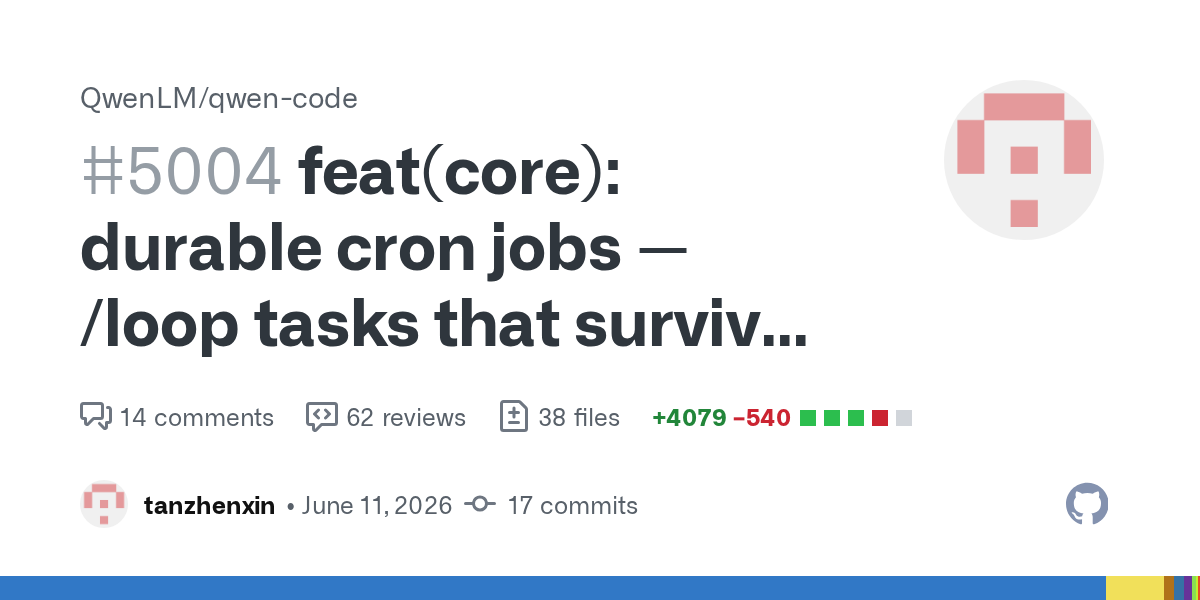
PR #5004, merged at 2026-06-13T11:30:41Z, is the headline item: durable cron-style jobs for Qwen Code’s /loop tasks. It is not a tiny patch. The pull request landed with 4,079 additions, 540 deletions, and 38 files changed, which is about the right size for a feature that stops being “chat UX” and starts being “job scheduling semantics.”
The implementation stores persistent jobs per project under ~/.qwen/tmp/<project-hash>/scheduled_tasks.json, explicitly outside the working tree. That design choice matters. If an agent’s schedule lived in the repo by default, every branch switch, cleanup script, accidental commit, or malicious repo edit could become part of the agent control plane. Keeping the runtime state out of the project does not solve every problem, but it draws a useful boundary: the repo can be the subject of the agent’s work without silently becoming the source of its schedule.
The feature is also intentionally not “every reminder survives forever.” The research brief notes that casual requests such as “remind me in five minutes” remain session-only, while requests that imply persistence — “keep checking my PRs every hour,” for example — can survive restarts. Missed one-shot reminders are confirm-gated at startup: the model asks before running them and does not execute late work silently. Missed recurring jobs fire once to catch up, then resume their cadence.
That is the right split. If I asked an agent to run something at 10:00 and it wakes up at noon, the world may have changed. CI may have gone green, the PR may have been merged, the deploy may have been rolled back, or the credentials the task expected may no longer be valid. Running late without confirmation is not helpful automation; it is time-shifted ambiguity with tools attached.
Recurring jobs are a different contract. If the user asked for ongoing monitoring, a catch-up execution is defensible — but Qwen’s seven-day auto-expiry is the real safety valve. Long-lived agent schedules should have half-lives. A forgotten recurring task with repo access is not a productivity feature; it is technical debt that can type.
The multi-session detail is where this gets serious
The feature that separates a credible implementation from a demo is multi-session coordination. Qwen Code’s durable loops are designed so that if multiple sessions are open in the same project, exactly one fires the persistent schedule. If that owner exits or crashes, another session takes over within roughly 10 seconds. Jobs can be listed and cancelled from any session, including headless mode.
That is the kind of sentence operators should care about. Coding agents are increasingly launched from terminals, IDEs, desktop clients, ACP-compatible frontends, web shells, and background daemons. If each one believes it owns the same “check my PR every hour” loop, you get duplicate comments, duplicate tool calls, rate-limit pain, and occasionally two agents “fixing” the same file from different contexts. Ownership election is not glamorous, but neither is a mutex. We still use those.
The practitioner test is straightforward: create a durable loop in a throwaway repo, restart the session, open a second Qwen Code instance in the same project, and verify only one fires. Then kill the owner and watch the failover. If your agent runtime cannot explain who owns a recurring job, it is not ready to be left running near production workflows.
Backpressure is a feature, not a failure
The second change, PR #5033, merged earlier the same morning with 1,677 additions, 89 deletions, and 24 files changed. It adds per-session prompt admission backpressure for qwen serve, defaulting to five accepted-but-unsettled prompts per session.
That default cap is more important than it looks. Durable schedules, daemon mode, SDK clients, browser frontends, and ACP integrations all create ways for prompts to arrive faster than the runtime can settle them. Without admission control, a server accepts work it cannot responsibly process. The failure mode then moves somewhere worse: memory pressure, long-lived SSE waits, dangling closures, confusing latency, duplicated retries, or model/tool calls executing far later than the user expects.
Qwen’s new overload behavior returns a stable REST 503 shape with Retry-After: 5, exposes ACP JSON-RPC error data with errorKind: "prompt_queue_full", and advertises the cap through /capabilities.limits.maxPendingPromptsPerSession. The TypeScript SDK also performs local per-session reservation so clients can fail early instead of opening unbounded temporary waits.
This is exactly what an agent server should do. Refusing work explicitly is not a degraded experience; it is the runtime being honest. If teams are comparing Qwen Code with Claude Code, Codex, OpenCode, or OpenClaw-style routing, they should include overload behavior in the evaluation matrix. “How smart is the model?” is only one question. “What happens when six clients send work at once?” is the one that decides whether the tool survives a real team.
MCP config needs approval that invalidates
The third change is the security half of the same infrastructure story: project .mcp.json and workspace approval gating. The June 13 commit changed 39 files with 2,534 additions and 68 deletions, establishing source precedence from low to high: user/default settings, project .mcp.json, workspace/system settings, session ACP or IDE servers, then --mcp-config.
The important piece is hash-bound approval. Project and workspace MCP servers are gated behind an approval store tied to the exact configuration. Edit .mcp.json, and approval goes back to pending. Session-injected MCP servers sit above repo config, so a checked-in file cannot override or gate the client’s higher-trust control plane.
That is not paranoia. It is the minimum viable answer to “the agent reads the repo, and the repo configures the agent.” MCP servers can expose file access, browser automation, issue trackers, databases, internal services, and shell-adjacent actions. A repository-controlled config file is convenient for teams, but it is also a supply-chain and prompt-injection surface. The approval primitive has to mean “I reviewed this exact config,” not “I once approved something with a similar filename.”
There is a broader lesson here for every agent vendor: checked-in configuration is not automatically trustworthy because it is developer-facing. Developers clone untrusted repos constantly. They open old branches. They run examples. They review drive-by reproductions. If the repo can influence the tool surface, the client needs precedence rules, explicit approvals, visible diffs, and invalidation on change. Otherwise “agent configuration” becomes another executable-adjacent file format with better marketing.
What builders should do now
If you are evaluating Qwen Code after v0.18.0, do not stop at edit quality. Test runtime behavior. Create a durable loop, restart the agent, run two sessions, verify one owner, and cancel from the non-owner session. Queue more than five prompts into qwen serve and confirm the sixth fails with the documented retryable shape. Add a project .mcp.json, approve it, change it, and confirm approval resets.
Also write down your team policy before enabling long-running loops. Which tasks may persist? Which tools are allowed in persistent jobs? Do missed jobs require confirmation? How are schedules audited? Who cancels a job created by someone else? What happens when a branch is deleted or a repo is archived? These are not philosophical questions. They are the operational checklist for giving an agent memory, time, and tools.
Alibaba’s strongest Qwen Code signal this week is not a model score. It is the runtime learning to say “later,” “no,” “only one of us,” and “please approve this exact config.” That is what serious agent infrastructure looks like: less magic, more contracts. Ship that.
Sources: QwenLM/qwen-code PR #5004, QwenLM/qwen-code PR #5033, Qwen Code MCP approval-gating commit, Qwen Code v0.18.0 release