Claude Code’s Official Plugin Directory Is Becoming the Agent Supply Chain — Treat It Like One

Claude Code plugins have crossed the line from “nice customization surface” into something much closer to a package manager for agent behavior. That is good news if you want repeatable team workflows. It is also the point where pretending plugins are just prompts becomes operational malpractice.
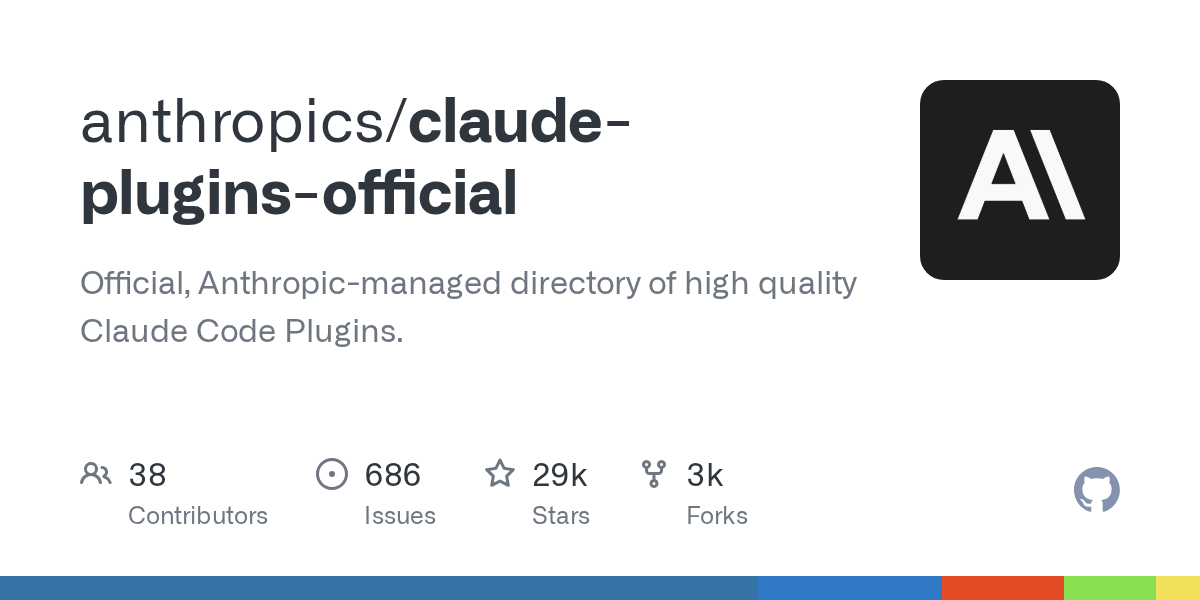
Anthropic’s official claude-plugins-official repository now points to a marketplace catalog with 204 plugin entries, according to the research snapshot for today’s run. The distribution is not toy-sized: 91 development plugins, 40 productivity plugins, 21 database plugins, 12 security plugins, 10 monitoring plugins, plus design, deployment, learning, testing, location, and uncategorized entries. The repo itself is already large enough to matter — about 29,000 stars, more than 3,000 forks, hundreds of open issues, Apache-2.0 licensing, and active commits as of June 1.
The boring framing is “Claude Code now has a plugin directory.” The more accurate framing is: Claude Code has an agent supply chain, and the default developer instinct will be to install first and ask questions after the hook fires.
A plugin is not a theme pack
Anthropic’s own plugin documentation describes plugins as shared packages for skills, agents, hooks, MCP servers, language-server configuration, background monitors, binaries, and settings. The standard shape includes .claude-plugin/plugin.json, skills/, agents/, hooks/, optional .mcp.json, optional .lsp.json, monitors/, and even bin/ entries that can be added to the Bash tool’s PATH while the plugin is enabled.
That is a lot of authority hiding behind a friendly install command. The official README says users can install from the directory with /plugin install {plugin-name}@claude-plugins-official or discover plugins through the interactive plugin UI. The same docs correctly distinguish standalone .claude/ customization from plugins: standalone is for personal or project-specific experiments; plugins are for sharing across teammates, communities, and marketplaces with versioned releases.
That distinction is exactly why this matters. Personal prompt tweaks are local preference. Versioned plugins become team infrastructure. Once a team installs a plugin that defines review behavior, hooks, MCP servers, or custom agents, the plugin is no longer “configuration.” It is part of the development environment’s execution model.
Anthropic’s warning is explicit enough that teams should quote it in their own internal docs: “Make sure you trust a plugin before installing, updating, or using it. Anthropic does not control what MCP servers, files, or other software are included in plugins and cannot verify that they will work as intended or that they won't change.” That is not legal padding. That is the security model.
The marketplace is useful because it is dangerous
The useful version of Claude Code plugins is obvious. A team can package a known code-review workflow, a house migration process, a production-readiness checklist, a security review routine, database helpers, Datadog or Jira integration, or language-server defaults as a reusable unit. New engineers do not have to paste a 700-line “how we use agents here” prompt into a chat window. The agent can load the right skill, agent, hook, or MCP surface at the point of work.
That is the upside: process becomes distributable. The downside is the same sentence with a different threat model: process becomes installable from repositories you did not audit.
There are two supply-chain layers here. First, the marketplace catalog can point to internal Anthropic plugins, third-party directories, external repositories, URL sources, and git subdirectories. SHA pinning helps, but it is not a review. Second, the plugin content can change how Claude Code behaves inside a repo: what it reads, what tools it exposes, what MCP servers it connects to, what hooks run at stop or commit time, and what commands are made convenient enough that developers stop thinking about them.
This is the same class of problem teams already learned with npm, GitHub Actions, VS Code extensions, browser extensions, and MCP servers. Convenience wins because it saves time every day. Governance arrives later, usually holding a postmortem.
The security-guidance plugin is a useful example because it is both the thing teams want and the thing teams need to govern. Version 2.0.0 is described as layering pattern warnings for roughly 25 dangerous patterns, LLM diff review on stop, and an SDK-driven commit reviewer that can trace cross-file vulnerabilities such as IDOR, auth bypass, SSRF, path traversal, XSS, unsafe deserialization, and hardcoded secrets. That is a strong safety net. It is also a plugin that may inspect diffs, invoke a model, and sit inside the commit loop. The question is not “security plugin good or bad?” The question is: which model does it use, what data does it send, where are findings logged, who can update it, and what happens in sensitive repositories?
What engineering teams should do this week
The right response is not to ban Claude Code plugins. That would be the kind of security theater that makes developers route around policy with shell aliases. The right response is to treat plugins as dependencies with privileges.
Start with inventory. Every developer using Claude Code should be able to answer which plugins are installed, which are personal experiments, which are team-approved, and which can touch external services. If the answer is “whatever I installed from Discover,” you do not have a plugin strategy; you have ambient authority with a UI.
Next, add plugin files to review scope. .claude-plugin, .mcp.json, hooks/, skills/, agents/, monitors/, and plugin-provided binaries should be reviewed the way CI workflows are reviewed. A plugin that defines an MCP server deserves at least the same skepticism as a GitHub Action that receives secrets. A hook that runs at stop time deserves the same review as a pre-commit hook. A skill that tells the agent how to “fix security issues automatically” deserves human inspection before it becomes muscle memory.
Then split policy by capability. Low-risk formatting or documentation helpers can be available broadly. Plugins that include MCP servers, hooks, binaries, network access, credential workflows, or external SaaS integrations should require approval. Plugins that affect production repos should be pinned, owned, and upgraded deliberately. If an organization uses Anthropic’s org-level plugin management, the important settings are not “available” versus “hidden” as a cosmetic choice. They are the control plane for whether agent behavior is curated or chaotic.
Finally, keep an audit trail. Teams already log package lockfiles, CI runs, and deploys because nobody wants to debug production from memory. Agent plugins deserve the same treatment: installed version or commit, source, approver, update history, and any privileges granted. The plugin marketplace makes distribution easier. It does not make accountability optional.
The editorial take: this is Claude Code’s package-manager moment. Plugins are exactly the right abstraction for distributing agent capability, but package managers became critical infrastructure because they were useful before they were safe. Teams that treat Claude Code plugins like reviewed infrastructure will move faster. Teams that treat them like prompt stickers will eventually get a very educational incident.
Sources: anthropics/claude-plugins-official, official marketplace catalog, Claude Code plugin docs, Claude Code marketplace docs, Claude organization plugin management docs