Claude Fable 5 Tops Arena, But the Fine Print Matters

The interesting thing about Claude Fable 5 taking the top spot on Arena is not that Anthropic found another few Elo points. That is the normal frontier-model treadmill: publish, benchmark, spike the chart, wait for the next lab to answer. The interesting thing is that the new public #1 model is not quite a single model in the operational sense. It is a frontier system with a fallback clause.
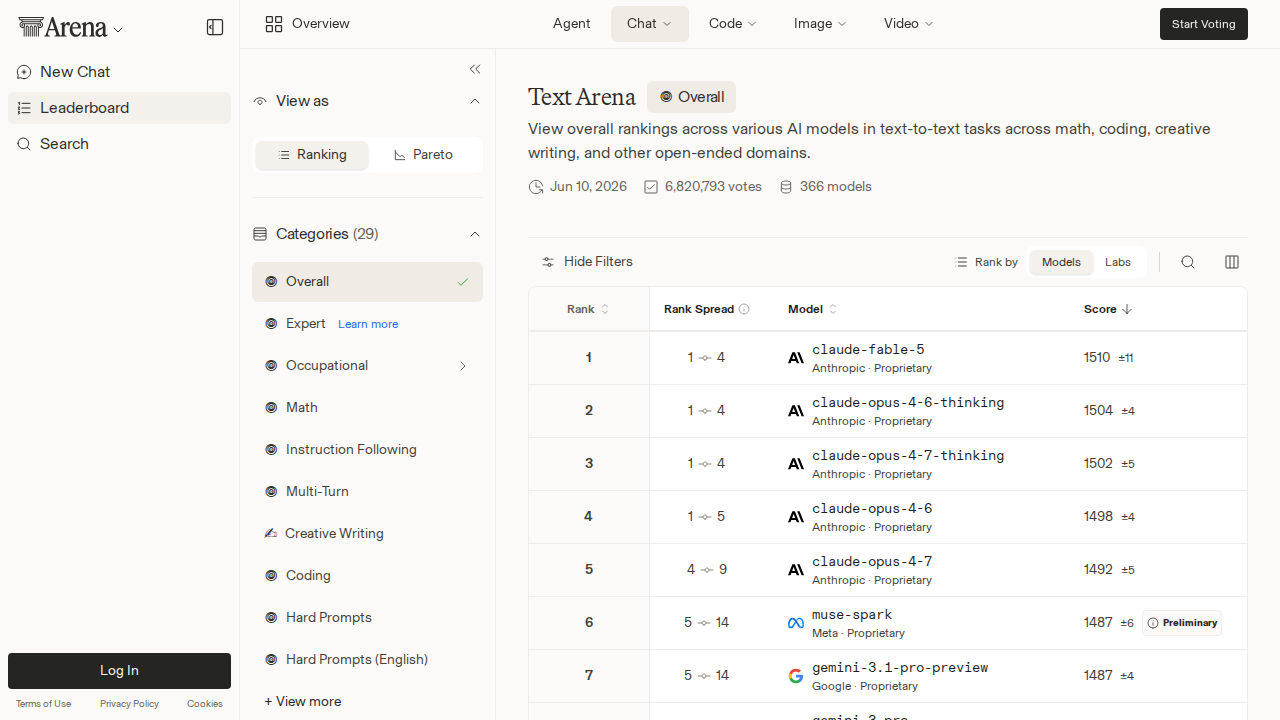
On the latest Arena Text leaderboard, claude-fable-5 entered at #1 with 1510 Elo on 2,883 votes, ahead of claude-opus-4-6-thinking at 1504. On Code Arena | WebDev, the result is louder: Fable debuted at #1 with 1665 Elo on 1,228 votes, a displayed 99-point lead over claude-opus-4-7-thinking at 1566. That is not a rounding error. It is also not a verdict from the gods. Early leaderboard entries can move, and WebDev’s vote count is still thin compared with older Opus models.
Still, the signal is hard to ignore. Anthropic now owns the top of both tracked Arena boards. The Text top five is all Claude, with Meta’s Muse Spark and Google’s Gemini line sitting just outside the Anthropic wall. The WebDev top seven is even more concentrated: Claude variants all the way down until Alibaba’s qwen3.7-max-20260517 and Z.ai’s glm-5.1 show up at #8 and #9. If you build coding tools, agents, evaluation harnesses, or internal developer platforms, this is not just model-ranking trivia. It is a map of where the current production-quality capability cluster appears to be forming.
The leaderboard win comes with routing semantics
Anthropic describes Fable 5 as a “Mythos-class” model made available for general use. Claude Mythos 5, the related trusted-access model, keeps some safeguards lifted for cyberdefense and infrastructure work. Fable is the safer public surface. The catch is that Fable does not always answer as Fable.
For certain cybersecurity, biology/chemistry, and distillation-related requests, Anthropic says requests can be automatically handled by Claude Opus 4.8 instead. The company says these safeguards trigger “on average, in less than 5% of sessions,” and that more than 95% of Fable sessions involve no fallback. Artificial Analysis observed fallback routing in roughly 8% of Intelligence Index tasks, mostly scientific questions, and 9% of Humanity’s Last Exam tasks.
That changes the contract engineers need to reason about. With older model deployments, teams could usually treat the model name as the execution boundary: we sent the request to Opus, Gemini, GPT, Qwen, or Llama, and that model answered. Fable makes the model name more like an entrypoint into a policy-controlled capability envelope. The requested model and the effective model can diverge.
That may be the right safety trade. It is also a logging, evaluation, billing, support, and trust problem. If your internal coding assistant sends a security-sensitive refactor request to Fable and receives an answer from Opus 4.8, your audit logs should say that. Your eval harness should record that. Your UI should probably disclose it. Silent substitution is how teams end up debugging ghosts: “Why did the model suddenly get worse on this class of tasks?” Because the model was not the model.
The WebDev score is the practical signal
The Text leaderboard matters because it measures broad preference. The WebDev board matters because it is closer to the work frontier-model customers actually pay for: long-horizon coding, multi-file reasoning, visual validation, and fewer babysitting loops. Fable’s 1665 Elo there is the headline number. The confidence band is still wide at +20/-20, and 1,228 votes is not enough to declare the next six months of coding agents solved, but a 99-point displayed lead over a strong Opus entry deserves attention.
The benchmark story outside Arena points in the same direction. Vellum’s synthesis of Anthropic’s published numbers cites 80.3% on SWE-Bench Pro, compared with Opus 4.8 at 69.2%, GPT-5.5 at 58.6%, and Gemini 3.1 Pro at 54.2%. On FrontierCode Diamond, Fable is listed at 29.3%, more than double Opus 4.8’s 13.4% and far ahead of GPT-5.5’s 5.7%. Artificial Analysis reports Fable at 64.9 on its Intelligence Index, #1 overall and roughly five points ahead of the closest non-Anthropic model, plus 53% on Humanity’s Last Exam.
The usual caveat applies: public benchmarks are not your workload. But engineers should not respond to that caveat by ignoring them. They should respond by building routing tests that look like their actual work. If your team does migrations, run Fable against one real migration slice. If your team does incident-response tooling, test the fallback surface explicitly. If your team does large-scale code review, measure false positives, edit distance, regression rate, and reviewer time saved — not just “the answer looked smart.”
Anthropic’s launch examples are unusually concrete for a model announcement. Stripe says Fable completed a migration in a 50-million-line Ruby codebase in one day that would have taken a team over two months manually. Anthropic also claims Mythos accelerated parts of drug design by around 10x, with 9 of 14 protein targets yielding strong candidates under investigation. Those examples are useful less as proof and more as hints about the intended workload: expensive, high-context, high-leverage, and asynchronous. This is not a model you sprinkle into every autocomplete request because it has a shiny rank badge.
The price says “route me carefully”
Fable costs $10 per million input tokens and $50 per million output tokens, with prompt-caching discounts. Artificial Analysis notes that this is double Opus 4.8’s $5/$25 tier. Anthropic also offers US-only inference at 1.1x pricing, and its Fable product page says Fable traffic requires 30-day data retention for safety monitoring.
That combination should stop teams from doing the lazy thing: swapping every premium model call to Fable and calling it modernization. At $10/$50, long-running agent sessions can get ugly fast if the product has unbounded context growth, no budget stop, and a “keep trying until green” loop. The engineering move is selective routing. Send Fable the tasks where one better pass is cheaper than three mediocre passes: deep code review, migration planning, architecture analysis, cross-repo implementation, security-sensitive reasoning where policy permits, and research synthesis that would otherwise burn human hours.
For everything else, use cheaper models. A ranking table is not a procurement strategy. If an internal bot is summarizing standup notes, extracting fields, or answering low-risk documentation questions, Fable is probably waste dressed as ambition. The best model stack in 2026 is not a single frontier model everywhere; it is a router with good observability, a cost ceiling, fallback awareness, and evals tied to business outcomes.
Community reaction is already circling the right discomforts. Hacker News discussion has been unusually large, with practitioners posting concrete coding examples rather than only launch-day jokes. Reddit is more split: some Claude users are frustrated by pricing and “over-aggressive safety filters,” while others describe the rollout as a form of AI inequality because the strongest capability is mediated by plan limits, credits, and trusted-access status. The messy reaction is predictable because Anthropic is not merely releasing a better model. It is releasing a better model with governance embedded in the call path.
That is probably the shape of frontier AI from here. The best public model may no longer be a single, clean object with a stable behavior profile. It may be a capability envelope: access depends on domain, customer identity, monitoring requirements, jurisdiction, and risk classification. Developers should design abstractions for that world now. Store requested model and effective model separately. Track fallback events. Run evals by task class. Put token budgets in the agent loop. Make the UI honest when a request is rerouted or constrained.
So yes, Fable 5’s Arena debut is an approval-worthy ranking change. But the more important review comment is this: the new #1 model is also a mainstream preview of frontier capability with dynamic demotion built into the product contract. Treat it as a powerful specialist, not a universal default. The teams that get value from Fable will not be the ones that paste its name into config first. They will be the ones that instrument the system well enough to know when Fable actually answered.
Sources: Arena AI Text Leaderboard, Anthropic, Claude Fable product page, Artificial Analysis, Vellum, Hacker News, Reddit