Claude Opus 4.7 Is Now GA on GitHub Copilot — and the Promotional Pricing Window Just Closed

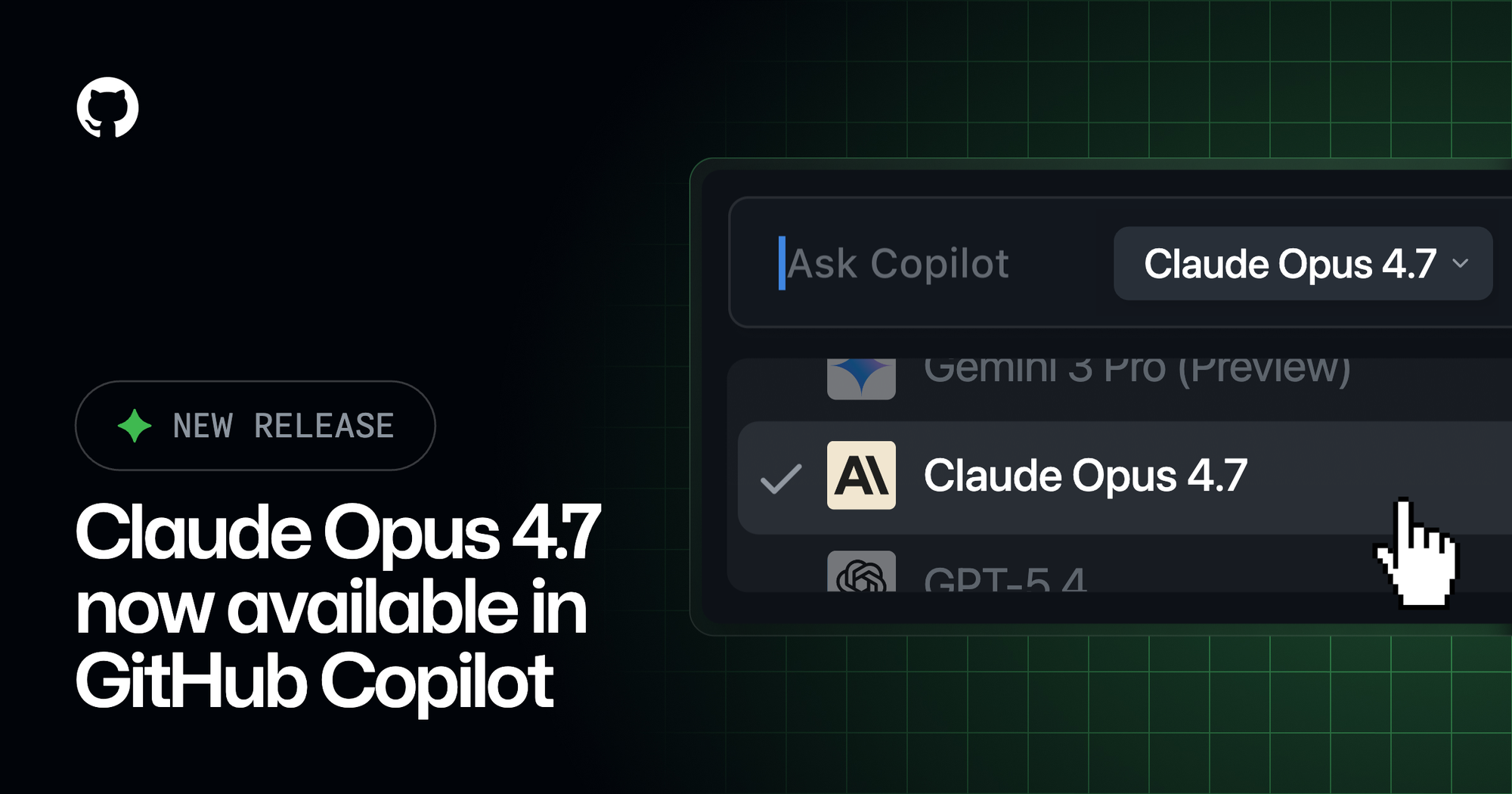
GitHub confirmed this week that Claude Opus 4.7 is now generally available across every Copilot surface — VS Code, Visual Studio, Copilot CLI, JetBrains, Xcode, Eclipse, GitHub.com, GitHub Mobile, and the cloud agent. The announcement came with an editor's note that is worth reading twice: the promotional pricing window that offered Opus 4.7 at a 7.5× multiplier ended April 30, and the new standard rate is 15×. That's a 2× price increase for the same model, three weeks after launch. If you thought the 7.5× was the real number, you were wrong. If you thought the 15× is the real number, you're probably still wrong — because June 1 switches the whole system to token-based AI Credits anyway.
The GA surfaces list is long because it needs to be. Opus 4.7 replaced Opus 4.5 and Opus 4.6 in the Copilot Pro+ picker simultaneously with the pricing change, which means there is no longer a downgrade path within the Opus family on Copilot. You use Opus 4.7 or you use something else. The older Opus models that many developers had already tuned their prompts and workflows around are gone — not deprecated, not hidden, removed. On a platform that preaches backward compatibility everywhere except in the parts that cost GitHub money, that's worth noting.
The multiplier math is where it gets uncomfortable. Under the current request-based system, Copilot Pro+ subscribers have a monthly request budget. Each Opus 4.7 interaction consumed 7.5 "requests" against that budget during the promotional window. At 15×, the same interaction consumes twice as many requests. For a developer running heavy agentic workflows — multi-file refactors, complex debugging sessions, architectural planning — that's not theoretical. A single Copilot session doing a real plan-and-implement task can burn through what feels like a disproportionate chunk of a monthly allocation, and the new multiplier makes that allocation feel even more constrained.
The comparison to direct API pricing is becoming impossible to avoid. Anthropic's Opus 4.7 API pricing is transparent and competitive. Copilot's Opus pricing is a multiplier on a request bucket that users have to reverse-engineer to cost out accurately. One user in the community forums calculated that Opus at 15× on Copilot now costs more per request than using Opus directly via the Anthropic API — before you account for the fact that Copilot's integration value (IDE context, repo awareness, Bing search, GitHub-native workflow) may or may not be worth the premium to any given team. That's a calculation more developers are going to run in the next 30 days.
The consolidation around Opus 4.7 as the sole premium Claude tier on Copilot is a product decision that makes sense for GitHub and is mildly inconvenient for users. Simplifying the picker reduces support burden and lets GitHub focus its frontier-model inference budget on one model instead of three. But it also removes flexibility. If your workflow happened to work better on Opus 4.5 or 4.6 — perhaps for reasons of cost, latency, or prompt sensitivity — that option disappears. You adapt or you leave. That's the tradeoff with integrated platforms: someone else decides which tradeoffs are worth making, and you live with their choices until they change them again.
What's actually changing on June 1 is the entire cost visibility model. The AI Credits system converts the multiplier math into token math: Pro gets 1,000 credits per month, Pro+ gets 3,900. Code completions stay free. Chat, CLI, agents, and Spaces consume credits at per-token rates that vary by model. Frontier models like Opus 4.7 and GPT-5.5 cost the most. Lightweight models cost a fraction of that. Users who want to budget accurately need to run the billing preview (available in Copilot settings now) and see what their April usage patterns would cost under the new rates. That's the data point that will tell you whether Copilot remains economically rational for your workflow or whether the integrated experience is no longer worth the premium over a direct API key and a well-configured IDE plugin.
The real story in the Opus 4.7 GA is the pricing arc. Launch at promotional rate to seed adoption, let developers build workflows around the model, then normalize the price before the subscription feels essential. It's the same playbook GitHub used for the entire Copilot product evolution: low friction, then constraints, then metering. For users who saw it coming, the 15× multiplier is confirmation. For users who didn't, it's a rude awakening wrapped in the language of general availability. Either way, June 1 arrives in 30 days with another pricing transition that will make even the 7.5× to 15× jump look like a warm-up act.
What makes this moment different from earlier Copilot pricing adjustments is that the underlying product has changed. Copilot is no longer just autocomplete and chat. It's an agentic platform that can run multi-step coding sessions, touch multiple files, and execute tasks that take minutes rather than seconds. That change in capability is being matched — belatedly — by a change in how GitHub charges for it. The old flat-rate request model made sense when Copilot was a sophisticated autocomplete. It makes less sense when Copilot is an autonomous coding agent running inference-heavy workflows on your behalf. The token-based credit system arriving June 1 is GitHub's attempt to align cost with capability. Whether it succeeds depends entirely on whether users feel they're getting proportional value for what they're paying — and right now, the community reaction suggests most users don't feel that alignment yet.
The HN thread on the Opus 4.7 changelog surfaced an observation that's worth taking seriously: the 15× multiplier effectively prices Opus 4.7 out of the "regular tool" category and into the "emergency button" category. At that cost per request, most developers won't use it for routine work. They'll save it for the problems they can't solve any other way. That's a fundamentally different relationship with the tool — and it's one that GitHub's marketing hasn't caught up with yet. When your pricing pushes your flagship model from "daily driver" to "last resort," you've changed the product's character whether you meant to or not.
For teams evaluating their Copilot spend, the next 30 days are critical. The billing preview tool — available in Copilot settings now — will show your April usage mapped to the new AI Credits rates. That CSV export is the data you need to make an informed decision. If your heavy Copilot usage is concentrated in autocomplete and light chat, you'll probably see minimal bill impact. If your usage includes regular agentic sessions with Opus or GPT-5.5, the new rates will likely be a shock. The preview is GitHub's first real attempt at billing transparency for this product. Use it before June 1 arrives, because after that, you're on the new system and the historical comparison gets much harder to reconstruct.
The Opus removal from Pro tier also deserves a separate practical note for developers who built muscle memory around Claude in Copilot. If you were a Pro subscriber using Opus 4.5 or 4.6 for specific workflows — perhaps because those models happened to perform better on your particular codebases or prompt styles — you're now faced with either upgrading to Pro+ or finding an alternative. Direct Anthropic API access with a third-party IDE plugin like Continue, Cody, or a custom setup gives you more control over model selection and pricing, but loses the GitHub-native integration (Bing search, repo context, PR awareness) that some teams find valuable enough to stay. This is the kind of tradeoff that integrated platforms always eventually impose: convenience versus control, and the balance shifts toward the vendor whenever the vendor decides it's time.
Sources: GitHub Blog Changelog — Claude Opus 4.7 is generally available, GitHub Copilot Plans, GitHub Copilot usage-based billing docs