Claude Opus 5 Did 601 Billion Tokens in Six Days. The Migration Signal Matters More Than the Benchmarks

The most useful number in this week’s model rankings is not an Elo score. It is 601 billion: the number of tokens developers routed through Claude Opus 5 on OpenRouter in less than a week. That is not a controlled benchmark, and it is not proof that Anthropic has built the best model. It is something arguably more valuable to engineering leaders deciding what to deploy: evidence that real workloads are already moving.
Opus 5 launched on July 24 and entered OpenRouter’s weekly usage table at number 18. Its 601 billion tokens put it only 14 billion behind Gemini 2.5 Flash and 22 billion ahead of Gemini 3.1 Flash Lite. In the same window, Claude Opus 4.8 fell four places, from number 10 to number 14, as its displayed traffic dropped from 1.02 trillion to 807 billion tokens. Opus 4.7, previously number 18 with 589 billion tokens, disappeared from the top 20.
The tempting story is a clean generational migration: Opus 5 arrived, customers switched, old models declined. The data does not support that certainty. OpenRouter’s rolling window mixes new demand, provider routing, application defaults, promotions and ordinary weekly variation. But 601 billion tokens is too much activity to dismiss as a few developers kicking the tires. The migration has started; what remains unknown is how much traffic sticks once launch curiosity meets production invoices and failure modes.
A leaderboard position is not an architecture decision
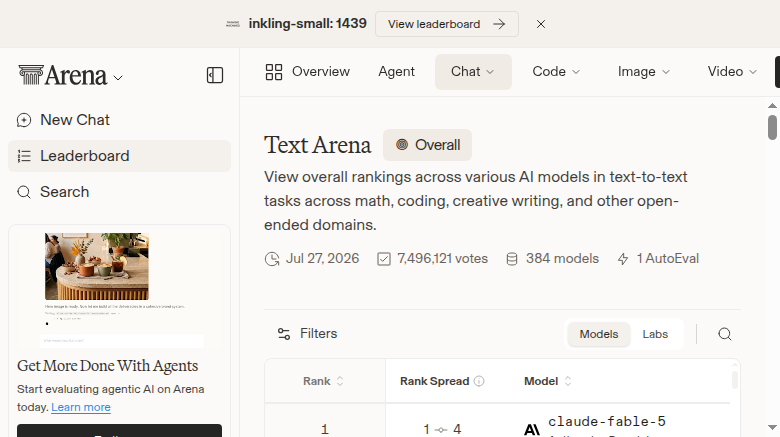
Arena AI’s text leaderboard barely moved. Claude Fable 5 remains first at 1508 Elo, followed by Claude Opus 4.6 Thinking at 1505 and Opus 4.7 Thinking at 1502. Opus 5 Max sits fifth at 1495, while Opus 5 High is seventh at 1493. That static top ten is a useful reminder that preference rankings and adoption rankings measure different systems.
Arena asks which answer a voter prefers under the conditions of a comparison. OpenRouter usage records tokens consumed through a marketplace shaped by price, latency, availability, context limits, routing and workload fit. Neither tells you whether a model can safely modify your monorepo, survive a 40-minute agent loop or produce a financial model that an analyst accepts without repair. “Best model” has become an underspecified question. The relevant object is now a cost-quality-reliability curve, not a single dot on a chart.
Anthropic prices Opus 5 at $5 per million input tokens and $25 per million output tokens, unchanged from Opus 4.8. It offers a one-million-token context window and up to 128,000 output tokens. Those headline limits sound expansive, but context capacity is not the same as context competence, and token price is not task price. A model that uses fewer tool calls, avoids retries and finishes sooner can be cheaper at the same per-token rate. A model that wanders through a giant context window or repeatedly trips a safeguard can be far more expensive.
Anthropic’s own results make the completed-task case. The company says Opus 5 more than doubles Opus 4.8’s Frontier-Bench performance at lower cost per completed task. On CursorBench 3.2 at maximum effort, it reports performance within 0.5% of Fable 5’s peak score at half the cost per task. On OSWorld 2.0, Anthropic says Opus 5 beats Fable 5’s best result at just over one-third of the cost. These are vendor-selected benchmarks and should be treated accordingly, but the unit of measurement is moving in the right direction: outcomes, not merely token rates.
The migration tax lives outside the benchmark
Early customer data is more concrete. Box reports an 8% overall improvement over Opus 4.8, including 11% in data analysis and 17% in due diligence. Another early customer reported nine percentage points better financial-modeling accuracy, one-third fewer turns and tool calls, and 60% less elapsed time. If those gains survive independent testing, the unchanged token price becomes much less important than the reduction in orchestration overhead.
Community reports expose the other side. A Reddit thread titled “Opus 5 — immediate disappointment” drew 266 votes and 167 comments in the captured snapshot, with complaints centered on restrictions during security work rather than basic coding ability. Hacker News users also reported elevated errors and inconsistent availability. These anecdotes are not statistically clean, but they identify deployment risks that curated evaluations omit: a brilliant model that refuses an authorized task or becomes unavailable halfway through an agent run is not reliable infrastructure.
There is another confounder teams routinely miss: the harness may be the regression. Opus 5 uses adaptive thinking and effort controls, while many production prompts, agent policies and CLAUDE.md files encode months of workarounds for older behavior. Those instructions can overconstrain a newer model or provoke needless planning and tool use. Migrating the model while freezing the harness is not a fair test; rewriting everything at once destroys the comparison. Run both.
Start with a clean baseline using the smallest necessary system prompt, then test the existing production harness against the same trace set. Pin model versions where the platform permits it. Log effort settings, tool-call count, retry rate, fallback behavior, wall-clock latency, accepted diffs and human correction time. Include long-running tasks, not only tidy one-shot prompts. For security, regulated-data or irreversible-action workflows, record policy refusals as their own failure class instead of blending them into a generic quality score.
A practical rollout should be boring. Shadow a slice of traffic, compare completed-task cost with Opus 4.8, then canary low-risk workflows before expanding. Keep a rollback route until the new model has covered your longest agent sessions and peak traffic periods. Do not let an aggregate leaderboard rank silently choose a model for every workload: code review, document extraction and autonomous tool use have different error budgets.
Ling shows why distribution can beat prestige
The counterpoint is Ling-3.0-flash. The free model climbed three places to number 10 on OpenRouter, rising from roughly 842 billion to 1.07 trillion displayed weekly tokens. It now sits ahead of every Anthropic model on the usage board. That does not mean Ling is more capable than Opus 5; it means an adequate model with free distribution can attract nearly twice the traffic of a premium model making a strong debut.
This split matters for product architecture. Expensive frontier capability is increasingly something to route to, not necessarily something to run by default. Teams should build evaluation and routing layers that can send routine, reversible work to a cheap or free model and escalate ambiguous, high-value tasks to a stronger one. The savings are not theoretical when the market is already producing a 1.07-trillion-token demonstration of price elasticity.
The week’s rankings therefore offer two rational strategies. Builders will pay premium prices when a model removes enough turns, latency and human cleanup. They will also pour traffic into a free model when “good enough” clears the workload’s acceptance threshold. The mistake is treating either behavior as loyalty to a provider—or treating Elo as a purchase order.
Opus 5’s launch is credible because developers have already entrusted it with production-scale volume, not because Anthropic found another benchmark to top. The next question is retention: whether those 601 billion tokens become a stable base after teams measure refusals, errors and completed-task economics. Until then, the sensible verdict is neither automatic upgrade nor cynical dismissal. Test the workload, instrument the harness, keep the rollback switch close, and make the model earn its place in the route.
Sources: Anthropic — Introducing Claude Opus 5, Claude Platform model guide, OpenRouter model page, Arena AI text leaderboard, ClaudeCode community discussion, Hacker News discussion