Claude Still Owns Arena, but the Rankings Now Matter Below the Crown

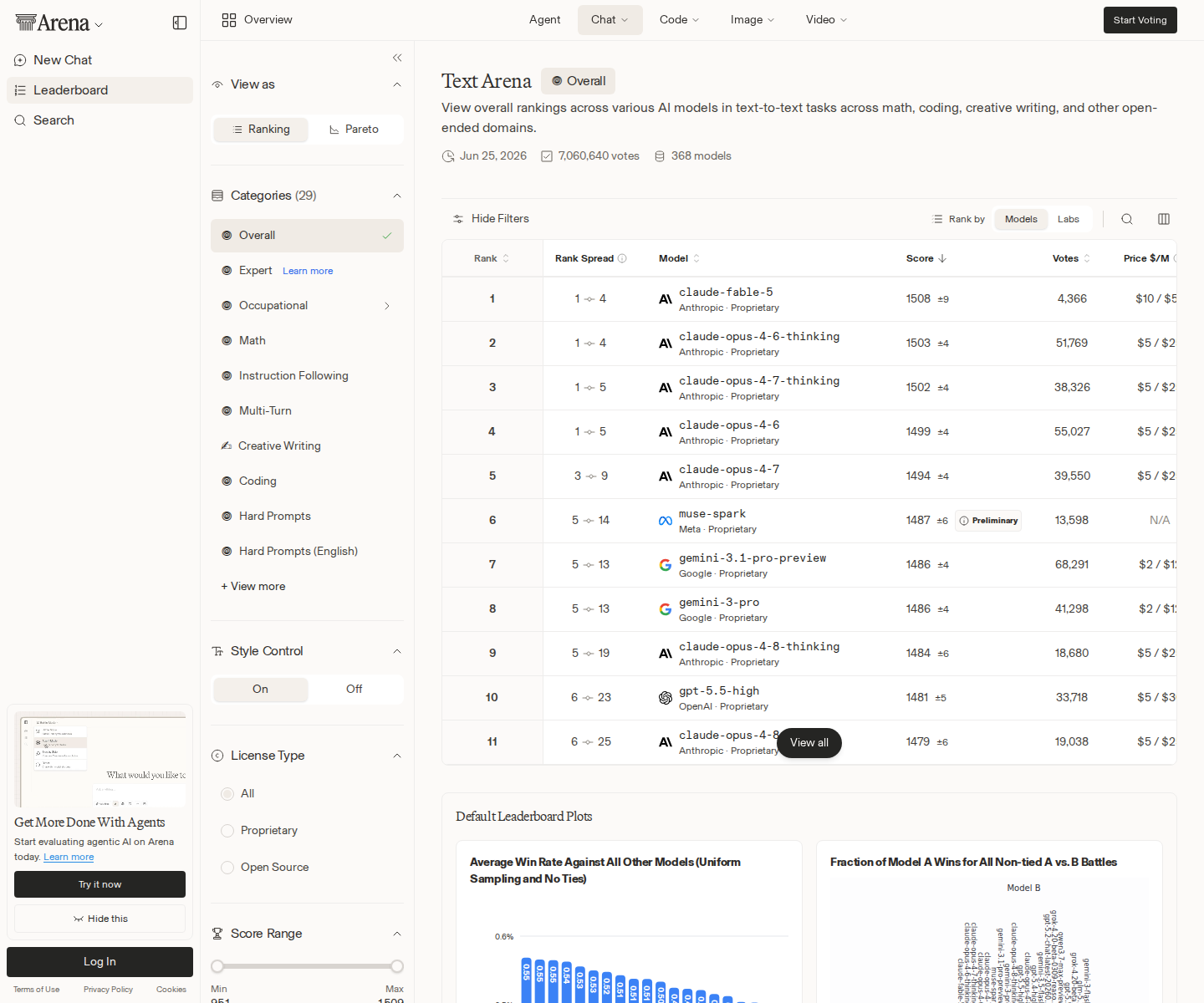
The useful story in today's LLM leaderboard is not that Claude is still winning. That has been true long enough to become table stakes. The sharper signal is that the frontier board is turning into a routing map: Anthropic owns the quality-sensitive top end, while a crowded, tightly scored middle tier is becoming the place where engineering teams should hunt for cheaper, faster, or more specialized defaults.
Arena's Text leaderboard has Claude Fable 5 at #1 with a 1508 Elo score on 4,366 votes, followed by Claude Opus 4.6 Thinking at 1503 on 51,769 votes and Claude Opus 4.7 Thinking at 1502 on 38,326 votes. Claude Opus 4.6 sits at #4 with 1499 Elo on 55,027 votes, and Claude Opus 4.7 is #5 at 1494 on 39,550 votes. That is not a lucky single-model spike. It is a provider occupying multiple adjacent slots across thinking and non-thinking variants, with enough votes on the established models to make the pattern hard to wave away.
For practitioners, that matters more than the daily winner badge. If you are building code review, high-ambiguity agent workflows, customer-facing reasoning paths, or anything where a bad answer becomes a support ticket, the conservative default is still Anthropic. Arena is not your eval suite, but it is a public sanity check, and right now that check says Claude remains the safest quality bet when the prompt is messy and the user expects judgment.
The middle of the board is where the engineering work is
The movement worth paying attention to happened below the top ten. Grok-4.20-beta-0309-reasoning jumped three places to #15 with 1476 Elo on 48,117 votes. Qwen3.7-max-preview moved up one slot to #16 at 1475 Elo, while GLM 5.1 fell four places to #19 at 1473. GPT-5.4 High slipped one spot to #12, and Claude Opus 4.8 moved up one to #11.
Those changes look small until you look at the compression. The gap between #10 GPT-5.5 High at 1481 and #20 Gemini 3 Flash at 1473 is eight Elo points. That is not a clean hierarchy; it is a traffic jam. In that kind of band, a few ranking positions should not trigger a migration. They should trigger a test plan.
The practical move is to split your model decisions into tiers. Keep a premium model for the steps where correctness, taste, or multi-step reasoning carry the user experience. Then evaluate the clustered contenders for work that can tolerate guardrails, retries, or downstream verification: extraction, summarization, classification, tool-call planning, log explanation, first-pass code transforms, and batch content operations. A model does not need to be #1 on Arena to be the correct default for 80% of your traffic.
That is especially true if your production cost curve is starting to look ridiculous. The leaderboard's top models are not just ranked by quality; they also imply operational tradeoffs around latency, availability, context behavior, and price. A team that treats Arena as a procurement ranking will overpay. A team that treats it as a shortlist generator will learn faster.
WebDev is quieter, but the coding signal is not narrow
Arena's WebDev board did not reshuffle its top 20 in the latest comparison, but it still adds useful color. Claude Fable 5 is #1 there too, with 1654 Elo. GLM 5.2 (max) is #2 at 1593, followed by Claude Opus 4.8 Thinking at 1565, Claude Opus 4.7 Thinking at 1563, and Claude Opus 4.7 at 1557. The leaderboard date is Jun. 19, so it appears less frequently refreshed than the Text board, but the shape is still instructive.
The important detail is GLM. GLM 5.1 slipping on the Text leaderboard does not mean Z.ai should be crossed off the coding shortlist. GLM 5.2 (max) holding #2 on WebDev suggests the family still has real front-end and implementation strength. That distinction matters because model discourse tends to flatten providers into one reputation score. Engineers do not buy reputations; they buy behavior on a workload.
If you run an AI coding product, a devtools workflow, or an internal app generator, your eval should not be "which model won the general leaderboard?" It should include UI repair tasks, state-management edits, regression-prone refactors, accessibility cleanup, test creation, and codebase-local instruction following. WebDev boards can point you toward candidates, but your own repo history is the only benchmark that knows where your bugs live.
There is also a subtle product lesson here. The providers with multiple strong variants are giving builders optionality: thinking mode for hard planning, faster non-thinking variants for routine edits, and specialized coding models for narrower jobs. That is the architecture teams should copy. Stop wiring one model to one product surface. Build a small routing layer, collect task-level outcomes, and make the default model a configuration decision rather than a product rewrite.
The OpenRouter gap is a warning about data pipelines
OpenRouter rankings could not be refreshed for this run. The rankings page rendered high-level scaffolding, the previous RSC payload scraper did not find a parseable model array, and an older frontend rankings API path returned 404. The carried-forward table from the prior snapshot should be treated as continuity, not fresh evidence.
That sounds like a footnote, but it is exactly the kind of failure that turns dashboards into fiction. LLM rankings are already easy to overinterpret; stale data makes the problem worse by giving yesterday's answer today's timestamp. The right editorial and engineering move is to label the gap, separate quality-leaderboard claims from usage-leaderboard claims, and avoid inventing movement where the pipeline did not produce evidence.
Teams should apply the same discipline internally. If your model router, eval dashboard, or cost monitor depends on hydrated third-party pages, scraping resilience is not an afterthought. Add freshness checks. Store source timestamps. Make stale rows visually different. Fail closed on claims that imply recency. A leaderboard that occasionally says "I don't know" is more trustworthy than one that confidently republishes ghosts.
The broader industry lesson is that rankings are becoming infrastructure. They influence procurement, routing, product positioning, investor decks, and engineering roadmaps. That means the methodology and freshness matter. A leaderboard is not just content once people start wiring business decisions around it.
What engineers should do with today's movement
Do not re-platform because Grok moved three slots or GLM moved four. That is leaderboard theater. Do add grok-4.20-beta-0309-reasoning and qwen3.7-max-preview to your next eval batch if they are available in your stack, especially for workloads where Claude quality is attractive but the latency or price profile is uncomfortable.
For production systems, the sensible pattern is boring and effective. Pick a high-confidence model for risky user-facing paths. Maintain a challenger pool for cheaper or faster tasks. Track outcomes by task type, not just aggregate thumbs-up rates. Run canaries before changing defaults. Keep prompt and model changes separately versioned so you can tell whether a win came from better instructions or a better engine.
Also, stop treating "reasoning" labels as interchangeable. Grok's reasoning variant moving up is interesting, but the only question that matters is whether its reasoning behavior helps your tasks under your constraints. Some reasoning models are excellent at decomposing ambiguous work and poor at terse structured output. Some are worth the extra latency only when the prompt has real branching complexity. Put them on tasks that need planning, not on every JSON extraction job because the leaderboard number looks respectable.
The top of Arena still says Claude is the quality default. The middle says the next wave of practical gains will come from routing, not allegiance. That is less fun than declaring a new champion, but it is more useful: the winning LLM stack in 2026 is not one model. It is an eval loop, a routing policy, and enough humility to know when a public leaderboard is a clue instead of a verdict.
Sources: Arena leaderboard, Arena WebDev leaderboard, OpenRouter rankings