Codex Is No Longer Waiting for Claude Code Users to Wander Over

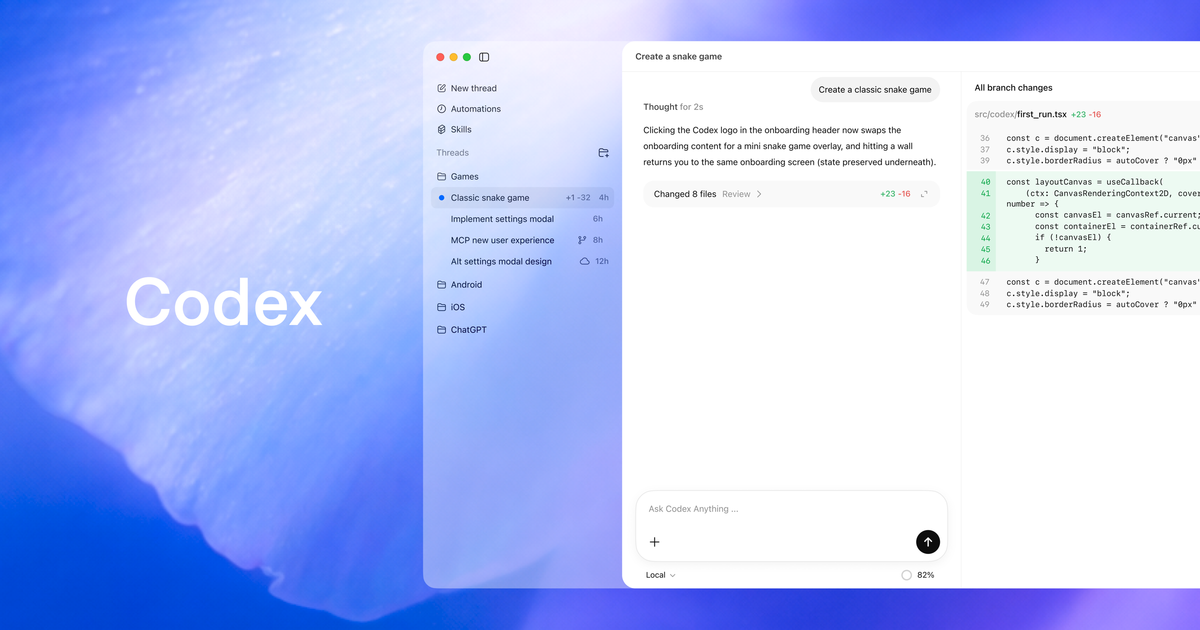
OpenAI just made the coding-agent market less polite.
The most important line in the latest Codex changelog is not a benchmark claim, a new model, or another screenshot of an agent editing a repo while everyone pretends not to notice the diff is enormous. It is the new “Migrate to Codex” flow for importing supported setup from Claude Code and Claude Cowork, including during onboarding. That is a different kind of product statement. Codex is no longer merely hoping Claude Code users compare tools someday. It is building the off-ramp.
That matters because coding agents have crossed a threshold where the model is only part of the switching cost. The sticky surface is now the harness: project instructions, allowed tools, MCP servers, approval preferences, browser access, sandbox defaults, team workflows, and the muscle memory developers build around slash commands and review loops. A migration flow acknowledges the obvious: serious users do not want to “try an agent” in the abstract. They want to bring their working environment with them.
The migration feature is the headline, but the workstation is the strategy
According to OpenAI’s official Codex changelog, the Codex app 26.608 release on June 9 added “Migrate to Codex” flows for importing supported setup from Claude Code and Claude Cowork. The June 11 app 26.609 entry then added Developer Mode for browser use in Chrome and the in-app browser, giving Codex controlled Chrome DevTools Protocol access for performance profiling, network traffic, console output, runtime errors, and page state. OpenAI also claims Browser use is “up to 2x faster” through CDP and DOM snapshot optimizations that reduce browser round trips.
Those features belong together. Importing setup is not just a convenience feature; it is a wedge into the daily development loop. Developer Mode then pushes Codex beyond “terminal agent that edits files” and toward “developer workstation that can inspect a running app.” Add the new /init support in the app composer for creating project instructions, plus rate-limit reset banking for Plus and Pro users and referral-based reset credits for consumer users, and the shape becomes clearer: OpenAI is trying to make Codex feel less like a CLI wrapper and more like the place coding work begins.
That is the right battlefield. Claude Code earned developer mindshare partly because it made the terminal agent feel natural. Cursor made the IDE feel agentic. Codex is now attacking both the setup layer and the app/runtime layer. The import button is the marketing moment. The boring controls around browser inspection, project initialization, rate-limit economics, and config boundaries are what determine whether teams keep using it after the novelty fades.
Treat “import supported setup” like a port, not a copy
Engineers should be careful here. “Import supported setup” is doing a lot of work. Claude Code and Codex do not necessarily mean the same thing when they talk about instructions, skills, MCP configuration, browser/computer use, sandboxing, approval modes, background runs, or app-server state. A migration flow can preserve useful intent while still changing semantics in places that matter.
The practical move is to treat the migration like a runtime port. After importing, inspect the generated instructions rather than assuming they are equivalent. Verify denied tools stay denied. Confirm MCP servers are present, authenticated, and scoped correctly. Check whether any browser or computer-use capability is enabled by default. Run the same small task in both agents and compare the diff, not just the final answer. If the original Claude Code setup encoded team policy, the Codex import needs a policy review, not a vibes-based thumbs up.
This is especially true for MCP. Codex’s configuration docs say trusted project-scoped config cannot override host-owned settings such as machine-local provider, auth, app request metadata, notification settings, profile selection, model providers, or telemetry routing. That is good architecture: project files should not be able to smuggle changes into machine-level trust boundaries. But it also means imported setup may intentionally stop short of transferring everything a developer expected. Teams need to know which parts are portable and which parts are local by design.
Browser Developer Mode changes the security review
The Developer Mode browser work deserves more attention than the migration headline will get. CDP access is powerful. It lets Codex observe performance traces, network requests, console errors, runtime exceptions, DOM state, and page behavior with fewer round trips. For frontend and full-stack debugging, that is a meaningful capability upgrade. A coding agent that can inspect the running app is far more useful than one guessing from source files alone.
It also expands the operational surface. Browser agents often touch authenticated sessions, internal dashboards, staging environments, customer-like data, and admin panels. Once an agent can see network traffic and page state, the access-control question moves from “can it edit this repo?” to “what can it observe while debugging?” That means teams should separate local toy usage from production-adjacent usage. Use throwaway browser profiles for experiments. Keep staging and production sessions distinct. Log what the agent accessed. Require explicit approval before letting an agent interact with sensitive web apps.
The HN conversation around Codex-style engineering is already skeptical in the useful way. In a June 5 thread about Harness engineering and Codex, commenters pushed back on line-count-as-productivity claims. One called a million-line demo useful evidence of context-management scale but not output quality; another noted that “we shipped 1 million lines of code in three weeks” is not obviously a flex. That is exactly the calibration the market needs. The question is not whether agents can generate more code. The question is whether the harness, review loop, runtime controls, and observability make the output maintainable.
The Rust plumbing says Codex is optimizing for release velocity too
The adjacent Codex CLI prerelease, rust-v0.140.0-alpha.14, reinforces the same theme in less marketable form. PR #27475 removes async_trait from first-party Codex Rust code, replacing it with explicit impl Future + Send or boxed Send futures, and adds cargo-deny policy so async-trait remains allowed only through remaining transitive wrapper crates. The validation cited 216 passing codex-exec-server tests and 39 passing codex-model-provider tests.
That is not launch-video material. It is runtime maintainability work. Explicit Send contracts matter when a long-lived agent spans local CLI, app server, remote execution, browser surfaces, and background workers. Another PR, #27702, parallelizes release code generation. The author reported a one-codegen-unit empty-target build at 981.150 seconds and a four-codegen-unit build at 507.486 seconds on an Apple M4 Max: a local 48% reduction, with stripped binary size increasing 14.7% and gzip-compressed size increasing 7.8%.
That tradeoff is revealing. Faster release machinery matters when your agent product is shipping across app, CLI, mobile, browser, and server surfaces. Coding-agent vendors are not just competing on model performance; they are competing on how quickly they can safely update the control plane around the model.
So yes, the SEO headline is “Codex can import Claude Code setup.” The engineering headline is sharper: OpenAI understands that the coding-agent war is now about switching costs, runtime controls, browser observability, and release cadence. Developers should try the migration flow, but they should do it with a checklist in hand. Import the setup. Diff the policy. Re-run representative tasks. Confirm MCP boundaries. Audit browser access. Then decide whether Codex is merely easier to try or actually safer to standardize.
That is the bar now. The best coding agent will not be the one that writes the most code fastest. It will be the one that makes the harness trustworthy enough that teams can let it near real work without pretending the review step is magic.
Sources: OpenAI Codex changelog, OpenAI Codex GitHub release, PR #27475, PR #27702, Codex config reference, Hacker News discussion