Cosmos 3 Is NVIDIA's Most Serious Attempt to Make Physical AI Less Fragmented

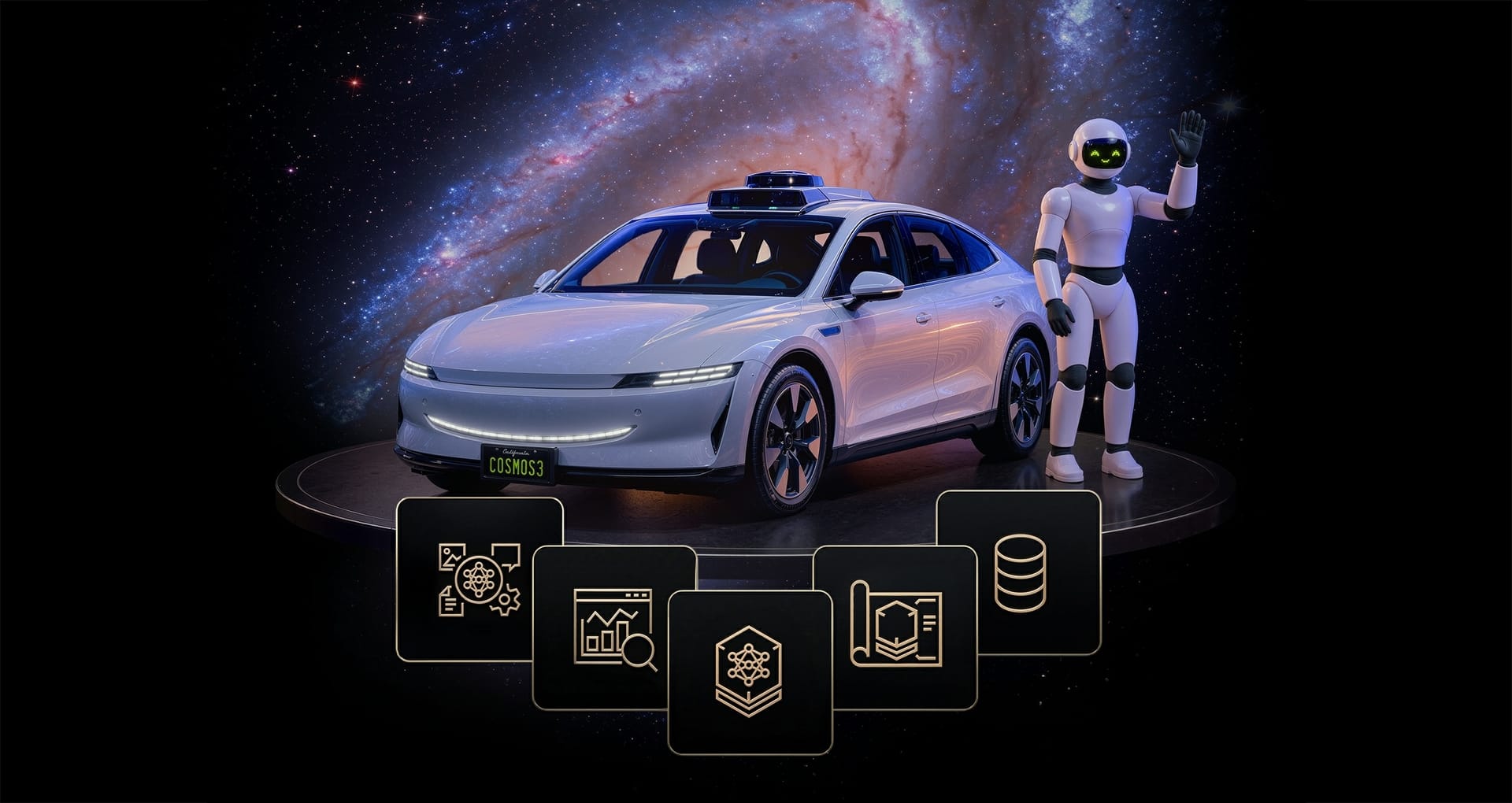
NVIDIA's announcement of Cosmos 3 leads with a phrase that sounds like a conference session title: "The big bang of physical AI is just around the corner." Jensen Huang said it, so it will be quoted. But the more interesting question for builders is not whether physical AI is about to have its big bang moment. It is whether Cosmos 3's architecture actually makes robotics and autonomous vehicle development less fragmented — or whether it just relocates the complexity from "too many incompatible model layers" to "one model family with a much larger evaluation surface."
Cosmos 3 is NVIDIA's most serious attempt to collapse several awkward physical AI workflows into a single stack. The pitch is that a robotics team no longer needs five separate systems: a vision-language model for scene understanding, a world model or video foundation for simulation, a synthetic data generator for training data, a reasoning model for task planning, and an action policy model for control. NVIDIA is arguing that a mixture-of-transformers architecture — pairing a reasoning transformer with an expert generation transformer — can handle all of those roles. That is a coherent architectural argument. Whether it holds up in production is a different question.
The architecture is worth understanding in some detail because it is not just marketing copy. Cosmos 3's MoE-style design separates understanding from generation: the reasoning transformer processes multimodal inputs — text, image, video, ambient sound, action trajectories — and the expert generation transformer produces video and action outputs. This is a meaningful split for physical AI applications. A robot or AV system needs to understand what it sees before it generates what to do next. Mixing those capabilities in a single monolithic model creates tradeoff tensions that the architecture explicitly sidesteps. Whether the mixture-of-experts routing actually delivers on that separation in practice is the kind of thing that will become clear only after real evaluation against domain-specific benchmarks and, more importantly, real deployment failures.
NVIDIA claims Cosmos 3 ranks first across several physical AI leaderboards — Artificial Analysis, Physics-IQ, PAI-Bench, R-Bench, RoboLab, RoboArena, VANTAGE-Bench, and TAR. Those rankings should be read as the start of an evaluation process, not the end of one. Physical AI benchmarks have a well-known validation problem: a model that generates plausible-looking video and action trajectories can score well on benchmark tasks while producing nonsense when deployed in an actual factory, warehouse, or intersection. In software agents, a bad action produces a bad git commit or a wrong API call. In physical systems, a bad action can damage equipment or injure people. Cosmos 3's benchmark leadership is meaningful as a signal that NVIDIA has built a strong base model. It does not substitute for domain-specific validation against the specific failure modes of your actual deployment environment.
The Hugging Face traction is a better practitioner signal than the benchmark rankings. Cosmos3-Nano showing 36.7k downloads and Cosmos3-Super showing 30k downloads within the first days of availability — with 212 and 160 likes respectively — tells you that developers are at least trying the models. That is a more useful signal than press syndication or analyst commentary. The PhysicalAI synthetic datasets collection with 156M rows surfaced in the collection metadata suggests the data side of the platform is getting traction too. The Cosmos Coalition — Agile Robots, Black Forest Labs, Generalist, LTX, Runway, and Skild AI — adds robotics and video-generation credibility, though coalition membership is not the same as production deployment.
For builders, the deployment surface is where Cosmos 3 becomes concrete. The GitHub documentation exposes research paths through Diffusers and Transformers — libraries that most ML practitioners already know — and serving paths through vLLM-Omni, vLLM, and NIM. That is a wider deployment surface than most open physical AI models offer. It means a team can start experimentation in a research-friendly environment and migrate to production serving without changing model families. The Cosmos Framework adds training and inference structure. The Hugging Face collection lowers discovery friction. NVIDIA has clearly thought about the developer journey from "download the weights" to "deploy a policy in simulation" to "evaluate against real hardware."
The claim that physical AI training and evaluation cycles can be reduced from months to days is the headline number. It should be treated with skepticism calibrated to your own evaluation loop. NVIDIA's claim describes a workflow where synthetic data generation, world model simulation, policy training, and evaluation are all connected. That pipeline can certainly be faster than a fully manual process with bespoke dataset converters, custom simulators, and disconnected evaluation tools. But "months to days" is a best-case scenario that assumes your sim-to-real gap is manageable, your sensor models are calibrated, your benchmark tasks are representative, and your policy transfer actually works. For most robotics teams, the bottleneck is rarely the raw cycle speed. It is the validation discipline required to trust the cycle's outputs.
The real test of Cosmos 3 will not be the announcement. It will be what happens six months from now when a robotics team tries to use it for a specific task — depalletizing in an unfamiliar warehouse, navigation in a construction site, inspection under lighting conditions the model was not trained on. The world model has to generate plausible futures. The action policy has to be fast enough for real-time control. The vision reasoning has to survive camera noise, occlusion, and lighting variation. None of that is a model problem alone. It is a systems integration, validation, and deployment discipline problem that no foundation model solves by existing.
NVIDIA's move is directionally correct. Physical AI teams need a unified foundation more than they need another leaderboard position. Cosmos 3 is the most capable and most open option in that direction. The editorial caution is not about the model — it is about the tendency to treat a strong foundation model as if it were a complete solution. It is not. It is a better starting point. The engineering work of validation, calibration, safety envelopes, and domain-specific evaluation still belongs to the team building the system. Cosmos 3 makes that work faster and more reproducible. It does not make it optional.
Sources: NVIDIA Newsroom