DeepStream 9 Turns Claude Code and Cursor Into Vision-Pipeline Scaffolding

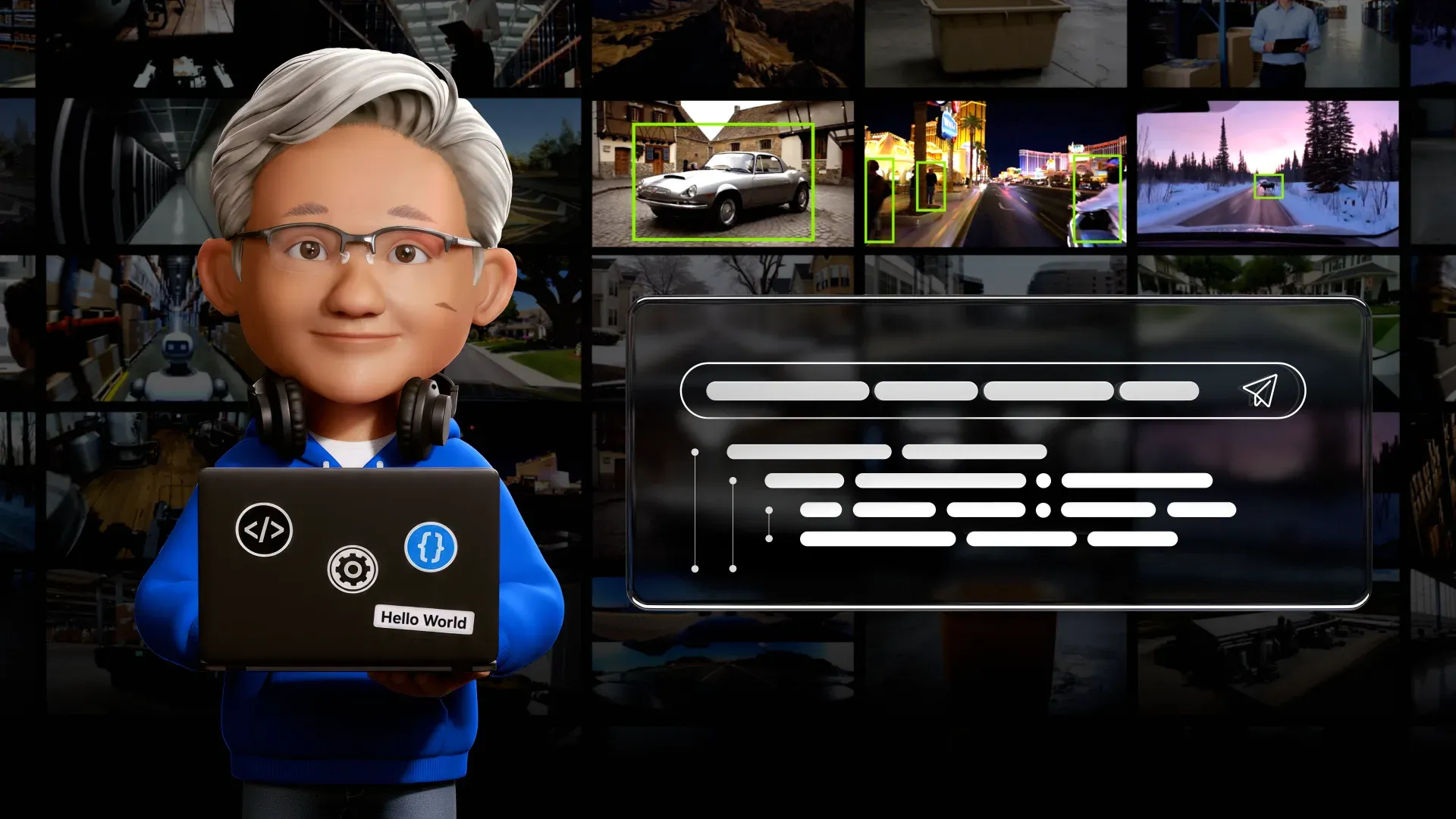
NVIDIA’s newest DeepStream pitch is not really about coding agents. It is about trying to make the messiest part of computer vision deployment feel boring again. That is a bigger deal than it sounds. Most vision teams do not get stuck because they cannot find a detector, tracker, or multimodal model. They get stuck because turning a promising demo into a service that can ingest camera streams, batch work sanely, expose APIs, survive restarts, and run efficiently on real hardware is where the calendar goes to die.
The new NVIDIA Technical Blog post on DeepStream coding agents is a direct attempt to attack that gap. NVIDIA shows Claude Code or Cursor generating two kinds of applications that are much closer to production than the usual prompt-engineering stage demo. One is a multi-stream video summarization service built around Cosmos Reason 2, Kafka, REST APIs, health monitoring, Docker packaging, and deployment scripts. The other is a YOLOv26 detection pipeline that handles ONNX export, TensorRT engine generation, custom parsing, and a FastAPI wrapper. In other words, NVIDIA is not asking agents to invent a novel model architecture. It is asking them to scaffold the plumbing around NVIDIA’s preferred stack, fast.
That distinction matters. The market is full of AI coding demos that produce pretty code snippets and then hand-wave away the operational bits. NVIDIA is aiming lower in a way that is actually more useful. It wants natural-language prompting to become the interface for repetitive pipeline assembly, while the performance-sensitive path stays anchored in DeepStream, TensorRT, GStreamer, and Metropolis. For developers shipping video systems, that is the right layer to automate.
The details in the post are more concrete than the average “agents can build apps” story. NVIDIA’s Cosmos Reason 2 example is designed to ingest N RTSP streams, keep streams isolated rather than muxing them together, sample frames at configurable intervals, batch frames per stream, push summaries to Kafka, and expose a production-style OpenAPI surface. The YOLOv26 example goes further than a toy inference loop by showing exactly where model integration breaks in real life: input tensor shape, output blob names, post-processing behavior, custom parsing libraries, and deployment packaging. NVIDIA even surfaces representative config lines like infer-dims=3;640;640, net-scale-factor=1/255, and a custom bbox parsing function wired into DeepStream inference. That is not glamorous, but it is the kind of specificity practitioners need.
There are at least three interesting strategic signals here.
First, NVIDIA is quietly turning coding agents into a distribution channel for its SDKs. If the easiest way to stand up a camera pipeline is to prompt Claude Code or Cursor with a DeepStream-fluent skill, then DeepStream becomes the default substrate even for teams that do not think of themselves as “DeepStream teams.” The model that writes the code matters less than the stack embedded in the examples, generated configs, and deployment scripts.
Second, this is a defense against framework drift. Vision developers have more choices than ever, from plain OpenCV and FFmpeg pipelines to custom Python microservices to orchestration around Triton, vLLM, or bespoke CUDA kernels. NVIDIA’s answer is to collapse that choice overload into a promptable path that still ends in TensorRT engines, DeepStream services, and NVIDIA-shaped deployment assumptions. If that works, it reduces experimentation cost while increasing ecosystem lock-in. That is a smart trade if you are NVIDIA, and often a reasonable one if you are the engineer who just needs the thing running by Friday.
Third, this is a hint about where agent coding is becoming genuinely valuable. The strongest near-term use case is not replacing senior engineers on greenfield architecture. It is compressing the ugly integration work that everybody understands but nobody enjoys. Writing boilerplate around stream ingestion, FastAPI routes, health checks, Dockerfiles, deployment guides, and parser glue is exactly the kind of high-context, low-prestige work that agents can speed up without requiring magical judgment.
The bottleneck was never the model alone
Vision AI has spent years pretending that the main unlock is a better backbone or bigger multimodal model. That helps, but the deployment stack is where economics are won or lost. A model that benchmarks well and takes six weeks to wire into a robust, observable streaming service is not more useful than a slightly worse model that ships into production this week. NVIDIA clearly understands this, which is why the post keeps returning to throughput, batching, stream management, and deployment readiness rather than pure model quality.
That also explains why the Cosmos Reason 2 example is more important than it first appears. Summarizing multi-camera video with a VLM is not interesting because “AI can watch cameras.” It is interesting because it forces you to solve stream isolation, batching policy, GPU allocation, backpressure, and output routing. Those are systems problems. NVIDIA is trying to make coding agents conversant in those systems patterns, at least inside its own ecosystem.
There is a catch, of course. Generated infrastructure code is only as good as the constraints around it. The blog says the coding agent understands your hardware and can generate optimized applications for it, but practitioners should read that as a starting point, not a guarantee. RTSP inputs are notoriously messy. Real deployments have flaky cameras, odd codecs, timing jitter, network partitions, memory pressure, and customer environments that do not resemble the clean demo. An agent can save time on scaffolding, but it cannot absolve a team from load testing, profiling, observability, and operational paranoia.
So what should teams actually do with this? If you run a vision stack, use this kind of workflow to accelerate the first 70% of the system, not the last 30%. Let the agent generate the app skeleton, inference configs, parser stubs, APIs, and deployment docs. Then make a human review ownership boundaries, failure handling, batching policy, GPU scheduling, security exposure, and metrics. Treat the output like an eager mid-level engineer: useful, fast, occasionally overconfident.
It is also worth standardizing your prompts the way you standardize infrastructure modules. The examples NVIDIA published are valuable not just because they generate code, but because they encode architecture choices. Good teams should turn those into internal templates: how streams are added, how health checks behave, what metrics get emitted, where Kafka or REST is used, and what “production ready” actually means in their environment. The long-term win is not one impressive prompt. It is a reusable prompting discipline for a narrow class of deployable systems.
The bigger editorial point is that NVIDIA is making an intelligent bet on where developer pain really lives. The industry keeps marketing models as the center of the story, but for many enterprises the hard part is operationalizing video and sensor AI without assembling a hand-rolled pile of GStreamer fragments, ad hoc scripts, and undocumented parser code. DeepStream 9’s coding-agent push says the boring glue is finally worthy of product attention. That is not as flashy as another benchmark chart, but it is closer to how software actually ships.
I would not call this a revolution. I would call it a solid review comment on the last two years of vision tooling. Developers do not need more model theater. They need fewer weeks lost to glue work. If NVIDIA can turn Claude Code and Cursor into competent DeepStream scaffolding, that is real leverage, and the teams that benefit first will be the ones building camera-heavy systems where deployment friction has been quietly killing ROI all along.
Sources: NVIDIA Technical Blog, NVIDIA DeepStream Coding Agent repository, NVIDIA DeepStream documentation