Free Agentic Models Just Cracked OpenRouter’s Top 20

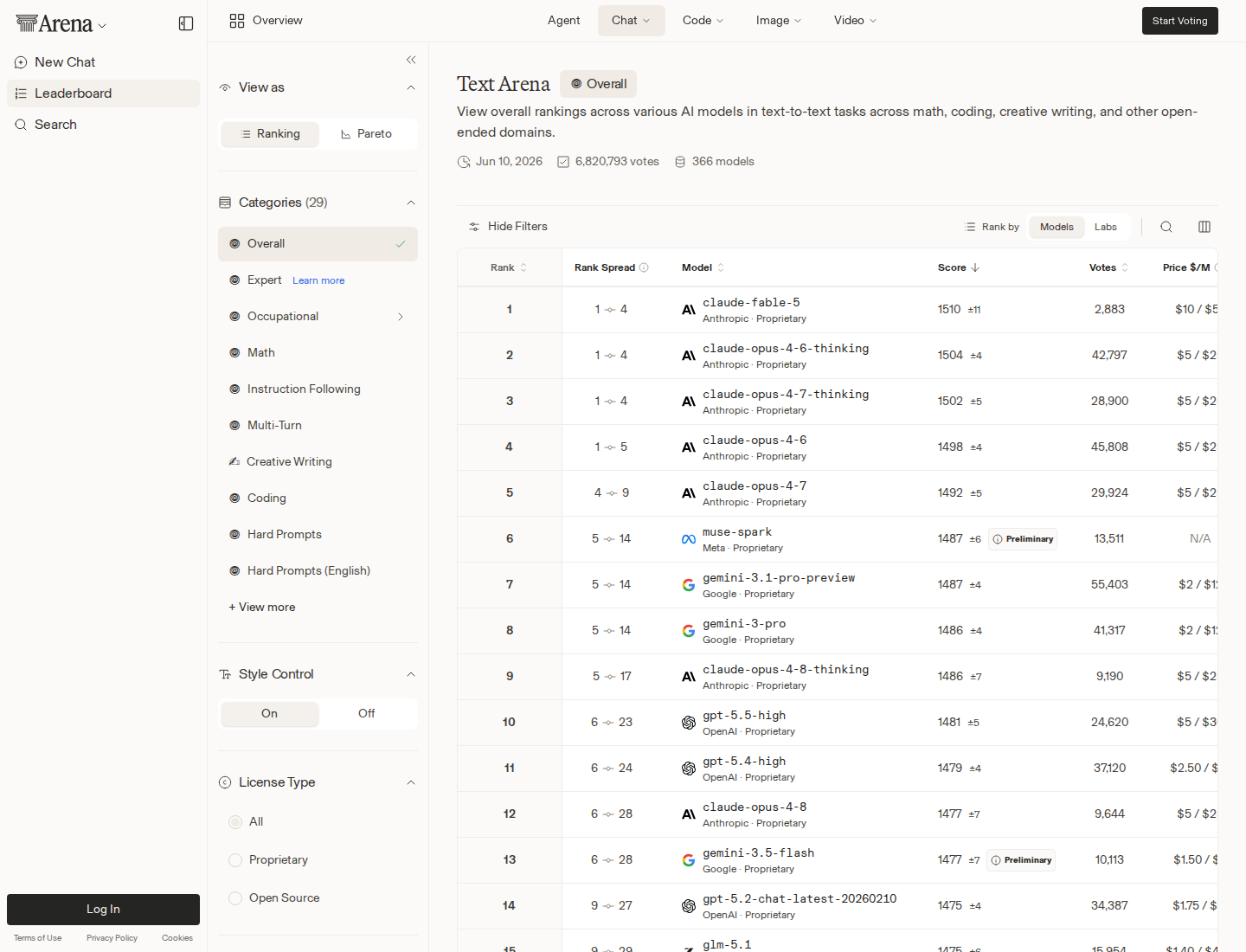
The most interesting movement in this week’s LLM rankings did not happen on the benchmark leaderboard. Arena AI’s text and coding charts were effectively frozen, with Anthropic still occupying the top of both tables. The real signal showed up in production routing: OpenRouter’s usage board added Nex-N2-Pro (free) at #19 with 494 billion weekly tokens, enough to push GPT-5.5 out of the visible top 20.
That is not a clean “new model beats frontier lab” story. It is better than that. It is a market structure story: agent workloads are hungry enough, price-sensitive enough, and easy enough to route that a free open-ish agentic model can become material in real usage before it becomes a benchmark celebrity.
The static Arena charts make the contrast sharper. On Arena’s text leaderboard, claude-fable-5 still leads at 1510 Elo, followed by four more Anthropic entries before Meta’s muse-spark appears at #6. In Code/WebDev, Anthropic’s advantage is even louder: claude-fable-5 sits at 1665 Elo, nearly 100 points above the next entry, while Alibaba’s qwen3.7-max-20260517 is the highest non-Anthropic coding model at #8 with 1534 Elo and 2,867 votes.
If your job is to pick the best model for a hard coding task today, Arena is still telling a fairly boring story: Claude is the expensive lane until your own evals prove otherwise. But OpenRouter is telling a more operationally useful story. The models that get the most real traffic are not always the models with the cleanest trophy cabinet. They are the ones that fit into developers’ routing logic: good enough capability, acceptable latency, cheap or free tokens, and tool support that does not fall apart under automation.
Free is not a benchmark score, but it is a routing strategy
Nex-N2-Pro’s debut is large enough to take seriously. OpenRouter ranks the free variant at #19 with a new week-over-week marker and 494B weekly tokens. Above it, the chart is already packed with models that look more like infrastructure choices than prestige purchases: DeepSeek V4 Flash leads with 4.41T tokens, MiniMax M3 is #2 with 4.32T and 73% week-over-week growth, and Tencent’s Hy3 preview is #3 with 4.14T.
The Nex model page describes N2-Pro as an agentic mixture-of-experts model with 17B active parameters out of 397B total, built on the Qwen3.5 architecture. The free OpenRouter listing supports text and image input, text output, reasoning, function calling, structured outputs, and a 262K context window. That feature list is not accidental; it is aimed directly at coding agents, research agents, and tool-using workflows where the model is less a chatbot and more a flaky junior process supervisor with API access.
The app breakdown is the useful part. OpenRouter attributes 286B tokens of Nex-N2-Pro traffic to Kilo Code, 103B to Hermes Agent, 17.3B to Claude Code, 11.9B to OpenClaw, and 10.1B to pi. That is not just people pasting riddles into a playground. It is agent traffic: codebase reads, tool calls, retries, summaries, file inspection, and all the other token-expensive glue work that makes modern AI coding feel useful when it works and absurdly wasteful when it does not.
This is why the “free” label matters. Agent loops are structurally inefficient. They read too much context, over-plan, inspect outputs twice, recover from their own mistakes, and then write a summary longer than the patch. Frontier models can make that loop better, but they also make it expensive. A model that is merely competent and free can win a large slice of the workflow if it handles exploration, scaffolding, test diagnosis, and low-risk edits well enough.
The deployment story is the warning label
Nex-N2-Pro is not a “run it on the spare GPU under your desk” model. The Hugging Face model card’s local serving example uses two 8×H100 servers, tensor parallelism 16, and Nex AGI’s customized sglang fork. That matters because “open model” does not automatically mean “operationally simple model.” For most teams, the practical version of openness here is not self-hosting tomorrow; it is having multiple hosted providers and enough pricing pressure to keep routing costs honest.
OpenRouter currently shows two free providers for the model, Nex AGI and SiliconFlow. The serving stats are usable but not invisible: best-provider p50 latency around 5.90 seconds, best throughput around 19 tokens per second, and average provider uptime over three days at 94.72%. Those numbers are fine for asynchronous agent work. They are not fine for customer-facing paths where every slow response turns into a support ticket and every provider wobble becomes your incident.
That distinction is where teams should be more disciplined. Do not promote a model into production because it is free. Promote it because it passed the exact job you are hiring it to do. Nex-N2-Pro belongs in the eval matrix for repository exploration, batch code review, internal assistants, issue triage, structured extraction, draft PR generation, and research workflows. It does not belong as a silent replacement for a paid frontier model in a latency-sensitive customer product until you have measured failure modes, retry costs, and provider behavior under load.
The model-card numbers are clearly tuned for the agentic coding market: 83.7 BrowseComp, 51.9 Toolathlon, 53.5 WildClawBench, 75.3 Terminal-Bench 2.1, 58.8 SWE-Bench Pro, and 80.8 SWE-Bench Verified. Those are the right categories to watch, because chat vibes are almost useless for evaluating tool agents. The failure that matters is not “the answer sounded bland.” It is “the agent called the wrong tool, hallucinated a file, broke JSON schema, retried itself into a loop, and burned 200K tokens discovering npm install failed.”
The right eval is dollars per accepted patch
For engineering teams, the action item is not to crown Nex-N2-Pro or dismiss it. Add it to your routing experiments and measure the things that actually affect your bill and your pager.
Start with a fixed task set from your own repos: small bug fixes, failing-test diagnosis, dependency upgrades, code search questions, documentation updates, and one or two ugly refactors. Run the same tasks through your current frontier default, a strong mid-tier model, and Nex-N2-Pro. Track pass rate, human review time, retry count, tool-call failures, structured-output failures, latency, and total tokens. Then compute the metric nobody puts on leaderboard banners: dollars per accepted patch.
That metric will probably produce a split routing strategy. Expensive models stay on ambiguous architecture changes, security-sensitive edits, and high-leverage code paths. Cheaper agentic models take the grunt work: reading, searching, reproducing, drafting, formatting, summarizing, and generating first-pass patches that a stronger model or a human can review. This is not glamorous, but it is how software teams actually save money without turning their codebase into a benchmark casualty.
The community skepticism around Nex-N2-Pro is also healthy. LocalLLaMA discussion has the usual spread: interest in the open/free hosted route, suspicion that benchmark optimization is doing some of the marketing work, and complaints that local Qwen-family setups still feel better for certain practical tasks. Good. Agentic models should be forced through hostile harnesses. If the claim is “this model can work,” the proof is not a launch post; it is fewer failed tool loops in someone else’s repo.
So the headline is not that Nex-N2-Pro beat GPT-5.5. It did not, and that framing would be lazy. The headline is that a free, Qwen-derived, agent-focused 397B-parameter MoE just consumed enough routed production traffic to appear beside closed frontier systems. That is a much more important signal for builders: model selection is becoming less like picking a single champion and more like building a compiler optimizer for intelligence — route the expensive pass only where it improves the output.
Arena still says Anthropic owns the top of the leaderboard. OpenRouter says the market is already routing around cost. Both can be true. The teams that win will not be the ones arguing which chart is “real.” They will be the ones instrumenting their agent stacks well enough to know when cheap is good enough, when frontier is necessary, and when the model is just confidently wasting tokens with better typography.
Sources: OpenRouter rankings, OpenRouter Nex-N2-Pro model page, Nex-N2-Pro Hugging Face model card, Arena AI text leaderboard, Arena AI Code/WebDev leaderboard, LocalLLaMA discussion.