GLM Took OpenRouter’s Top Spot. Don’t Call It the Best Model.

The most useful thing about a new number-one model is not the crown. It is the reminder that the crown is rented.
GLM 5.3 Flash has moved into first place on OpenRouter’s weekly usage ranking, carrying 18.4 trillion tokens through the routing platform and passing DeepSeek V4.1 Flash at 17.8 trillion. That is a real change in production behavior, but it is a narrow one: 600 billion tokens sounds enormous until you notice that the gap is only about 3.3% of GLM’s total. In a rolling window influenced by launches, promotions and a handful of large applications, this is a lead, not a moat.
The distinction matters because model leaderboards have become procurement documents by accident. A sorted table is irresistibly easy to interpret: number one must be best, number two must be the runner-up, and everything below the fold can be ignored. OpenRouter’s ranking does not support that conclusion. It counts prompt and completion tokens on its own routed API, aggregates them into daily UTC buckets, keeps model variants separate and excludes private requests. It does not rank request volume, unique customers, revenue, task completion or answer quality.
That makes GLM’s move interesting for exactly what it measures: somebody is sending a lot of work to it. It does not tell us whether that work is coding, roleplay, document processing, synthetic-data generation or a popular agent retrying the same failed tool call.
Token volume is adoption with the labels torn off
Usage is stronger evidence than launch-day applause. Developers can praise a model on social media without ever putting it behind an endpoint; 18.4 trillion weekly tokens require actual traffic. But tokens are a distorted unit of economic activity. A verbose model records more volume for the same task. A tokenizer that splits text differently can move the counter without moving customer value. Long-context batch jobs can dwarf interactive requests, while a concise premium model may generate more revenue and complete more useful work with far fewer tokens.
Price and distribution also matter. A cheap model bundled into a popular gateway preset can climb faster than a more capable model that requires explicit selection. Free tiers are even more obvious: Nvidia’s Nemotron 3 Ultra free variant sits seventh with 5.09 trillion tokens. That number proves demand under those conditions. It does not tell a buyer how demand survives when capacity is constrained, pricing changes or the free queue slows down.
GLM 5.3 Flash does bring independent context beyond the traffic chart. OpenRouter’s model page reports a 41.8 Artificial Analysis Intelligence Index score, a 71.5 coding index and a 50.9 agentic index. Those figures make the model worth evaluating, especially for software and tool-using workloads. They still should not be multiplied by 18.4 trillion and converted into an architecture decision. Benchmark capability and routed adoption answer different questions, and neither measures your production acceptance criteria.
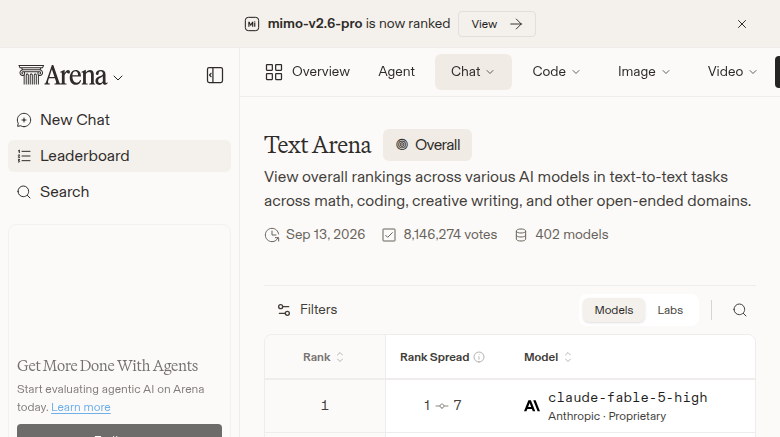
LM Arena makes the separation visible. Its overall top 20 did not reorder, and Anthropic models occupy the first three rendered positions. Arena is based on pairwise user preference; OpenRouter is showing token volume. One asks which answer users prefer in a comparison. The other asks where traffic passed through one marketplace. A model can win either, both or neither while still being the right choice for a particular system.
DeepSeek lost the slot, not the distribution battle
The provider-level picture is less dramatic than the headline. DeepSeek has three Flash variants in the top nine: V4.1 Flash at 17.8 trillion tokens, V4 Flash 0731 at 8.64 trillion and V4 Flash 0423 at 3.51 trillion. Together they account for 29.95 trillion weekly tokens. Z.ai has the new leader plus GLM 5.3 in tenth place, totaling 21.54 trillion. DeepSeek therefore lost the individual number-one position while retaining substantially more top-tier traffic across its family.
This fragmentation is an operational warning. Teams often store a friendly family name—“DeepSeek Flash” or “GLM”—when they should preserve the exact routed model identifier and provider response. Dated snapshots can differ in tool calling, refusal behavior, output shape and latency. If an incident begins after a provider silently changes an alias, family-level telemetry turns the investigation into archaeology. Log the resolved model, provider, price and retry path on every request. Treat a version change like a dependency upgrade, because that is what it is.
The rest of the ranking reinforces how little meaning belongs in a one-position move. GPT-5.6 Luna took fourth from DeepSeek V4 Flash 0731 by 30 billion tokens—8.67 trillion versus 8.64 trillion, a difference of roughly one third of one percent. Solar Pro 4 passed GLM 5.2 by 20 billion, 1.73 trillion to 1.71 trillion. Those swaps are statistical weather until they persist. Publishing every adjacent flip as a quality verdict would be the model-market equivalent of redesigning a service because CPU utilization moved from 41.2% to 41.4%.
Use the leaderboard as an evaluation trigger
Engineering teams should not ignore the move. They should translate it into a controlled test. Start with a representative slice of production traces, including the boring requests and ugly edge cases that polished benchmark prompts miss. Run GLM 5.3 Flash against the incumbent with the same system prompt, tool schema and output constraints. Score task completion, structured-output validity, tool-call accuracy, refusal rate and factual error—not aesthetic preference alone.
Measure p50 and p95 latency, but also time to a successful result. A fast first response that requires two retries is slow. Compute cost per completed task rather than price per million tokens. For agents, count loops, tool failures and human interventions. For retrieval systems, separate citation correctness from fluent synthesis. For code generation, execute tests and inspect the size and reversibility of the patch. The unit that matters is useful work, not generated text.
Then deploy in shadow mode. Send a small fraction of live prompts to the candidate without serving its output, compare the results asynchronously and watch for workload segments where it wins or fails. If the numbers hold, use a canary with an explicit rollback threshold. A gateway makes switching models technically easy; that convenience is not a substitute for change control.
There is also a portfolio lesson here. The top two models alone account for 36.2 trillion weekly tokens, yet the top 20 spans Z.ai, DeepSeek, Tencent, OpenAI, Xiaomi, Nvidia, Google, Meta, Upstage, Anthropic, MiniMax, Moonshot and Poolside. The market is not converging on one universal winner. It is sorting into price-performance envelopes, workload niches and distribution channels. Sensible systems will route by task and maintain at least one tested fallback rather than hard-coding allegiance to whichever logo tops this week’s chart.
Watch what happens next, not just what happened yesterday. If GLM’s lead survives several rolling windows, grows without a promotion and is accompanied by stronger provider share, stable pricing and comparable signals from independent evaluations, it becomes evidence of durable adoption. If the order flips again in a day, the correct interpretation is not that the industry changed its mind twice. It is that a narrow, trailing usage chart is sensitive to traffic composition.
GLM 5.3 Flash has earned engineers’ attention. It has not earned an automatic migration. “Most used,” “most preferred” and “best for this workload” remain three different pull requests—and only the last one belongs in your production architecture.
Sources: OpenRouter AI Model Rankings, OpenRouter usage-accounting documentation, GLM 5.3 Flash model page, LM Arena leaderboard