The Cheapest Model Won, and That Tells You Everything About 2026 LLM Adoption

There is a version of the LLM rankings story that runs like this: a Chinese open-weights lab launched a 552-billion-parameter model ten days ago and it shot to number one on the world's largest public inference router, so DeepSeek is now the king of language models until proven otherwise. That version is wrong, but the chart it pretends to explain is real, and it points at something more interesting than a leaderboard coronation. Model adoption in late 2026 is an infrastructure story. Compress the cache, cut the price, silently migrate the endpoint, and a fresh release can top a real-usage chart before quality benchmarks move at all.
That is what happened in OpenRouter's weekly rankings window ending September 19. DeepSeek V4.1 Flash processed 14.6 trillion tokens and took the top slot, up from second place a week earlier. GLM 5.3 Flash jumped two spots to second with 13 trillion tokens. GPT-5.6 Luna, which led the previous snapshot at 15.2 trillion, fell to third at 12.4 trillion. A new entrant, Poolside's Laguna S 2.1, debuted at number 20 with 1.18 trillion tokens. DeepSeek V4 Pro 0423 dropped out of the top 20. Most of the rest of the chart was quiet rotation — Muse Spark 1.3 Contributor and Gemini 3.8 Flash swapped at 11 and 12, but the bones of the ranking are the same.
The new piece on the board is what you should actually read.
The migration is the headline
DeepSeek shipped V4.1 Flash on September 10, ten days before the usage window closed. Ten days is not enough time to win an organic popularity contest against entrenched incumbents. The only way V4.1 Flash moves from zero to 14.6 trillion tokens in that span is if DeepSeek moved existing traffic there itself.
That is exactly what happened. DeepSeek announced that starting September 14 at 04:00 UTC, requests to its deepseek-v4-pro endpoint would route to V4.1 Flash at Flash pricing until V4.1 Pro shipped. The older deepseek-v4-flash and the vision-experimental endpoints were also redirected. If you sent any traffic to DeepSeek's Pro tier in the last week of the window, your bill and your results came from V4.1 Flash whether you opted in or not. That consolidation is why a single new release looks like an overnight market-share takeover. It is closer to a river being redirected into a new gauge while the old gauges were kept on the dashboard.
This does not invalidate the chart. OpenRouter measures behavior with money and workloads behind it, and OpenAI did not lose ground to DeepSeek so much as to whoever is the cheapest available default. But it does mean the 300 percent figure being passed around on the chart is, at best, half organic adoption and half routing policy. Anyone publishing that headline number without the migration note is mistaking an operations call for a referendum.
The architecture claims that matter
Skip the benchmarks. The interesting moves in V4.1 Flash are operational, not abstract quality. DeepSeek describes the model as a 552-billion-parameter mixture-of-experts using a new Causal Encoder–Decoder design. The active parameter count is 8 billion for input and 16 billion for output, which is the kind of asymmetry that should make a serving engineer sit up: providers only pay for the parts of the model actually doing work per token.
The two numbers that matter for agents are KV-cache memory and storage. DeepSeek claims V4.1 Flash needs one quarter the HBM and one eighth the SSD for its KV cache compared with the prior generation. In agent workloads where the system repeatedly sends long histories, repository context, tool outputs, and stable system prompts, the cost of holding and retrieving that cached context can dominate the nominal per-token arithmetic. A model that can cache four times as much conversation in the same GPU memory and twice as much on local SSDs is not just a smaller bill. It is a different ceiling on what an agent can keep in its working memory without paying retrieval latency.
The price floor matches. OpenRouter lists V4.1 Flash at $0.15 per million input tokens and $0.60 per million output tokens, with DeepSeek's native peak/off-peak pricing at half that on off-peak hours. For workloads that can tolerate latency, the off-peak number is the new bottom of the cheap-but-decent tier. Compare that to Claude Sonnet 5 at around $3 input and $15 output today and you can see why routed APIs are sending real traffic DeepSeek's way: the per-task math changed even when the per-quality math did not.
What the OpenRouter table really measures
OpenRouter's ranking page is the closest thing the industry has to a usage leaderboard, and it is worth being precise about what it counts. The chart aggregates prompt and completion tokens across daily UTC buckets, treats free and paid variants of the same model as separate entries, and excludes private self-hosted and direct-provider traffic. The number next to a model name is tokens, not requests, not users, not spend, not quality. A model with a million-token context will look heavier than a model with eight thousand just because each request counts for more.
The bottom half of the chart is the strongest evidence that quality is not what drives rank. NVIDIA's Nemotron 3 Ultra is listed as "free" at number 8 with 4.19 trillion tokens. Poolside's Laguna S 2.1 entered at 20 also marked free. Free tiers are volume subsidized by their providers' strategy, not by users choosing them on merit. The paid tier of the chart is where adoption pressure actually shows up, and even there a 1,048,576-token context window for V4.1 Flash will inflate the number versus smaller-context peers.
Use the table as a map of where routed demand is flowing, not as a procurement scoreboard. It tells you capacity is available, prices are tolerable, and the ecosystem has figured out how to route to a model. It does not tell you whether the model is right for your task.
Arena AI: still Anthropic, still quiet
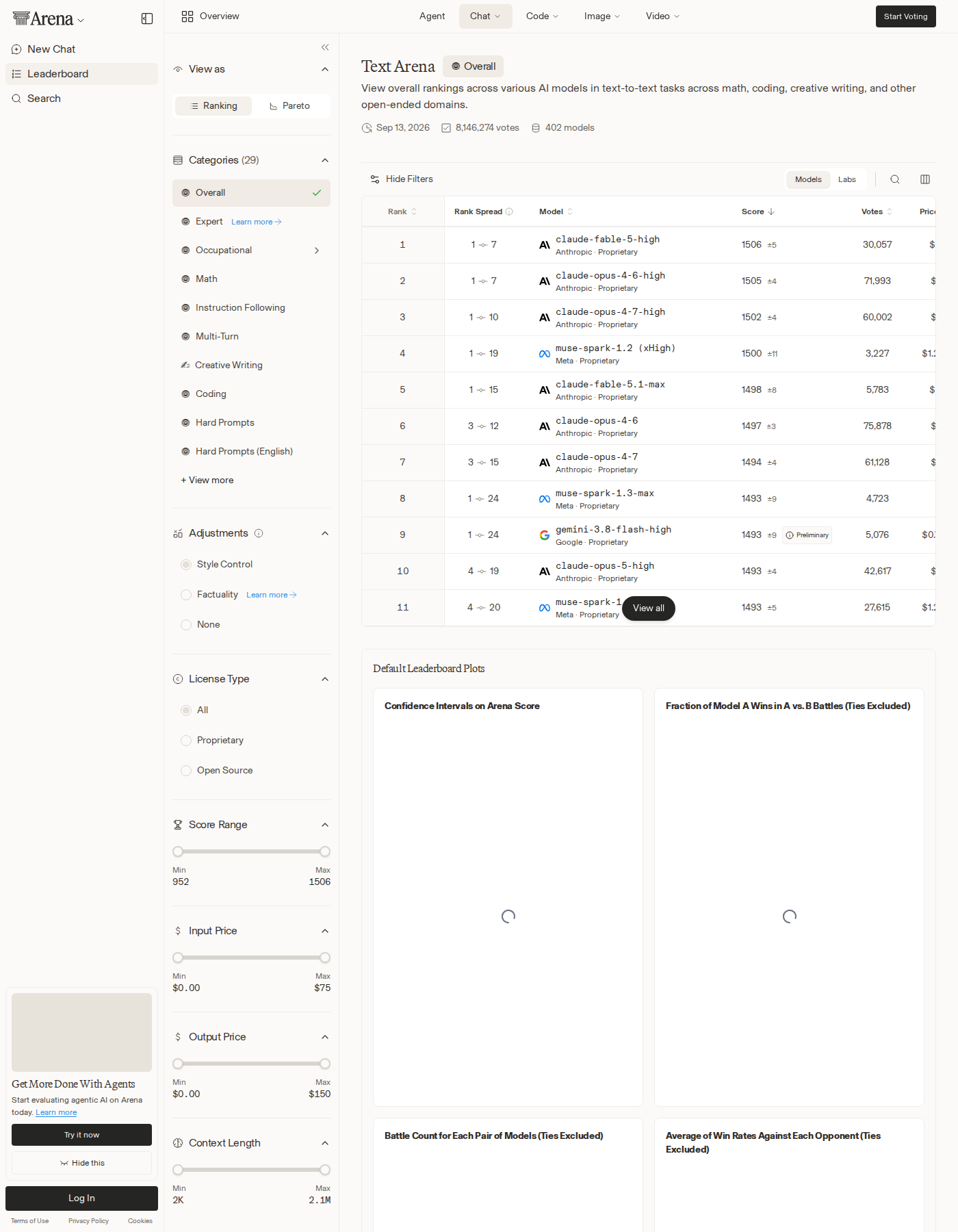
On the human-preference side, Arena AI's text leaderboard looks frozen at the top. Eight of the top fourteen entries belong to Anthropic, with Claude Fable 5 and the Opus 4-6 / 4-7 / 5 family taking the upper slots. Meta's Muse Spark variants cluster at 4, 8, 11, and 13. Google fills in with Gemini 3.8 and 3.7 Flash at the high and middle tiers plus Gemini 3 Pro variants at 15 and 16. The rest of the top 20 is one Kimi, one GLM Max, and two OpenAI entries. No DeepSeek in the top 20 of the Arena leaderboard, despite topping OpenRouter by tokens. The two charts are measuring different things and that is the point.
If you want a single sentence to summarize the present moment in benchmarks: Arena is voting on who is best, OpenRouter is voting on who is cheapest per token per request. Both are real signals. Neither is the answer to "which model should I deploy."
What to actually do this week
If you are already sending traffic to deepseek-v4-pro, audit it now. Your endpoint silently switched to a new model with new weights and a new pricing tier on September 14. Re-run your golden eval traces, compare structured output and tool-call behavior to last week's baselines, check refusal patterns, and pin a version where the platform permits it. Keep a fallback route. Log the resolved provider and model name in your telemetry, not just the one you requested. Vendor migrations are a feature of the cheap-tier market and they will keep happening.
If you build agent systems with long context, V4.1 Flash is worth a real bake-off — not a vibe test, not a benchmark rank, a head-to-head on your own traces. Measure time-to-first-token on cache hits, end-to-end task completion against your hard set, tokens consumed per success, and dollars per resolved task. The KV-cache compression claim is a vendor claim until your own p99 numbers confirm it. If it holds, you have headroom for longer-running agents at lower cost. If it does not, fourteen trillion tokens processed by someone else will not fix your workload.
If you are pricing a new product, treat the OpenRouter chart as a capacity signal. The fact that a ten-day-old release can hit 14.6 trillion tokens means the routing infrastructure has absorbed it and the demand exists. That is what changes a build-versus-buy calculation — knowing that a cheap default is reachable at scale, not knowing it is best.
And if you write about AI benchmarks, please stop equating usage volume with quality. The chart moved for the most boring reason in the world: DeepSeek compressed its cache, cut its price, and redirected its own traffic. That is not a story about whose model is smarter. It is a story about who can ship a more efficient inference stack than their competitors this quarter. Both matter, and they are not the same measurement.
The interesting race in late 2026 is not who tops the leaderboard. It is who can keep cutting the cost of cached long-context inference while keeping quality within shouting distance of the frontier. DeepSeek just made a credible run. Anthropic, OpenAI, Google, and Meta will answer, not with bigger benchmarks, but with cheaper caches. Watch that number, not the chart.
Sources: OpenRouter Rankings, DeepSeek V4.1 Flash announcement, DeepSeek V4 Pro announcement, Arena AI Text Leaderboard, Hacker News discussion, Reddit practitioner thread.