Ling-3.0 Flash Hit OpenRouter’s Top 20. That’s a Trial, Not a Verdict

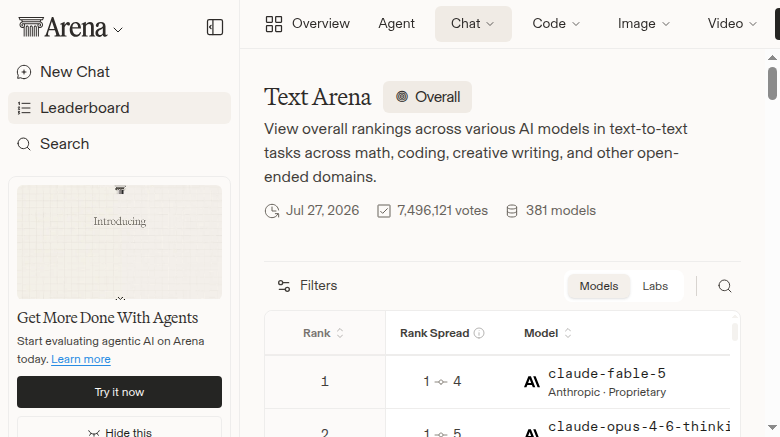
Leaderboards are most useful when they disagree. This week, OpenRouter says developers poured 612 billion tokens into a model that costs nothing, while Arena says the best answers still come from an Anthropic wall at the top of its preference chart. Those results are not competing verdicts on the same contest. They expose the two markets forming underneath modern AI infrastructure: one for maximum answer quality, and another for acceptable work at radically lower marginal cost.
The new arrival is InclusionAI’s Ling-3.0-flash, released on July 23 and already ranked eighteenth in OpenRouter’s weekly top 20. Its free endpoint charges $0 for both input and output, exposes a 262,144-token context window, permits up to 32,768 output tokens, and supports tool use, log probabilities, sampling controls, and optional reasoning. That is an unusually complete invitation to experiment, and developers accepted it at industrial scale.
But 612 billion tokens are evidence of trial, not proof of quality. OpenRouter’s ranking measures usage, which is shaped by price, launch curiosity, placement, routing defaults, and availability as much as model capability. A free endpoint can win a token-volume race simply because every cautious platform engineer can point a shadow workload at it without opening a procurement ticket.
The important number is 5.1 billion, not 124 billion
Ant describes Ling-3.0-flash as a 124-billion-parameter mixture-of-experts model that activates roughly 5.1 billion parameters for each token. In other words, only about 4.1% of its total parameter pool participates in a given token’s computation. For builders, that active footprint is the economically relevant figure: total parameters describe available capacity, while active parameters more directly influence how much computation serving requires.
The comparison with Ling-2.6-flash makes the direction clearer. The earlier model had 104 billion total parameters and 7.4 billion active parameters. Ling 3.0 increases total capacity by about 19% while reducing active parameters by roughly 31%. Ant also claims the model uses one-eighth the total and one-twelfth the active parameters of Ling-2.6-1T while matching or beating that much larger model on most published benchmarks.
That last claim deserves a yellow flag. The launch did not include a standalone technical report or an independently reproducible evaluation suite, and reports at publication time said the weights were not yet available on InclusionAI’s Hugging Face page despite the model’s open-weight positioning. “Open” is not a property conveyed by an announcement. It is a chain of artifacts—weights, license, tokenizer, inference code, evaluation method—that other engineers can inspect and reproduce.
Third-party architectural analysis points to another reason the model may be cheap to run: a reported 5:1 blend of Kimi Delta Attention and Multi-head Latent Attention, alongside 1/64 expert activation. The design uses cheaper recurrent or linear attention for most layers and periodically restores global attention for long-range alignment. Sparse feed-forward computation attacks one serving cost; mostly linear attention attacks the growing cost of long contexts. If the implementation holds up, 256K context stops being a luxury feature and becomes an ordinary operating envelope.
That “if” is doing real work. A context-window number proves that an API accepts a long prompt, not that the model reliably uses information near the beginning, preserves state across tool calls, or resolves conflicting instructions late in a document. Teams should test retrieval needles at several depths, facts distributed across files, state carried through multiple tool invocations, and adversarial instructions near the end. Long-context reliability is a system behavior, not a field in a model card.
Free models rotate; durable workloads leave receipts
OpenRouter’s chart already contains a warning against reading launch-week volume as loyalty. Tencent’s free Hy3 variant was ninth and has now fallen out of the top 20, while the paid Hy3 endpoint surged by more than 999% week over week to third place with 4.76 trillion tokens. That may reflect a successful conversion from sampling to paid use, a routing change, or simply attention moving between endpoints. What it does not support is the idea that free-tier rank predicts durable adoption on its own.
The rest of the usage chart shows how quickly the middle can reshuffle. DeepSeek V4 Pro rose from fifth to fourth with 3.34 trillion tokens, edging GLM 5.2 at 3.31 trillion. Step 3.7 Flash grew 167% to 2.02 trillion. Kimi K3 climbed to tenth on 1.25 trillion tokens, up 128%, and Grok 4.5 reached twentieth with 573 billion, up 77%. These are meaningful deployment signals, but they are workload signals—not controlled comparisons of reasoning quality.
Arena supplies the complementary view. Its top four remained unchanged, led by claude-fable-5 at an Elo of 1508. Anthropic’s claude-opus-5-max entered at fifth with 1495, giving Anthropic six of the top seven positions; Meta’s muse-spark-1.1 and muse-spark took eighth and ninth, and Google’s gemini-3.1-pro-preview ranked tenth. OpenAI’s highest entry in the expanded top 20 was gpt-5.6-sol-xhigh at thirteenth.
Arena measures human preference under its own sampling and voting conditions, so it is not a universal truth either. Still, the contrast is useful. Anthropic currently owns the premium preference tier, while OpenRouter usage is led by Xiaomi’s MiMo-V2.5 at 10.8 trillion tokens, DeepSeek V4 Flash at 6.73 trillion, and Tencent’s Hy3. The models people prefer in a head-to-head answer comparison are not necessarily the models platforms choose for millions of background tasks.
That split will widen as agent systems mature. A product rarely needs the single “best” model for every step. Repository search, document classification, schema extraction, test generation, and draft patches may tolerate a cheaper model; security review, destructive actions, final user-facing decisions, and ambiguous recovery paths may justify a stronger one. The winning architecture is increasingly a routing policy, not a model logo.
Use the free window as an evaluation subsidy
The practical move is not to migrate production to Ling this afternoon. Put it behind the model interface you already use and run a fixed, versioned task suite against the incumbent. Include real repository tasks and tool traces rather than benchmark riddles. Record completion rate, tool-call validity, retries, wall-clock latency, input and output tokens, recovery after a bad action, and the amount of human review required.
Measure cost at the workflow level. A free model that loops three times, emits oversized outputs, or corrupts state can cost more in latency and engineering attention than a paid model that completes the task once. Conversely, if Ling handles 80% of reversible work cleanly, its value is not that it “beats” Claude in the abstract. Its value is that it can remove paid inference from a large, well-defined slice of the pipeline.
Start with reversible workloads: code search, structured extraction, test generation, research collection, and draft patches that must pass CI. Apply hard token and time budgets. Log prompts, outputs, routing decisions, and failures. Keep a higher-confidence fallback or human approval for deployments, permission changes, security-sensitive code, and any tool call that cannot be cheaply undone.
Then watch what happens after the launch incentives fade. Does Ling remain in OpenRouter’s top 20 if pricing changes? Do multiple providers serve it reliably? Do weights, a clear license, inference artifacts, and reproducible evaluations arrive? Can independent testers reproduce Ant’s efficiency and quality claims? Those signals will distinguish a useful new infrastructure component from a free-endpoint traffic spike.
The week’s rankings do not crown one universal winner. They show a market becoming mature enough to optimize for different objectives. Arena says Anthropic is setting the quality bar. OpenRouter says builders will aggressively explore efficient alternatives when distribution friction disappears. Ling-3.0-flash has earned a serious trial, not a victory lap—and the teams that benefit most will benchmark the entire workflow instead of outsourcing their judgment to either leaderboard.
Sources: OpenRouter weekly rankings, OpenRouter model catalog, Arena AI leaderboard, Ant Ling announcement, Kilo launch analysis, Digital Applied technical analysis, LocalLLaMA discussion