LLM Rankings Are Split Between Prestige and Production Gravity

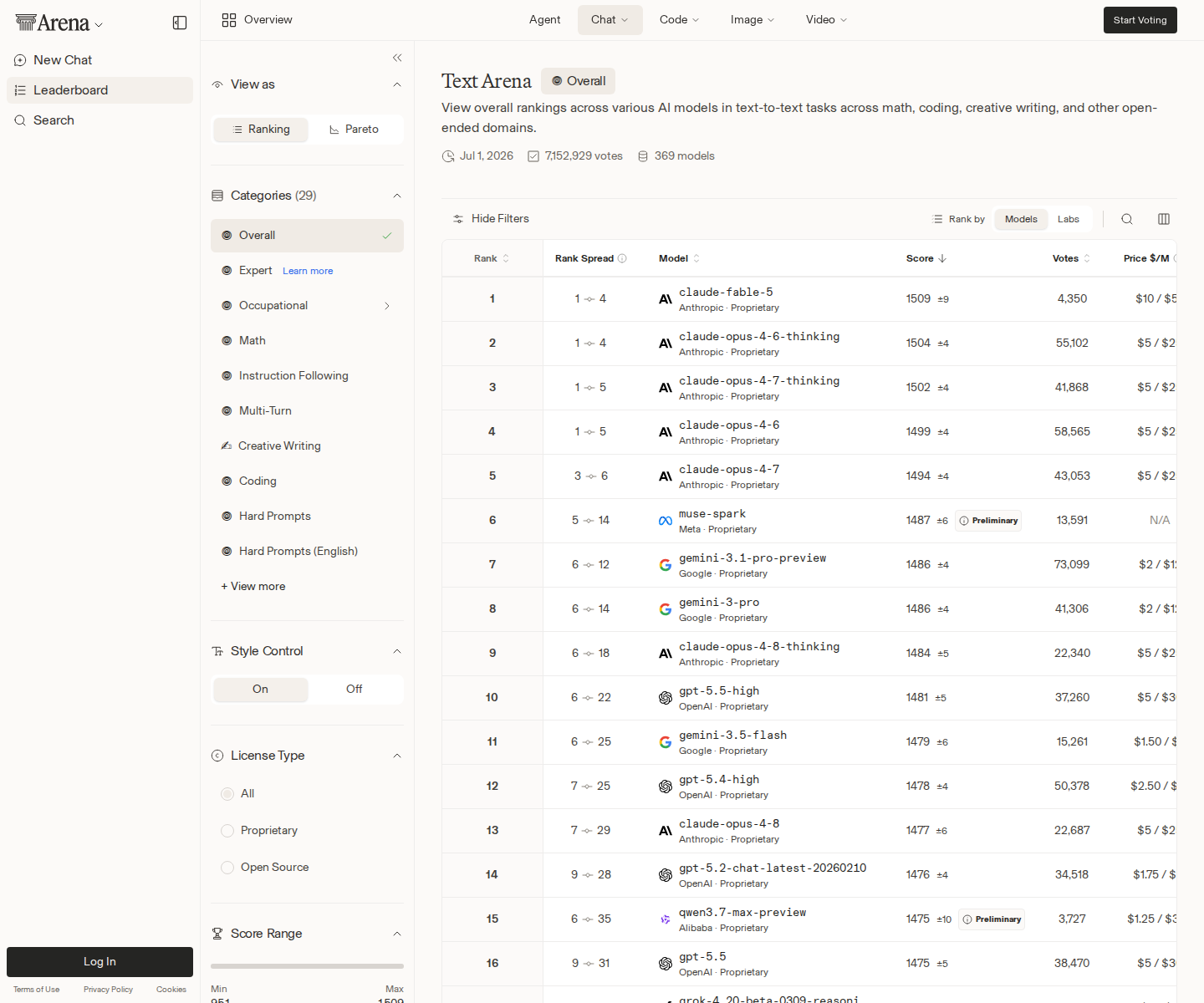
The most useful LLM leaderboard story this week is the boring-looking one: the quality board barely moved, while the usage board kept rearranging itself underneath. That is exactly the kind of split engineers should care about. Benchmarks tell you what wins in a controlled comparison. Production token volume tells you what survives contact with budgets, latency targets, retry loops, agent scaffolding, and the daily indignity of real users asking the same question twelve different ways.
Arena AI's text leaderboard is almost frozen at the top. The top five are still all Anthropic-flavored: claude-fable-5 leads at 1508 Elo, followed by claude-opus-4-6-thinking at 1503, claude-opus-4-7-thinking at 1502, claude-opus-4-6 at 1499, and claude-opus-4-7 at 1494. Meta's muse-spark sits at #6 with 1487, Google's gemini-3.1-pro-preview and gemini-3-pro are tied at 1486, Anthropic's claude-opus-4-8-thinking is #9 at 1484, and OpenAI's gpt-5.5-high rounds out the top 10 at 1481.
If all you read is the Arena table, the conclusion is simple: the subjective frontier is stable, and Anthropic remains the vendor to beat for head-to-head text preference. But that is only half the system. The more operationally useful movement is happening on OpenRouter, where the ranking is based on weekly token volume rather than preference votes. There, the top of the market looks less like a prestige contest and more like an invoice.
DeepSeek V4 Flash still leads OpenRouter with about 4.9 trillion weekly tokens. Xiaomi's MiMo-V2.5 is still #2 at about 4.2 trillion. The meaningful change is below them: Tencent's Hy3 preview climbed into #3 with about 3.7 trillion weekly tokens, pushing MiniMax M3 to #4 at about 3.6 trillion. That is not a symbolic move. At this scale, a one-rank flip represents a large amount of application traffic, automation, and batch processing shifting from one model economics profile to another.
Prestige is concentrated; usage is plural
The split between Arena and OpenRouter is not a contradiction. It is a reminder that "best model" is an underspecified requirement. Best at what? Best answer quality in a pairwise preference test? Best cost per acceptable completion? Best latency at p95? Best tool-calling reliability? Best long-context behavior after the fifteenth retrieval chunk? Best model your finance team will let you keep using after the prototype becomes a product?
The OpenRouter top 20 makes that distinction hard to ignore. After DeepSeek, Xiaomi, Tencent, and MiniMax, the board includes Owl Alpha at #5 with 2.9 trillion weekly tokens, GLM 5.2 at #6 with 2.4 trillion, and DeepSeek V4 Pro at #7 with 2.2 trillion. Anthropic does show up strongly: Claude Opus 4.8 moved to #8 with about 2.0 trillion weekly tokens, ahead of Claude Opus 4.7 at #9 with about 1.8 trillion, while Claude Sonnet 4.6 holds #10 at 1.5 trillion. But the usage leaderboard is not owned by the same models that own the Arena top five.
That matters because most production systems do not need a single default model. They need a routing policy. A modern AI product has at least three classes of work: premium reasoning where failures are expensive, medium-stakes interaction where quality and latency both matter, and cheap background throughput where the system should spend as little as possible while staying above a quality floor. The Arena board is useful for the first bucket. OpenRouter's usage board is a better hint for the second and third.
This is the first practical takeaway: stop treating leaderboard position as architecture. Use it as a hypothesis generator. If you are building an agent, put the top Arena models in the evaluation set for hard planning, synthesis, and ambiguous user-facing work. Then put the OpenRouter climbers in the evaluation set for summarization, extraction, classification, codebase indexing, regression triage, and other tasks where volume dominates. The model that wins the demo may not be the model that should process ten million background jobs.
The Opus 4.8 flip is a migration signal
The movement inside Anthropic's own line is worth a closer look. Claude Opus 4.8 passing Opus 4.7 on OpenRouter is not the biggest delta on the board, but it is one of the cleanest signals. Same family, same premium positioning, adjacent versions. When the newer model overtakes the older one in live token volume, the market is usually saying the upgrade friction was tolerable and the quality, reliability, or compatibility improvement was enough to move real workloads.
Engineers should read that as permission to run a focused migration test, not as a reason to blindly swap defaults. Same-family migrations still break prompts. They change verbosity, refusal behavior, tool-call formatting, hidden chain-of-thought assumptions, JSON discipline, and the amount of patience the model has for under-specified instructions. The right move is to take the prompts that cost you money or trigger support tickets, replay them against 4.7 and 4.8, and compare more than final-answer preference. Measure schema validity, tool-call retries, token usage, latency, and the frequency of "almost right but operationally useless" completions.
The second practical takeaway is to maintain a small standing eval suite for every model family you depend on. Not a research benchmark. A product benchmark. Fifty to two hundred representative tasks, with the edge cases that have hurt you before: messy input, adversarial phrasing, partial context, stale documents, ambiguous instructions, non-English text if your users produce it, and payloads large enough to expose context-window behavior. If a model climbs the usage board, you can test it in an afternoon instead of arguing from vibes.
Nemotron and the open-ish pressure on defaults
NVIDIA's Nemotron 3 Ultra moving to #13 with about 936 billion weekly tokens, just ahead of Gemini 3 Flash Preview at about 926 billion, is another small movement with a larger implication. It is not a coronation. It does not mean Nemotron is suddenly the best general-purpose model. It does suggest that alternatives outside the usual consumer-chat spotlight can win meaningful production share when the packaging is right.
This is where the industry keeps relearning the same lesson: a model does not have to win every benchmark to become important. It has to be good enough for a valuable workload, cheap enough to scale, available through the interfaces teams already use, and predictable enough that engineers can debug failures. For infrastructure vendors, that is a more durable wedge than a splashy leaderboard screenshot. For application teams, it is a reason to keep the model shortlist broader than the brands that dominate social feeds.
The DeepSeek V3.2 slip tells the same story in reverse. It fell two spots to #18, with about 557 billion weekly tokens, while Gemini 2.5 Flash Lite and Gemini 2.5 Flash each moved up one rank. A drop from #16 to #18 is not a collapse; half a trillion weekly tokens is still substantial. But in a market where routing changes can move traffic quickly, yesterday's default can become today's fallback unless it keeps winning on the boring dimensions: price, latency, reliability, and integration behavior.
The third practical takeaway is to make model choice reversible. Too many teams still weld prompts directly to one vendor's quirks, then call it an AI strategy. Put model configuration behind a routing layer. Normalize response handling. Track model, version, latency, input tokens, output tokens, retry count, validation failures, and user-visible outcome. When a model like Hy3 preview passes MiniMax M3, or Opus 4.8 passes 4.7, you should be able to test a traffic slice instead of scheduling a rewrite.
There is also a procurement lesson hiding in the rankings. The models pushing trillions of tokens are not merely popular; they are proving that teams have found workloads where the unit economics work. That should influence how engineering leaders talk to vendors. Ask less about benchmark hero numbers and more about sustained throughput pricing, cache behavior, rate-limit predictability, data-retention terms, batch discounts, and incident transparency. The model market is no longer just a capability race. It is an operations market.
So the editorial read is this: Arena says the frontier text crown is stable, and Anthropic still has the cleanest claim at the top. OpenRouter says production demand is more fragmented, more cost-sensitive, and more willing to route around prestige when the workload allows it. The winning engineering posture is not loyalty to a leaderboard. It is disciplined pluralism: pick premium models where judgment matters, route cheaper models where scale matters, and keep your evals sharp enough that switching is an engineering decision instead of a religious one.
If the top of Arena stays frozen while OpenRouter keeps moving, that is not a quiet week. That is the market separating benchmark admiration from production gravity. Builders should watch both, but only one of them shows where the tokens are actually going.
Sources: Arena AI leaderboard, Arena AI text leaderboard, OpenRouter rankings, OpenRouter rankings endpoint, OpenRouter models API.