LLM Rankings Are Split Between Prestige and Production Gravity

The most useful LLM ranking this week is not the one with the prettiest Elo number. It is the messy one that shows what developers are actually paying to run.
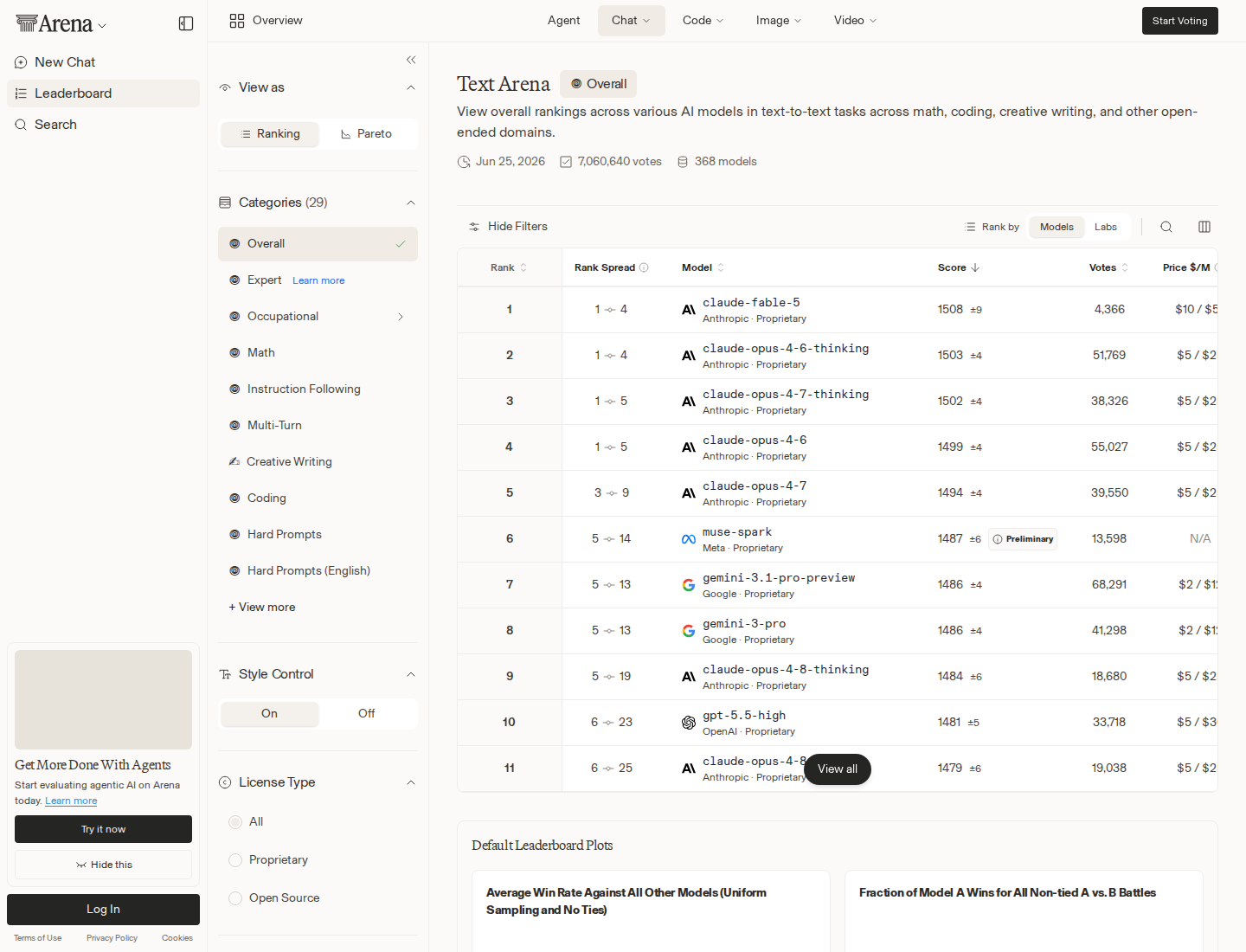
Arena's text leaderboard is basically holding still: claude-fable-5 leads at 1508 Elo, followed by claude-opus-4-6-thinking at 1503, claude-opus-4-7-thinking at 1502, claude-opus-4-6 at 1499, and claude-opus-4-7 at 1494. Anthropic owns the top five, with Meta's muse-spark at 1487, Google's gemini-3.1-pro-preview and gemini-3-pro both at 1486, another Claude variant at 1484, and gpt-5.5-high rounding out the top ten at 1481.
That is an impressive board, but it is not a surprising one. The surprise is over on OpenRouter, where usage is moving under the benchmark surface. DeepSeek V4 Flash remains first with 4.75 trillion weekly tokens, MiMo V2.5 is second at 4.26T, MiniMax M3 is third at 3.67T, and Tencent's Hy3 Preview reclaimed fourth at 3.65T. Three of the top four weekly token leaders are not OpenAI, Anthropic, or Google.
That should change how teams read leaderboards. Arena is telling you where preference quality is sticky. OpenRouter is telling you where production gravity is pulling.
The leaderboard split is now the story
Hy3 Preview moving ahead of Owl Alpha is not a simple "winner beats loser" event. Owl Alpha still grew 21% week over week, yet slipped from fourth to fifth because Hy3 grew enough to pass it by roughly 279 billion weekly tokens. That is what a real usage market looks like: rank can move against a product even when its own volume is healthy, because nearby competitors are accelerating faster.
The mid-table movement is more important than the top slot. GLM 5.2 moved to sixth with 2.32T weekly tokens and +31% week-over-week growth. DeepSeek V4 Pro rose to seventh at 2.15T, while Claude 4.7 Opus slipped to eighth at 2T after a -19% weekly move. Step 3.7 Flash posted the same +31% growth rate at eleventh, Nemotron 3 Ultra grew +37% at fourteenth, and Laguna M.1 jumped +41% at fifteenth.
The negative side is just as useful. gpt-oss-120b fell -44%, DeepSeek V3.2 dropped -33%, and both Gemini 2.5 Flash and Gemini 2.5 Flash Lite declined -8%. None of these moves, alone, proves a model has become bad. They do suggest developers are actively repricing their defaults. When token volume shifts this much in a week, the market is not waiting for a clean benchmark consensus before changing routes.
There is a good reason for that: production model choice is not a beauty contest. It is a budget, latency, reliability, and failure-mode decision wearing a leaderboard's jacket.
Reasoning tokens are the new hidden cloud bill
The GLM 5.2 discussion around Hacker News is a useful corrective to the usual benchmark reading. Practitioners were not only asking whether the model is smart. They were asking how expensive the "thinking" is. One report described GLM 5.2 at max effort spending roughly 45,000 tokens and more than 15 minutes before writing the first file for a Nim math-evaluator task. Another argued that GLM 5.2 High can cut token use by about 2x to 2.5x with little quality loss on many workloads.
That is the conversation teams should be having internally. A model can be high-quality and still be the wrong default for CI automation, support triage, batch summarization, or a coding assistant that has to answer before the user's coffee cools. The model that wins an adversarial prompt battle may not win a thousand mundane production calls where the correct answer is "good enough, quickly, under budget."
Reasoning-heavy models make this harder because they can hide cost in places dashboards do not always make obvious. Prompt tokens are easy to reason about. Completion tokens are visible in the response. Native reasoning tokens, scratchpads, retries, and tool-loop churn are where the bill starts looking like distributed systems debugging: technically explainable, still annoying at 2 a.m.
The practical response is boring and necessary. Do not promote a model because it moved up a public leaderboard. Promote it because it wins your workload under your constraints. Run the same tasks through high-effort and max-effort settings. Track wall-clock time, total tokens, reasoning tokens if exposed, retry rate, tool-call count, and human acceptance. Then pick the lowest-effort setting that reliably clears the quality bar.
If your eval harness only stores pass/fail, it is under-instrumented. A model that passes while using 3x the tokens and 4x the latency is not tied with the cheaper option. It lost, unless the task is important enough that the extra cost buys measurable risk reduction.
Provider abstraction has moved from architecture astronautics to table stakes
The OpenRouter top four matter because they show how fragmented real usage has become. DeepSeek, Xiaomi, MiniMax, and Tencent are carrying enormous weekly volume while Arena's preference board remains heavily Anthropic at the top. Those facts do not contradict each other. They describe two layers of the stack.
At the top layer, teams still need frontier-grade models for high-judgment work: architecture review, hard debugging, agent planning, security-sensitive analysis, and anything where the cost of a wrong answer is materially higher than the cost of inference. Arena-style rankings are useful here because they help maintain a shortlist. If Claude Fable 5, Opus thinking variants, Gemini Pro, and GPT high-effort models remain clustered near the top, they deserve serious evaluation for those paths.
At the volume layer, usage data says the default should be contested. Extraction, classification, routine summarization, test generation, log explanation, and internal assistant flows do not all need the most prestigious model. Some need a fast model with predictable formatting. Some need a cheap long-context model. Some need a provider that is not rate-limited during your busiest hour. Some need a model that is merely competent but cheap enough to run aggressively.
This is where teams that hardcoded one premium model everywhere are going to feel old-fashioned. The better pattern is a router with explicit policy: which model family handles which class of task, what fallback is allowed, when to escalate to a stronger model, and when to stop retrying because the workflow is broken rather than the model. The point is not to build a grand abstraction layer for its own sake. The point is to keep model choice reversible.
Reversibility is the real engineering advantage. If GLM 5.2 keeps gaining but only makes sense in High mode for your workload, you should be able to test that without rewriting application code. If Claude Opus volume drops because teams are moving routine work elsewhere, you should be able to keep it for the paths where it earns its margin. If Gemini Flash loses share for a week, you should know whether your own telemetry agrees before changing anything.
Arena is the control group, not the deployment plan
Arena's stability is still valuable. The WebDev/code board is also steady at the top: claude-fable-5 leads at 1654, followed by GLM 5.2 max at 1593, claude-opus-4-8-thinking at 1565, claude-opus-4-7-thinking at 1563, and claude-opus-4-7 at 1557. Arena's agent ranking similarly shows Claude Fable 5 High ahead at 13.34% ±1.55%, with Claude Opus 4.8 Thinking at 9.37% ±1.29% and GPT 5.5 xHigh at 8.21% ±1.02%.
Those are useful signals. They are just not enough. A preference benchmark can tell you which models deserve to be in the room. It cannot tell you whether the model fits your latency SLO, your token budget, your customer's region, your data-retention requirements, or the weirdly specific codebase conventions that determine whether generated patches are accepted or thrown away.
The right move this week is not to chase the top of either board. It is to split your model evaluation into two tracks. Use Arena to refresh the quality shortlist for hard tasks. Use OpenRouter-style usage movement to decide which cheaper or faster contenders deserve a controlled trial in high-volume paths. Then let your own telemetry settle the argument.
My read: the frontier labs still own the prestige layer, but the usage market is quietly becoming more pragmatic. Builders are voting with tokens, and the vote says price-performance, routing, and reasoning efficiency now matter as much as top-line quality. The teams that internalize that will spend less, move faster, and have fewer religious arguments about model brands. That is the most underrated benchmark result on the board.
Sources: Arena AI leaderboard, OpenRouter rankings, OpenRouter rankings API, OpenRouter model catalog, Hacker News discussion on GLM 5.2, Chatbot Arena/OpenLM