LLM Rankings Have Split Into Two Markets

The leaderboard story this week is not that Anthropic is still sitting on the throne. That part is almost boring now. The more useful story is that the market has stopped behaving like there is one throne at all.
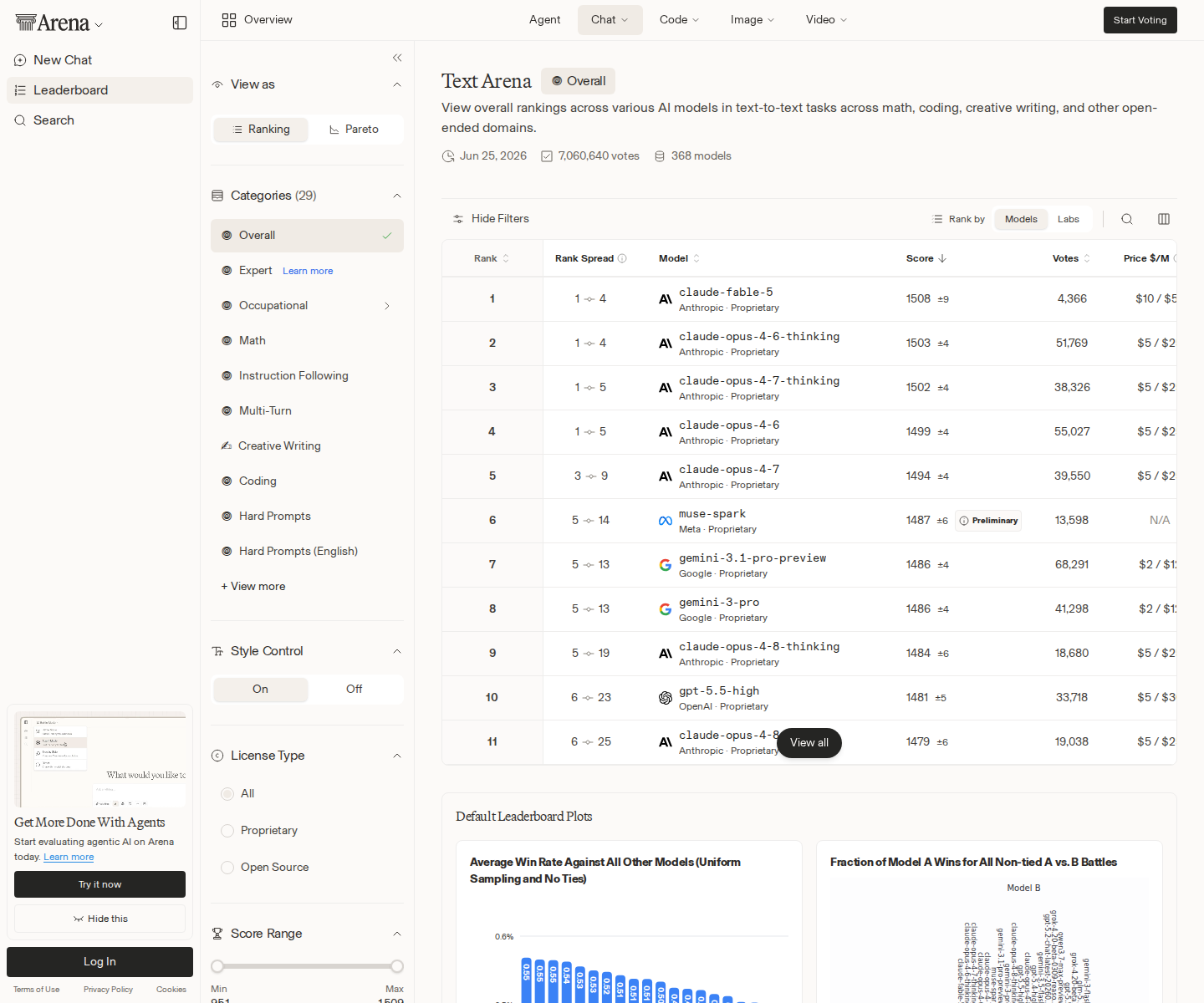
Arena's Text leaderboard is quiet: claude-fable-5 leads at 1508 Elo, followed by claude-opus-4-6-thinking at 1503, claude-opus-4-7-thinking at 1502, claude-opus-4-6 at 1499, and claude-opus-4-7 at 1494. On the WebDev board, Claude Fable 5 is even further ahead at 1654 Elo. If your question is "which model wins human preference comparisons at the frontier?", the answer remains heavily Claude-shaped.
But OpenRouter's weekly token rankings tell a different story. DeepSeek V4 Flash is #1 with 4.70T weekly tokens despite being down 4% week over week. MiMo-V2.5 is right behind it at 4.54T, up 18%. MiniMax M3 is #3 with 3.76T. Owl Alpha climbed to #4 with 3.38T tokens and a 37% weekly jump. Hy3 preview rounds out the top five with 3.29T.
Claude Opus 4.7 does not appear until #6 on OpenRouter, with 2.36T weekly tokens. Claude Opus 4.8 is #9 at 1.96T, even after a 25% weekly increase. GPT-5.5 is #12 at 976B. Gemini 3 Flash Preview is #13 at 902B. These are not small products being ignored by the market; they are high-profile frontier systems. They are just not where the bulk of routed token volume is going this week.
Preference Benchmarks And Production Traffic Have Officially Split
The lazy way to read model rankings is to ask who is #1. The useful way is to ask what each ranking is actually measuring.
Arena is closer to a controlled taste test. It is built around pairwise human judgments, Elo-style scoring, and enough volume to make the top of the board meaningful: the Text board reports 7,060,640 votes across 368 models, and the WebDev board reports 391,241 votes across 90 models. That is a serious signal, especially for ambiguous tasks where taste, instruction following, reasoning quality, and polish matter.
OpenRouter's ranking is closer to a production routing ledger. It captures where tokens are flowing when developers, applications, wrappers, agents, and routing systems are making economic decisions. That means price, latency, free availability, context length, provider reliability, app defaults, and acceptable quality all get mixed into the result. It is noisier than Arena, but it may be closer to how software actually gets built.
This is why the contrast matters. Arena says Anthropic is still winning the prestige layer. OpenRouter says the throughput layer is broad, price-sensitive, and much more competitive. Those are not contradictory signals. They are two different markets wearing the same "LLM rankings" label.
The operational board moved more than the evaluation board. Owl Alpha rose into the top five. GLM 5.2 climbed to #8 with 1.98T weekly tokens, up 86%. Step 3.7 Flash held #11 at 1.49T while jumping 82% week over week. Nemotron 3 Ultra free moved up two places to #15. Kimi K2.6 fell two places to #20 and dropped 27% week over week. That kind of movement is exactly what you expect in a usage market where routing defaults and workload economics can matter as much as raw model quality.
The WebDev Board Is A Warning Against Over-Generalizing
The Arena WebDev leaderboard adds a useful wrinkle. Claude Fable 5 is #1 there too, but glm-5.2 (max) is #2 at 1593 Elo, ahead of multiple Claude Opus variants. The rest of the top 20 is crowded with names that a "frontier model only" procurement process might underweight: Seed 2.1 Pro Preview at #8, Qwen3.7 Max at #10, GLM 5.1 at #11, Kimi K2.6 at #13, MiniMax M3 at #15, and Kimi K2.7 Code at #20.
That should make engineering teams cautious about generic model policies. "Use the best model" is not a strategy unless the workload is also generic, and production workloads rarely are. Web UI generation, code repair, test writing, schema extraction, retrieval synthesis, routing decisions, and customer support drafts all stress different parts of a model. A model can be mediocre at open-ended taste tests and still be excellent at a narrow job class. It can also look brilliant in a benchmark and still be a bad default if it is too expensive or too slow for the request path.
The practical move is to stop treating public leaderboards as a config file. They are scouting reports. Useful, sometimes very useful, but still external signals. The thing that matters inside your product is whether a model produces the right answer, in the right time, at the right cost, for your actual users.
Route By Job Class, Not By Brand Loyalty
For builders, the action item is straightforward: segment your AI traffic. Use the Arena winners for high-ambiguity work: architecture planning, difficult code review, multi-step debugging, ambiguous product reasoning, legal-sensitive summaries, and recovery from failed tool use. That is where the extra quality headroom is easiest to justify.
Then use cheaper high-throughput models for bounded work: classification, extraction, formatting, summarization, autocomplete-style substeps, batch enrichment, speculative branches, and agent bookkeeping. Most AI systems now contain more of these calls than users realize. A customer may see one polished answer, but the application may have performed several invisible transformations before that answer existed. Those invisible transformations are where the OpenRouter board starts to look less like trivia and more like an engineering budget.
There is also a reliability angle. If your system is pinned to one premium provider, your failure mode is simple: when that provider slows down, changes behavior, or gets expensive, your product feels it immediately. A small routing layer with two or three validated alternatives per task class gives you leverage. It does not need to be fancy. Start with a primary model, a cheaper fallback, and a high-quality escalation path. Log quality failures, retries, latency, and cost. Review the routing table weekly.
The mistake is to build a model abstraction that hides the differences completely. Teams often try to make every provider look identical behind a single interface, then discover that tool calling, context handling, refusals, JSON reliability, and streaming behavior differ in exactly the places that matter. Abstract the boring transport. Preserve the model-specific behavior you need to measure. A routing layer that cannot remember why one model was chosen over another is just a cost center with nice variable names.
Procurement should read the rankings the same way. A model rising on OpenRouter is not automatically better; it may be cheaper, newly promoted, newly available, temporarily free, or popular through one high-volume app. A model holding a high Arena Elo is not automatically the right default for every request; it may be overkill for 80% of your tokens. The winning posture is boring and effective: maintain a small internal eval suite, replay real traces, score outputs by task type, and track cost and latency beside quality. Public rankings tell you where to look. Your traces tell you what to ship.
My read: the "best model" era is giving way to the "best routing policy" era. Anthropic can keep winning the judgment boards and still leave enormous room for DeepSeek, Xiaomi, MiniMax, Z.ai, Tencent, OpenRouter, Google, OpenAI, and others to win production volume. That is healthy. It means the market is no longer just rewarding demos; it is rewarding models that fit into real software budgets.
The standup version: keep Claude near the top of the toolbox, but stop pretending every prompt deserves the fanciest hammer. The teams that win from here will not be the ones refreshing leaderboards most often. They will be the ones turning those leaderboards into measured routing decisions, then deleting the expensive calls nobody can justify.
Sources: Arena leaderboard, Arena WebDev leaderboard, OpenRouter rankings, OpenRouter weekly rankings API, OpenRouter model catalog API