MAI-Code-1-Flash Is Live in GitHub Copilot — And the Benchmark Story Is Only Half the Point

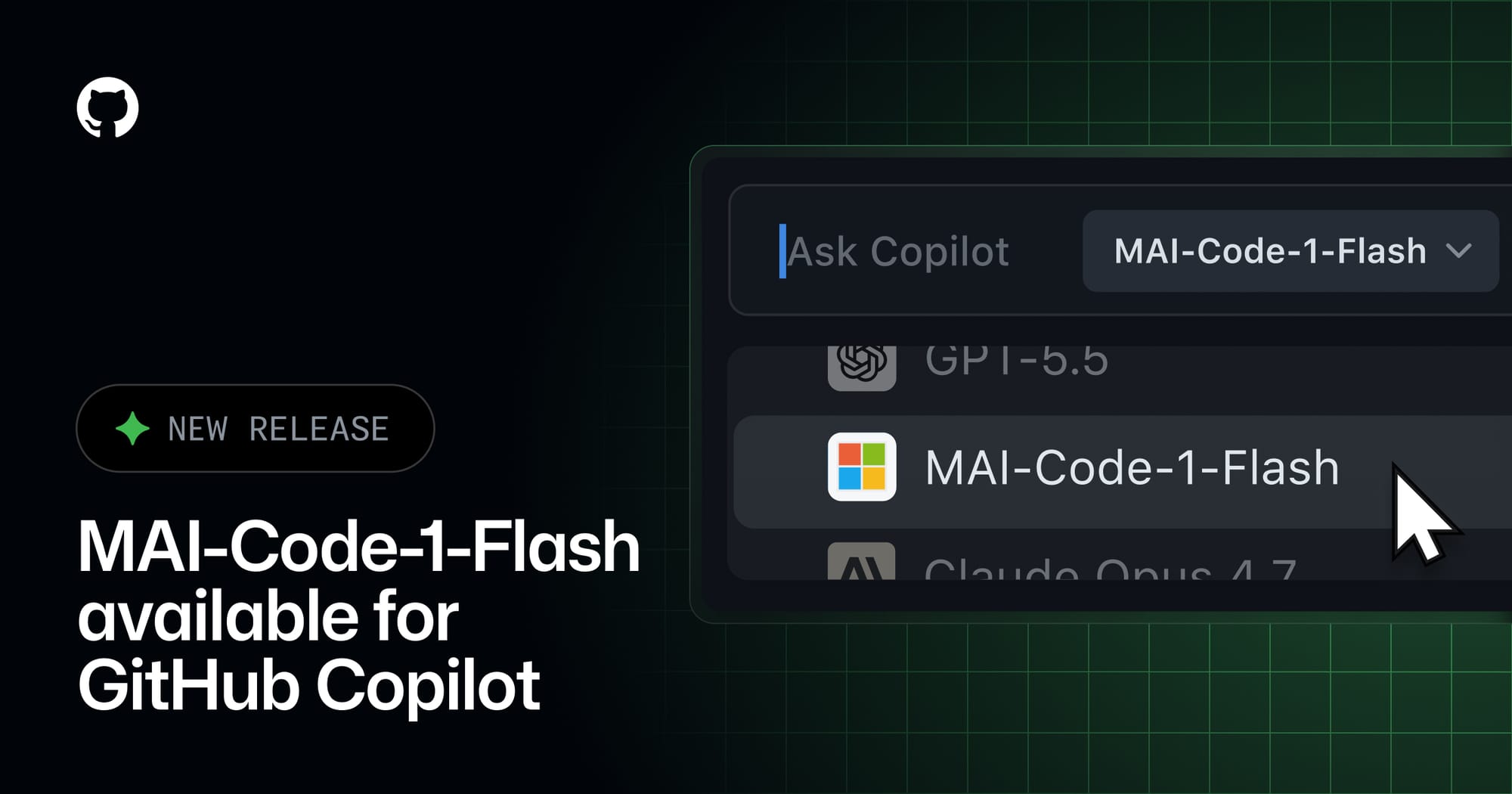
Microsoft's MAI-Code-1-Flash is now live across all GitHub Copilot tiers, confirmed via GitHub Changelog on June 10 with a retroactive publish date that means the rollout has been underway for over a week. The benchmark numbers are the headline material: +16 points on SWE-Bench Pro against Claude Haiku 4.5, up to 60% fewer tokens on SWE-Bench Verified, and a sparse MoE architecture that activates 5B parameters out of 137B total. Those are real results, verified against Copilot's own production harness rather than a cleaned-up eval benchmark. You should care about the numbers. But the more consequential story is what the numbers obscure.
The MAI-Code-1-Flash announcement is not primarily a model story. It is a routing story. Microsoft has been building toward a Copilot that routes between models based on task complexity — fast completion models for simple operations, heavier models for multi-file refactors — and MAI-Code-1-Flash is the first evidence that the routing decision is also a pricing decision.
The architecture: sparse MoE, not distilled shortcuts
Before the routing angle takes over, it is worth establishing what MAI-Code-1-Flash actually is. Microsoft built a sparse Mixture of Experts transformer: 137B total parameters but only 5B active per token. That is an efficiency architecture, not a蒸馏 shortcut. The model was trained from scratch on what Microsoft describes as clean, traceable, enterprise-grade data — no distillation from third-party models, no benchmark-optimized evals. The evaluation setup is worth highlighting because it is self-referential in a useful way: Microsoft tested MAI-Code-1-Flash using the same production harness that serves live Copilot users. That means the benchmark numbers reflect real-world behavior, not a cleaned-up lab test.
The SWE-Bench results tell a consistent story. On SWE-Bench Verified, the model solves harder problems with up to 60% fewer tokens than Claude Haiku 4.5 — which matters because token count is the direct proxy for latency and cost under usage-based billing. On SWE-Bench Pro, the lead is 16 percentage points (51.2% vs 35.2%). On SWE-Bench Multilingual and Terminal Bench 2, the directional trend holds. The adaptive solution length control adds a qualitative layer: the model adjusts its depth based on problem complexity, expanding reasoning for hard problems and staying concise for simple ones.
The billing context that makes the numbers real
Here is the part that is easy to miss if you are reading this as a benchmark roundup. GitHub Copilot switched to usage-based billing on June 1. Pro+, Pro, and Max users on that plan are now burning tokens per session, not paying a flat monthly fee. MAI-Code-1-Flash's 60% token reduction is not just a benchmark vanity metric. For users on usage-based billing, a model that clears the same task with fewer tokens changes the monthly cost profile. That is direct, quantifiable value — not "better AI," but cheaper AI for equivalent quality on the tasks the benchmark measures.
The adaptive solution length control is both a feature and a cost mechanism. Microsoft trained the model to self-assess problem complexity and adjust response depth accordingly. The practical effect is that the decision about "simple vs. complex" shifts from the developer — who would otherwise pick a model tier — to the model itself. That is a reasonable tradeoff if the model's self-assessment is accurate. It is a bad tradeoff if it systematically underestimates difficulty and produces wrong-but-cheap answers. Microsoft has not published error analysis on where the adaptive depth fails. That data will matter once users start comparing per-session token burn against previous behavior.
What this means for Copilot's product architecture
The seven-model MAI family launched at Build 2026: MAI-Code-1-Flash (coding, available now), MAI-Thinking-1 (reasoning, private preview), MAI-Image-2.5 (PowerPoint/OneDrive), and others. The throughline is a Copilot product surface that can route between models based on task type and complexity — not because users are manually switching dropdowns, but because the system is making that decision based on what it knows about the task. MAI-Code-1-Flash is the first instantiation of that routing logic in a live product.
For Copilot Free and Student users, the availability matters because these tiers were previously stuck with a single model. MAI-Code-1-Flash being available across all tiers suggests Microsoft is treating the flash-tier model as the default Copilot experience, not a premium upsell. That is a meaningful shift in how the product is positioned — and it suggests the economics of usage-based billing are influencing model availability decisions at the base tier.
What practitioners should actually do with this
The rollout is gradual, which means there is time to compare behavior before committing. If you are on usage-based billing, the first action is to establish a baseline: track token consumption per session or per day before MAI-Code-1-Flash fully activates in your plan. Once it is active, compare per-session burn rate against the previous model. The 60% token reduction claim is directional — your codebase's patterns, task distribution, and complexity profile will produce different results than SWE-Bench.
The second action is more architectural: if your team is building workflows that involve model routing — either through Copilot's built-in routing or through custom routing logic — MAI-Code-1-Flash is the first production data point for what Microsoft's "adaptive complexity" routing looks like in practice. Watch for whether the model correctly identifies its own failure modes and escalates, or whether it systematically underestimates difficulty on specific task types. That observation will inform how you design your own routing logic.
The third action is to hold the benchmark numbers at arm's length until independent evals land. Microsoft-reported benchmark results are a signal, not a proof. SWE-Bench performance does not always translate to repository-specific patterns, unfamiliar codebases, or the specific edge cases your team encounters. The production harness evaluation is the right instinct, but self-reported results from a product that competes with Anthropic and OpenAI should be read with appropriate skepticism.
The take
MAI-Code-1-Flash is real, and the token efficiency story is credible given the benchmark data and the production-harness training approach. But the benchmark story is the surface narrative. The structural story is that Microsoft is using its own model as a cost-control lever inside its own product — and that is the first evidence that the company's in-house coding model strategy has crossed the threshold from "interesting experiment" to "production routing decision." Whether that is good for Copilot users depends on whether the routing decisions stay invisible and correct, or whether they become the next thing developers blame when their coding assistant confidently solves the wrong problem.
Sources: GitHub Changelog, Microsoft AI, Microsoft AI (MAI family)