Microsoft’s Skills Repo Turns Agent Instructions Into Supply-Chain Code

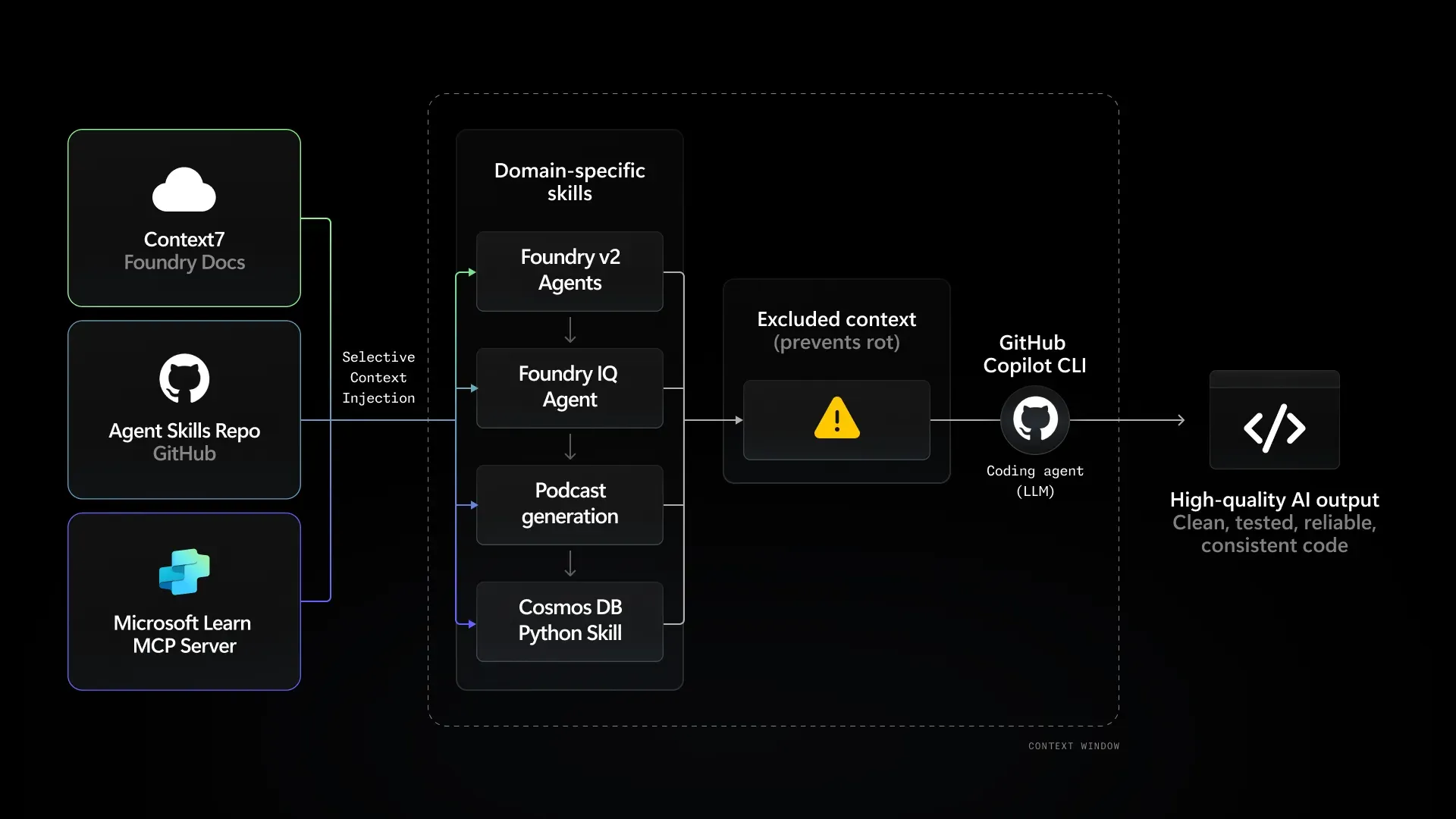
Microsoft’s microsoft/skills repository looks, at first glance, like another pile of helpful Markdown for coding agents. That is the least interesting way to read it. The better read is that Microsoft is treating agent context as an installable, versioned, reviewable artifact — and that means agent instructions are becoming part of the software supply chain.
The repo now describes “Skills, custom agents, AGENTS.md templates, and MCP configurations for AI coding agents working with Azure SDKs and Microsoft AI Foundry.” It lists 174 skills across core, Foundry, Python, .NET, TypeScript, Java, Rust, and other categories. It includes plugins, custom agents, MCP configs for docs, GitHub, and browser automation, an AGENTS.md template, a documentation site, and a Skill Explorer with one-click install. The install command is intentionally ordinary: npx skills add microsoft/skills.
That ordinariness is the point. Once agent behavior can be installed like a package, shared across projects, and symlinked into multiple agent harnesses, it stops being “just prompt text.” It becomes operational configuration. And operational configuration has all the familiar problems: ownership, versioning, review, dependency drift, security boundaries, and the occasional surprise when something updated upstream and your build system started doing a new trick.
Context is becoming package-managed.
Microsoft’s January framing called this “activation context” for coding agents, and the repo has grown from a reported 126 skills to 174. Recent activity includes syncs from GitHub-Copilot-for-Azure on May 11 and May 8. At research time, the repo showed 2,293 stars, 258 forks, and 48 open issues — not massive by framework standards, but large enough to matter for an ecosystem repo whose value is mostly in domain-specific instructions and integration glue.
The growth matters because it reflects a broader shift. Teams are no longer asking only which model or agent framework to use. They are asking how to teach agents the project-specific and domain-specific context needed to be useful: which SDK patterns are canonical, which deployment path is allowed, which docs are authoritative, which MCP servers expose which tools, and where instructions should live so Claude Code, Codex, GitHub Copilot, OpenCode, Cursor, and other harnesses can all consume them without maintaining five divergent copies.
The current answer across the industry is messy: AGENTS.md, CLAUDE.md, Cursor rules, custom skills, MCP configs, repo-local prompts, IDE settings, and wrapper scripts. Microsoft’s repo does not solve that entire portability problem, but it does point toward a practical middle layer: package domain knowledge as skills, install the subset a project needs, place it where the agent harness expects it, and reuse it across environments.
The README’s warning is unusually honest: “Use skills selectively. Loading all skills causes context rot: diluted attention, wasted tokens, conflated patterns.” That line should be printed above every agent-config directory. Most teams respond to weak agent output by adding more instructions. Microsoft is saying the opposite: load less, but make it more relevant.
That matches what builders see in practice. An agent working on Azure Cosmos DB probably benefits from a narrow Cosmos-oriented skill. It does not benefit from also carrying unrelated Foundry, Java, Rust, and deployment instructions into the same context window. More context is not automatically more intelligence. Past a certain point, it is competing guidance with a token bill attached.
Portable instructions create portable risk.
The supply-chain angle is the part teams should take seriously. A skill can teach an agent how to create resources, run commands, call MCP servers, configure GitHub workflows, deploy infrastructure, query docs, or use browser automation. It may be Markdown, but Markdown that changes an agent’s tool behavior is not passive documentation. It is executable-adjacent policy.
This does not mean Microsoft’s repo is unsafe. It means the category deserves the same discipline teams already apply to CI scripts, Dockerfiles, Terraform modules, GitHub Actions, and dependency manifests. Who maintains the skill? What tools does it imply? What credentials does it assume? Does it tell the agent to prefer a risky command? Does it configure an MCP server that can reach production resources? Are updates pinned, reviewed, or blindly pulled by an installer?
The repo’s multi-agent placement story makes this more important, not less. The README describes installing skills into directories such as .github/skills/, with symlinks for multi-agent setups and sharing across destinations like .opencode/skills and .claude/skills. That is useful because teams do not want to maintain parallel instruction sets. But shared context also means a bad or stale instruction can propagate across harnesses. A rule written for one agent’s tool semantics may behave differently in another. A skill that is safe when no shell tool exists may be unsafe when loaded by an agent with broader command access.
MCP raises the stakes again. MCP configs are not just words; they are capability wiring. They decide what external tools an agent can discover and call. Pair a permissive skill with a powerful MCP server and the agent’s effective authority changes. This is why “agent configuration portability” and “agent supply-chain security” are really the same story viewed from two angles. The more portable the config becomes, the more reviewable it needs to become.
For practitioners, the action item is not “install all 174 skills and hope for enterprise magic.” The repo itself tells you not to do that. Start with an inventory. What agent instructions exist in your repos today? AGENTS.md, CLAUDE.md, skills, Cursor rules, Copilot custom instructions, MCP configs, plugin hooks, automation scripts — put them under one review model. Then decide which instructions should be global, which should be project-local, and which should be loaded only on demand.
If you adopt microsoft/skills, vendor or pin the specific skills production workflows depend on. Review diffs like code. Prefer narrow, task-specific skills over giant “make the agent smarter” blobs. Document which MCP servers each skill expects. Test the skill with the harnesses you actually use, not just the one in the README. And remove stale instructions aggressively; context rot is real, and it compounds quietly.
The bigger lesson is that the agent ecosystem is rebuilding the package manager, but for context. That is useful and inevitable. It also means teams need to stop treating prompts and skills as throwaway text files. Microsoft’s repo is valuable because it makes domain expertise easier to distribute. It is important because it proves that agent configuration is now supply-chain code. Review accordingly.
Sources: microsoft/skills, Microsoft Azure blog on agent skills, Microsoft Skills documentation, microsoft/azure-skills, Microsoft Power Platform business skills