Ollama 0.30.9 RC1 Is Small, But the Context-Window Fix Hits the Local-Agent Pain Point

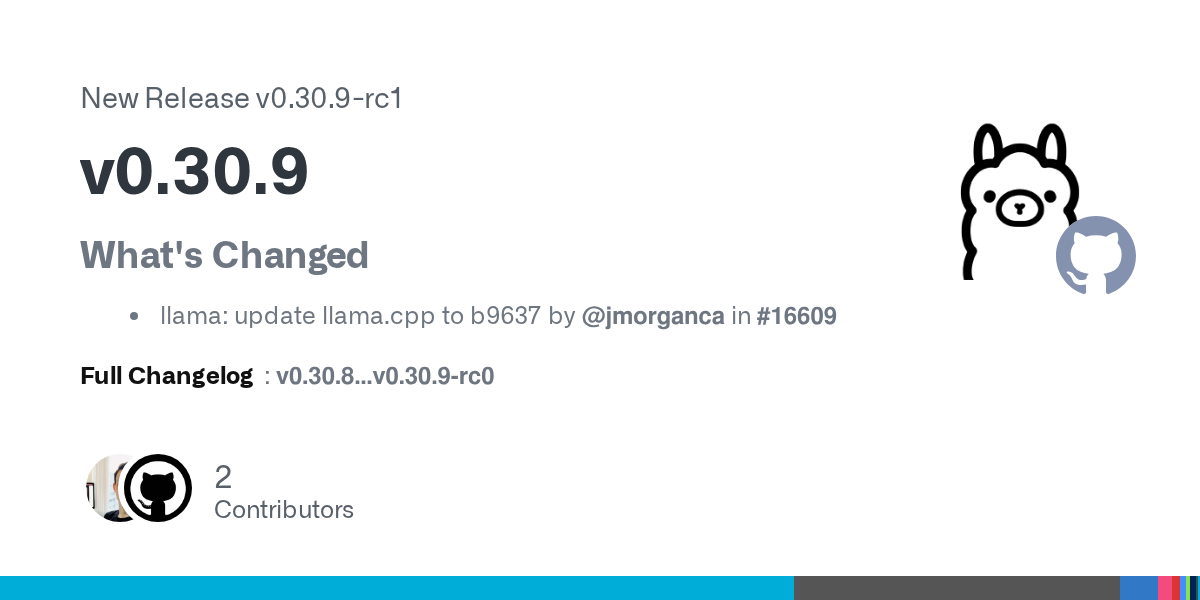
Ollama’s v0.30.9-rc1 is not a headline release. That is exactly why it is worth reading. The local-agent stack does not fail because the launch page forgot another adjective; it fails when context windows behave mysteriously, model renderers drift from model expectations, and the runtime leaves an agent harness guessing whether the model forgot the task or simply hit a boundary.
The release candidate has only three commits between v0.30.8 and v0.30.9-rc1, but they sit in the load-bearing part of local AI infrastructure: an update to llama.cpp at b9637, an updated LFM2 parser/renderer for optional thinking, and server-side context shifting for windows larger than 8k with an explicit error when the context limit is hit. That last item is the one agent builders should underline. Local coding agents are context-management systems with a model attached, not chat boxes with a terminal prompt.
GitHub’s API shows the RC was published on June 15, 2026 at 19:55:07Z, marked as a prerelease, with 17 release assets. The repository was sitting around 174,253 stars and 16,635 forks at research time, which is a useful reminder that Ollama is no longer a niche convenience wrapper. For a large chunk of developers, Ollama is the default first hop from “I want to run a model locally” to “I want a local endpoint my tools can call.”
The context window is where local agents stop pretending
Local agentic programming is hungry in a way single-turn local inference is not. A real agent loop pulls in repository maps, file snippets, shell output, logs, plans, memory, tool results, diffs, and occasionally the entire emotional history of a build system that has not been loved since 2019. A model that seems perfectly capable in a clean prompt can become erratic once the harness starts carrying that operational debris through a long session.
That is why the context-shift work matters. When an agent exceeds context, there are roughly three outcomes. Bad systems degrade silently: instructions disappear, earlier tool results fall out, and the model starts making confident claims about evidence it no longer has. Mediocre systems fail, but only after the user infers the failure from weird behavior. Better systems make the boundary explicit enough for the harness to recover. Ollama adding context shifting above 8k and surfacing an explicit limit error is not glamorous, but it moves the local stack toward the third category.
The practitioner implication is straightforward: if your local-agent harness cannot distinguish “the model made a bad reasoning choice” from “the server hit the context wall,” your debugging loop is broken. An explicit error lets the surrounding tool decide what to do next: compact history, summarize prior steps, trim tool output, switch models, or fall back to a hosted endpoint. Silent degradation gives you vibes. Vibes do not belong in production runbooks.
This is also where local inference economics get honest. The local-agent story is often sold as privacy plus cost control: run Gemma, Qwen, DeepSeek, Kimi, or another model locally, avoid per-token bills, and keep sensitive code closer to the machine. That pitch is real, but only within operational limits. VRAM fit is not the same thing as agent suitability. A model that fits in memory but loses the plot during long-context repo work is cheap in the same way a flaky CI server is cheap: only if nobody accounts for the time wasted around it.
Hermes turns Ollama from model server into workflow surface
The context fix lands at an interesting moment because Ollama’s Hermes Agent docs were also refreshed in the same freshness window. Ollama now frames Hermes as “a self-improving AI agent” with automatic skill creation, cross-session memory, and more than 70 default skills. The quickstart is no longer “wire these pieces together and good luck.” It is ollama launch hermes, with Ollama handling install, model selection, onboarding against http://127.0.0.1:11434/v1, and optional messaging gateway setup for Telegram, Discord, Slack, WhatsApp, Signal, or email.
That changes what the release candidate means. Ollama is not merely serving local models to curious developers. It is becoming part of a local agent runtime path: model server, model library, launcher, memory-bearing agent, skills, and messaging surface. In that world, context behavior is not an implementation detail. It is the runtime contract that decides whether the agent can carry a task across multiple steps without hallucinating continuity.
The recommended Hermes models make the tradeoff concrete. Ollama points to local gemma4 for reasoning and code generation at roughly 16 GB VRAM, and qwen3.6 for reasoning, coding, and visual understanding at roughly 24 GB VRAM. The Gemma 4 library page positions the model for “reasoning, agentic workflows, coding, and multimodal understanding.” Those are serious claims. The supporting runtime has to expose when the model is no longer operating with the context the harness thinks it has.
There is another subtle point here: updating the LFM2 parser/renderer for optional thinking is part of the same systems story. Model families increasingly ship different conventions around hidden reasoning, optional thinking modes, tool text, special tokens, and response rendering. Local runtimes that treat all models as interchangeable text generators will keep hitting edge cases. The boring parser and renderer work is what lets a local endpoint preserve the model’s intended contract rather than accidentally corrupting prompts or outputs at the boundary.
What engineers should actually test
If you are using Ollama as a toy, wait for the stable release unless you like release candidates for sport. If you are building a local coding-agent stack, this RC is worth testing in a controlled environment because it hits the exact failure mode that matters: long sessions near the context boundary.
Start with a workload that previously made the agent drift: repository exploration, long log analysis, multi-file edits, or a Hermes workflow that accumulates memory and tool output. Run it on v0.30.8, then on v0.30.9-rc1. Watch the server logs. Confirm whether context shifting behaves predictably above 8k. Force the limit and make sure the new error is visible to your harness, not buried in a place only a human tailing logs will notice.
Then test model-specific behavior separately. Gemma 4 and Qwen 3.6 may both be reasonable candidates for local agent work, but they will not fail in identical ways. Measure time-to-first-token, steady-state latency, memory pressure, and answer quality after several tool calls. Pay special attention to whether your harness compacts or persists tool results before dumping them back into context. The server can improve boundary behavior; it cannot save an agent design that treats every grep result as sacred scripture.
Finally, decide what role local inference should play in your architecture. For some teams, it is the default path for privacy-sensitive code review and background analysis. For others, it is a cheap worker for low-risk tasks, with hosted models reserved for hard reasoning or long-context jobs. For still others, it is a dev sandbox. All three are valid. The mistake is pretending local means unlimited just because the marginal token cost is hidden behind a GPU fan.
The local-agent race will not be won by one more benchmark screenshot. It will be won by runtimes that make context, memory, and failure boundaries explicit enough for engineers to build on. Ollama 0.30.9-rc1 is a small release candidate, but the direction is right: when local agents hit the wall, the system should tell you where the wall is.
Sources: Ollama v0.30.9-rc1 release, Ollama compare, Ollama Hermes Agent docs, Gemma 4 on Ollama