OpenClaw’s Agent SDK Packaging Draft Treats Agent Workspaces Like Deployable Artifacts

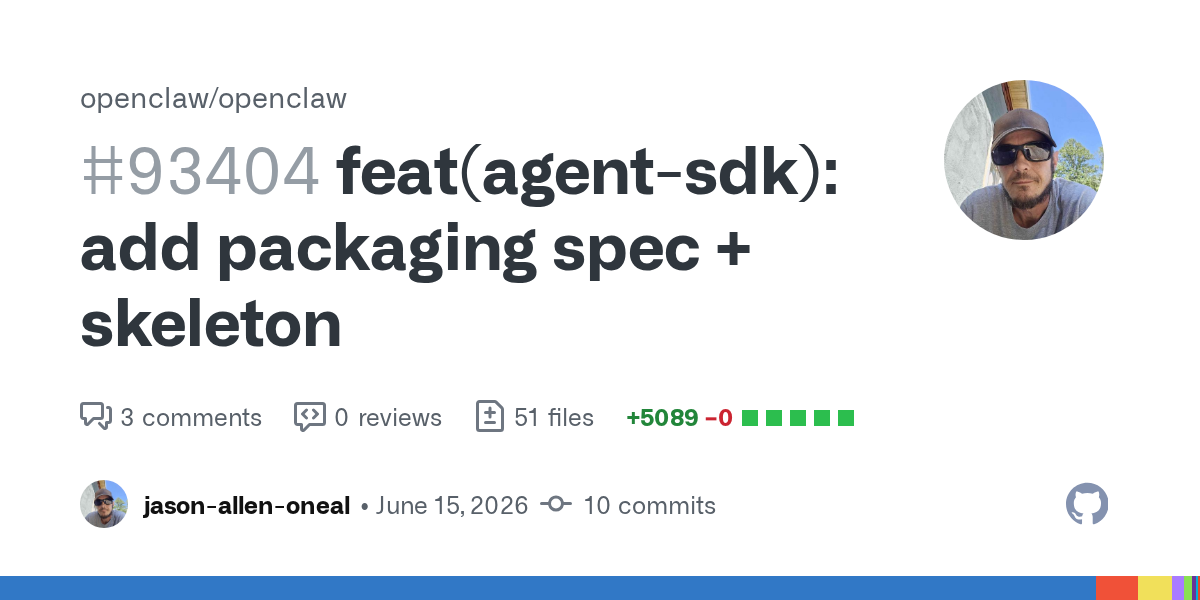
The agent ecosystem has spent too long treating production agents like a handful of markdown files that happen to know where the tools are. That model was fine when agents were experiments. It breaks the moment an agent has secrets, schedules, channel bindings, memory policy, sandbox rules, and enough autonomy to surprise you. OpenClaw PR #93404 is a draft, not a finished runtime feature, but the direction is right: package the agent as a deployable artifact, or admit you are deploying folklore.
The PR adds a draft Agent SDK Packaging spec and a private TypeScript skeleton under packages/agent-sdk/. It is big — 5,089 additions, 51 changed files, 10 commits — and explicitly in spec review. The proposed package shape includes agent-package.json, generated openclaw.integrity.json, copied instruction files, skills, secrets, tool policy, channel bindings, schedules, sandbox constraints, and behavior tests. The spec’s stated goal is to turn an agent into a “declarative, inspectable, tamper-evident, testable artifact.” That is not marketing copy. That is the minimum bar for production trust.
The most important idea in the draft is that an agent is not just a prompt. A real agent is an operational unit. It has instructions, yes, but also permissions, model choices, memory scope, tool access, egress rules, cron schedules, chat bindings, secret declarations, upgrade behavior, and tests that prove it still behaves after the next edit. If those pieces live in loose files plus hand-edited config, deployments cannot be reviewed reliably. They can only be remembered.
Instruction files are prompt-layer code
The draft defaults denyMutableInstructionFiles to true, covering AGENTS.md, SOUL.md, USER.md, HEARTBEAT.md, copied files, and skill SKILL.md files. That is the sharpest design call in the spec. Instruction files are not documentation in the ordinary sense. They are executable influence over an autonomous system. If they change after review, behavior changes. If a package can mutate them silently, it can modify the agent’s policy posture as surely as a binary patch can modify a service.
The proposed openclaw.integrity.json is therefore more than housekeeping. It is a content-integrity manifest for prompt-layer code and packaged assets. Dependency lockfiles answer “what did we resolve?” Integrity manifests answer “did the thing we reviewed change?” Agent platforms need both. A skill install, an instruction update, or a helper script drift can all alter behavior without changing the headline config. The artifact boundary should catch that.
This connects directly to the broader supply-chain story around agent skills and plugins. Traditional software supply chain thinking already learned that source, dependencies, build provenance, and deployment artifacts need traceability. Agent systems add a stranger category: natural-language instructions and tool manifests that change behavior without compiling anything. Treating those as package contents with integrity metadata is not overkill. It is catching up.
Policy ceilings beat prompt promises
The draft also gets the policy hierarchy right: runtime hard policy, operator policy, global sandbox/tool policy, package manifest, then markdown instructions. Lower layers can restrict but not re-enable. That sentence should be printed above every agent platform’s config editor. A package manifest should not be able to punch through runtime egress restrictions. A skill’s markdown should not re-enable exec if the operator disabled it. A schedule should not smuggle a broader channel permission into a deployment because the agent “needs” it.
The sandbox examples are appropriately concrete: restricted egress, allowed and denied domains, DNS rebinding checks, private-range denial, read/write path controls, and elevated=false. Secret declarations include required or optional consumers, mappings from environment, gateway, or file, and audit settings like logAccess and redactInTranscripts. These are the boring fields that decide whether an agent package is a product artifact or a liability in a zip file.
For practitioners, the takeaway is to start inventorying your agents as artifacts even before the spec lands. Write down which files define behavior. Hash or otherwise track critical instruction files. Separate operator policy from package wishes. Declare which secrets each agent consumes and why. Treat schedules and channel bindings as deploy-time permissions, not incidental config. Add behavior tests for the agent’s critical promises: what it may send, what it may read, what tools it must not call, and what it should do under refusal.
This also changes how teams should evaluate agent platforms. “Can I build an agent quickly?” is no longer enough. Ask whether you can package it, validate it, diff it, test it, enable it with a dry-run config compile, and disable it cleanly. PR #93404 sketches CLI verbs like openclaw agent pack, validate, enable, and disable, with enable doing a dry-run config compile and diff before live writes. That is the workflow shape teams need if agents are going to move between laptops, repos, staging environments, and production workspaces.
The caution is real. ClawSweeper’s review flags the PR as not merge-ready without real behavior proof and raises three contract concerns: 23 hard-coded draft config paths, a new private package/API surface, and four JSON sidecar artifacts written outside canonical config or SQLite state paths. That review is not bikeshedding. Package formats become contracts faster than maintainers expect. Examples get copied. Private APIs acquire users. Sidecar files become migration problems. A spec about reproducibility should not accidentally introduce a second, less governed state system.
That is why this is worth covering as a draft rather than a launch. The important signal is not that OpenClaw has solved agent packaging. It has not. The important signal is that the project is naming the right problem. Agents are becoming deployment units, and deployment units need manifests, integrity, policy ceilings, secrets declarations, sandbox constraints, test harnesses, upgrade semantics, and reviewable diffs. Anything less is a prompt folder with production ambitions.
The editorial take: agent workspaces are turning into deployable artifacts whether platforms acknowledge it or not. OpenClaw’s packaging draft is early and messy, but the premise is correct. If an agent can act with durable permissions, it deserves the same artifact discipline we apply to software — plus extra paranoia for the parts written in prose.
Sources: OpenClaw PR #93404, Agent SDK Packaging Spec draft, OpenSSF SLSA provenance framework