OpenClaw’s Bound-Agent Workspace Bug Is the Multi-Agent Failure Mode Hiding in Plain Sight

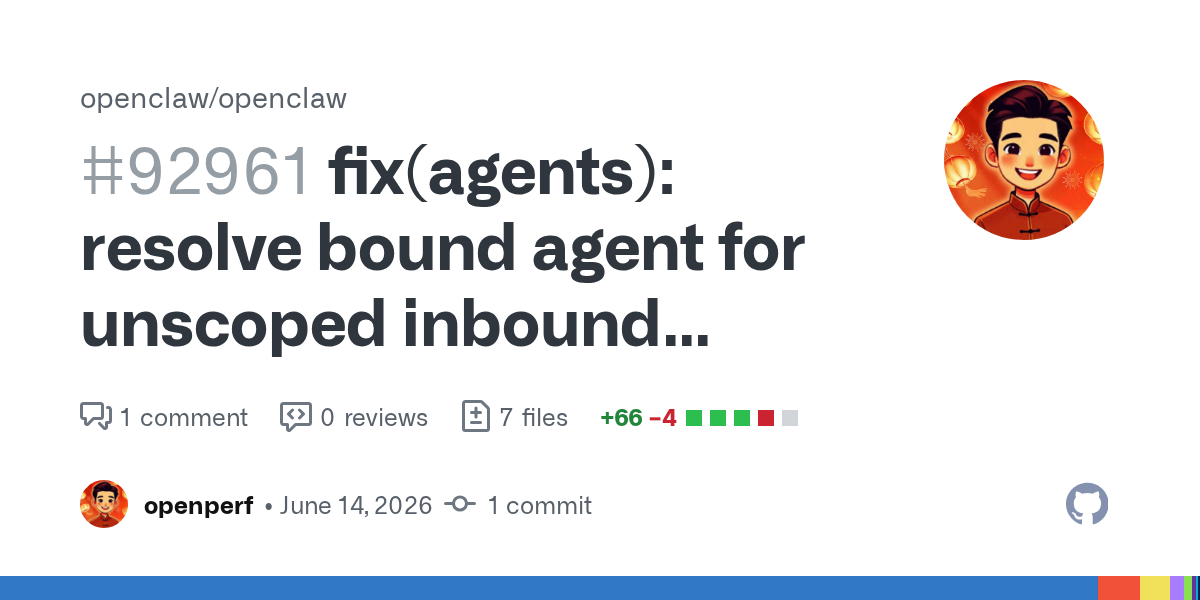
Multi-agent systems do not fail first in the place the demo tells you to look. They fail in the boring glue: which identity got resolved, which workspace got injected, which memory store got consulted, and where the transcript was written after the turn. OpenClaw PR #92961 is a small patch on paper — 66 additions, 4 deletions, 7 files — but it exposes one of the most important product truths in agent orchestration: a bot can look like the right agent while quietly running with the wrong brain.
The bug fixed by the PR is deceptively simple. A channel message could be bound to a non-default OpenClaw agent, and the visible outbound identity would still appear correct. But when the inbound event context was built, the routed agent ID was dropped. If the resulting session key did not encode an agent, downstream resolution fell back to the default agent, which meant the run could receive the default workspace’s SOUL.md, AGENTS.md, USER.md, and IDENTITY.md instead of the workspace belonging to the bound agent.
That is the kind of bug users describe as “haunted” because every individual layer appears plausible. The message arrived in the right channel. The bot answered as the right persona. The route binding existed. The session persisted. But the Project Context — the files that define who the agent is, what it knows, what rules it follows, and which user/project it serves — could come from the default workspace. “Right agent, wrong workspace” is not a minor routing inconvenience. It is identity confusion at runtime.
Scope consistency is the actual multi-agent feature
The fix carries the routed bound agent into the inbound context and uses it as a fallback during agent resolution. The precedence order is the important part: explicit agentId wins, then a session-key-encoded agent, then the bound route agent, then default. That ladder is exactly what you want. A route binding should not override an explicit cross-agent command. But if the user simply talks through a channel that is bound to a project agent, the runtime should not shrug and inject the default workspace because a session key was underspecified.
OpenClaw also aligns persistence through initSessionState, so transcript and session-store writes land under the same bound agent that supplied the workspace. That matters more than it sounds. A multi-agent system is not just a message dispatcher. It is a bundle of identity, memory, local files, transcript history, tool policy, and user expectations. If any one of those is scoped differently from the others, you get subtle governance bugs instead of obvious crashes.
This is why the labels on the PR are worth reading. It is marked agents, P1, size: S, merge-risk: session-state, and status: ready for maintainer look. The patch is small, but the risk category is correct. Session-state bugs are where agent platforms leak trust. ClawSweeper’s same-day review counted three changed agent-resolution call sites and one aligned persistence path, and called out the persistent data-model surface in src/auto-reply/reply/session.ts as upgrade-sensitive. That is exactly the right review posture: not “does this compile?” but “does this preserve the shape of stored identity over time?”
The user-facing failure is worse than a 500
A hard failure would have been easier to debug. If OpenClaw had rejected the inbound message because no agent could be resolved, the operator would know the route was broken. Instead, the system produced a plausible answer using an unintended workspace. In agent systems, plausible wrongness is more dangerous than downtime because it erodes the user’s ability to reason about authority. Who answered? Which instructions applied? Which memory was visible? Which transcript will future turns inherit?
For teams running OpenClaw with multiple agents — one per project, customer, channel, role, or department — the immediate action is to test the full scope chain. Do not stop at “the bot name is correct.” Give a non-default agent a unique workspace marker, bind a channel to it, send a message, then inspect the injected Project Context and stored transcript location. If the display identity, workspace files, and session store disagree, you have a security and governance bug wearing a UX costume.
The same test should be repeated for resets, resumed sessions, background tasks, and any admin API that accepts a session key. A nearby issue, #92960, reports a related scoping failure in sessions.describe, where global session lookup could resolve through the default store agent even when the caller was scoped to a non-default agentId. PR #92964 forwards that scoped agent into target resolution. Different endpoint, same disease: agent identity has to travel with the operation, not live as an assumption outside it.
Agent-native knowledge makes this sharper, not softer
The bigger industry lesson is that “multi-agent” is becoming a provenance problem. The market likes to talk about specialized agents: engineering agents, ops agents, research agents, customer agents. But specialization only works if the system can prove which context fed which answer. Stack Overflow for Agents, MCP resources, active memory, wiki artifacts, workspace docs, and retrieved project knowledge all inherit the same failure mode: correct content in the wrong agent is still wrong.
That is especially true when work moves from one-off chat into persistent collaboration channels. A Slack route bound to an infrastructure agent may have different safety rules than a product-writing agent. A customer-support agent may have access to account context that an engineering agent should not see. A personal assistant agent may have memory that should never enter a shared project workspace. The agent boundary is not cosmetic. It is a policy boundary.
The practical standard should be boring and strict: every run should carry a single resolved scope that is visible in logs, used for workspace injection, used for memory lookup, used for transcript persistence, and available for audit. If a later component wants to override that scope, it should do so explicitly and leave evidence. Anything else becomes folklore.
PR #92961 is a good fix because it repairs the fallback path without flattening the precedence model. It does not pretend that channel binding is the only source of truth. It simply makes sure that when the route is the only meaningful agent signal, OpenClaw remembers it. That is the right shape of fix.
The editorial read: this is not “OpenClaw fixed a route bug.” This is OpenClaw finding one of the hidden seams in multi-agent orchestration. If identity, workspace, memory, and transcript do not resolve together, you do not have a multi-agent system. You have impersonation with extra steps.
Sources: OpenClaw PR #92961, OpenClaw issue #92960, OpenClaw PR #92964