OpenClaw’s New agents.setDefault RPC Turns Config Surgery Into an Actual Product Surface

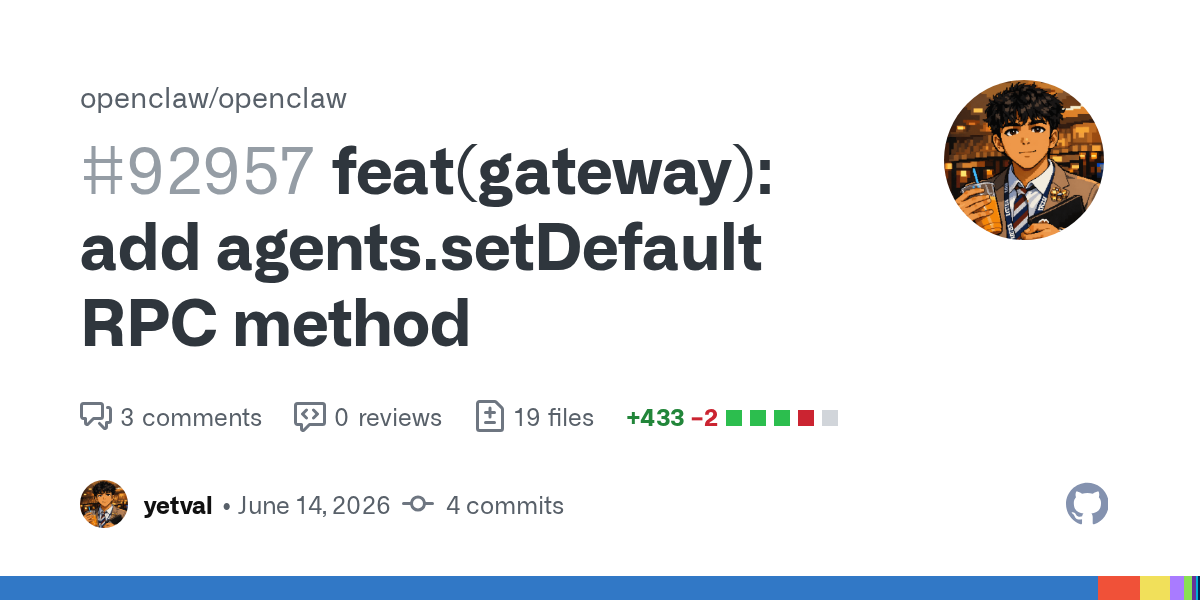
The difference between a hackable agent framework and a usable agent platform is often one boring RPC. OpenClaw PR #92957 adds agents.setDefault, a Gateway method that does exactly what it says: make one configured agent the default. That sounds minor until you look at what developers had to do before. Changing the default agent meant reading the whole config, finding the right array entry, building a merge patch, clearing the old default flag, preserving unrelated fields, handling baseHash conflicts, and hoping no concurrent config writer stomped the result.
That is not an API. That is config surgery with a friendly CLI nearby.
The new method accepts { agentId } and returns { ok: true, defaultId }. It requires operator.admin, rejects unknown agent IDs, sets default: true on the target agent, clears it from every other entry, and persists through the same retrying config-write path used by other agent mutations. The implementation touches the command layer, config mutation code, Gateway protocol schema, dispatch wiring, Admin HTTP RPC exposure, Swift models, docs, and tests. The patch is not tiny — 433 additions, 2 deletions, 19 changed files — because productizing an operation usually means plumbing it through every surface that has to honor the contract.
The default agent is not a preference toggle
In OpenClaw, the default agent is the fallback identity for unscoped sessions and “just start a chat” flows. It can influence workspace selection, model defaults, memory behavior, channel routing fallback, and the first impression a client gives to a user. Treating that as a raw JSON flag is fine when only one operator edits one file by hand. It stops scaling the moment desktop, web, mobile, channel plugins, admin panels, and automation scripts all need to manage agents.
The product driver came from issue #52928, where a desktop client called ClawWork wanted an Agents settings UI with a simple “set as default” button. Without a typed operation, the client would have to wire generic config.patch and become responsible for OpenClaw’s internal config shape. That is how ecosystems accumulate incompatible config writers. One app forgets to clear the previous default. Another preserves stale fields. A third mishandles a hash conflict. Six months later, maintainers are debugging a “random” upgrade bug that is really five unofficial implementations of the same missing operation.
The narrow RPC is better platform design because it turns intent into a constrained mutation. “Make this agent the default” is safer than “please mutate this arbitrary config tree correctly.” The server owns the invariants. Clients own the user experience. That is the division of labor mature control planes eventually learn.
Small control-plane APIs are platform selection criteria
Most coding-agent comparisons still obsess over model quality, benchmark tables, and whether the terminal UI feels slick. Those matter, but they are not enough anymore. Once teams run multiple agents, the control plane becomes part of the product: create agents, edit agents, set defaults, bind channels, inspect sessions, rotate models, manage permissions, and audit what changed. If those operations are only available through general-purpose config mutation, every client becomes a partial admin console with sharp edges.
That should go on the checklist for anyone evaluating agent platforms. Can the system express common administrative intent as typed operations? Are those operations permission-scoped? Do they use the same persistence path across CLI, HTTP, app-server, and desktop clients? Are conflicts retried safely? Can UIs explain the effect of a change without reverse-engineering internal config? If not, the platform may be flexible, but it is also pushing too much responsibility onto client authors.
OpenClaw gets the basic boundary right here. The method requires operator.admin, which is appropriate because changing the default agent can redirect future unscoped work into a different workspace. That is not a harmless preference. A wrong default can cause new conversations to inherit the wrong project context, memory policy, model stack, or tool configuration. The method removes config surgery, but it does not remove operational responsibility.
UIs still need to make the blast radius visible
The next layer is disclosure. A clean agents.setDefault call should not become a one-click footgun in every client. UIs should show which agent is becoming default, which agent currently holds the role, and what kinds of flows depend on default resolution. If a workspace has channel bindings, cron jobs, or saved sessions that are explicitly scoped, those should be distinguished from unscoped flows that will follow the new default. Good admin UX tells operators not only what changed, but what will start resolving differently after the change.
There is also an audit angle. Default-agent changes should be easy to log and review because they alter the platform’s fallback identity. A future incident investigation should be able to answer: who changed the default, from what to what, through which client, and when? PR #92957 is not primarily an audit-log patch, but typed operations make auditing easier because the intent is explicit. A raw config patch can mean anything. agents.setDefault means one thing.
The ClawSweeper review called the patch compatibility-sensitive, which is the right instinct. Default behavior is where backwards compatibility hides. Existing clients may assume a particular config shape, existing sessions may rely on default fallback, and external tools may be watching agents.list for read-only state. Turning the write path into a formal RPC is still the correct move, but the review should make sure every client surface sees the same contract.
The broader pattern is the thing worth keeping. Agent platforms are growing past the “edit JSON and restart” phase. That does not mean configuration disappears; it means common operations graduate into narrow APIs with permissions, validation, retries, and docs. Databases learned this. Cloud control planes learned this. Agent runtimes are learning it now, one unglamorous RPC at a time.
The editorial read: agents.setDefault is boring in exactly the right way. Multi-agent UX does not become real when a platform can store multiple agents. It becomes real when clients can manage them without spelunking JSON and accidentally rewriting the control plane with a button.
Sources: OpenClaw PR #92957, OpenClaw issue #52928, OpenClaw Gateway protocol docs