OpenClaw’s OPENCLAW_SESSION_ID PR Turns Bash Commands Into Auditable Agent Work

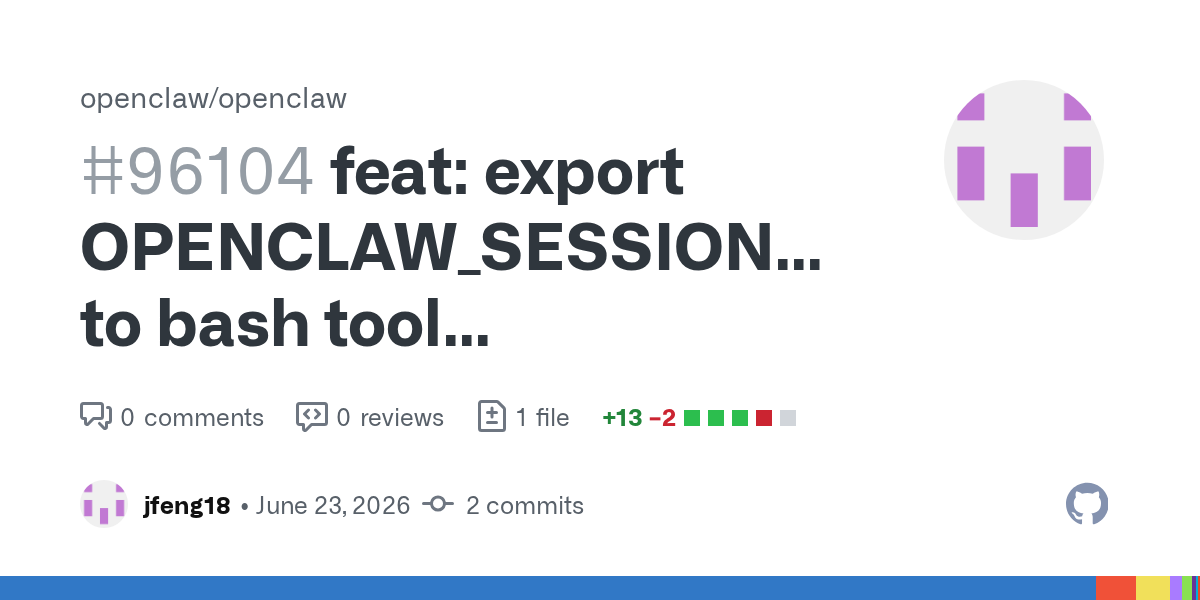
A single environment variable is not usually a headline. In an agent runtime, it can be the difference between “some shell process did something” and “session X, acting on request Y, spawned this command at this time.” OpenClaw PR #96104 adds OPENCLAW_SESSION_ID to bash tool subprocess environments, and the change is small enough to fit in a routine diff: 13 additions, 2 deletions, one file touched. The operational meaning is bigger. Agent-spawned commands are becoming auditable work units, not anonymous debris in a process tree.
The PR was opened June 23 and closes feature request #96101, filed minutes earlier. It modifies src/agents/agent-tools.ts, imports ToolsOptions, and passes createCodingTools(codingRoot, codingToolsOptions) when options.sessionId is present. The inserted BashSpawnHook sets ctx.env.OPENCLAW_SESSION_ID = options.sessionId! for child processes created by the bash tool. No new public interface is introduced. Validation is intentionally boring: tsc --noEmit with zero errors.
The contributor’s rationale is the real story. Claude Code already exports CLAUDE_CODE_SESSION_ID to child processes in v2.1.132 and later. OpenClaw is adopting the same pattern. That is not copycat trivia; it is a signal that coding-agent runtimes are converging on process-level provenance as table stakes. If agents are allowed to run commands, observability cannot stop at the chat transcript.
The shell is where agent accountability gets real
Most teams start auditing coding agents at the wrong layer. They save prompts. They log tool calls. They maybe capture model usage. Those are useful, but they are not sufficient once the agent can spawn arbitrary subprocesses. The operating system sees shells, package managers, compilers, test runners, curl calls, database clients, and sometimes long-running local services. Without a stable session identifier, external process monitors can tell you what executed, but not why it executed or which agent conversation caused it.
That missing “why” becomes painful during incidents. Which agent session ran curl against an internal endpoint? Which user request kicked off a CPU-heavy build? Which background delegation wrote to a sensitive path? Which session launched a process that outlived the conversation? If process telemetry cannot join back to agent session logs, the answer becomes forensic archaeology: correlate timestamps, parent PIDs, terminal names, working directories, and hope nothing overlapped. That is not an audit strategy. That is vibes with grep.
An environment variable is the right primitive precisely because it is boring. It works across languages and tools. It is visible to process-level collectors. On Linux-style systems, it can be inspected through /proc/<pid>/environ by suitably privileged monitoring agents. It does not require every observability vendor to integrate with OpenClaw’s internal session protocol. The agent runtime simply passes a correlation key into the execution environment, and the rest of the stack can decide how to use it.
Metadata, not authority
There is an important caveat: OPENCLAW_SESSION_ID should be treated as metadata, not a secret and not a capability. Environment variables can be inherited, copied, scrubbed, or spoofed by child processes. A malicious or confused subprocess can set its own value. Audit pipelines should therefore join the session id with process ancestry, runtime logs, working directory, executable path, user id, and timestamp windows. The variable gives you a correlation handle; it should not become the only proof of origin.
That caveat does not make the change less useful. It makes the implementation boundary clearer. The goal is not tamper-proof attestation. The goal is to make ordinary observability dramatically more useful. A process tree with OPENCLAW_SESSION_ID attached can be grouped by agent session, linked to tool-call traces, and compared against user-visible actions. That is enough to unlock dashboards and alerts that are impossible when every command looks like generic shell noise.
This also pairs neatly with OpenClaw PR #95770 from June 22, which added model-call prompt and usage telemetry at the span where model cost happens. Together, the two changes sketch the stack agent operators actually need: model-side attribution for tokens and latency, runtime-side attribution for tool calls, and OS-side attribution for spawned processes. Coding agents are hybrid systems. They think in model calls, act through tools, and leave evidence as processes. A serious observability story has to cover all three.
What operators should wire up next
If you operate OpenClaw in a shared workspace, CI-like environment, developer workstation fleet, or production-adjacent automation host, capture OPENCLAW_SESSION_ID in your process telemetry as soon as this lands in your version. Join it with OpenClaw session logs. Build views for commands per session, long-running subprocesses, network egress by session, filesystem writes by session, denied-path attempts, and resource consumption. If you already collect OpenTelemetry spans for model calls, add the session id as the bridge between model cost and local execution cost.
Security teams should also update their review questions. “Does the agent require approval before shell commands?” is necessary but incomplete. Ask whether approved commands can be traced after execution. Ask whether background agents and subagents preserve session identity. Ask whether a process spawned by an agent can be tied to the user-facing conversation that authorized it. Ask whether the audit trail survives restarts, compaction, and delegated work. Agent permissions without provenance are hard to defend after the fact.
The broader industry direction is clear. Agent platforms are learning that trust boundaries cannot live only inside the model runtime. They have to extend down into the operating system layer, because that is where real work happens and where incidents are investigated. OPENCLAW_SESSION_ID is a small patch with the right architectural instinct: make agent work carry its origin with it.
Sources: OpenClaw PR #96104, OpenClaw issue #96101, OpenClaw PR #95770, OpenTelemetry GenAI semantic conventions