OpenRouter OAuth in OpenClaw Is About Model Routing Without Another Secret-Handling Ritual

OpenRouter OAuth in OpenClaw sounds like a login convenience. It is more important than that, because provider authentication is becoming part of the agent control plane. The more an agent runtime depends on model routing, fallback chains, free-tier testing, media providers, and per-team billing profiles, the less acceptable it is for setup to mean “copy this long-lived key from a browser tab and hope it lands in the right env var.”
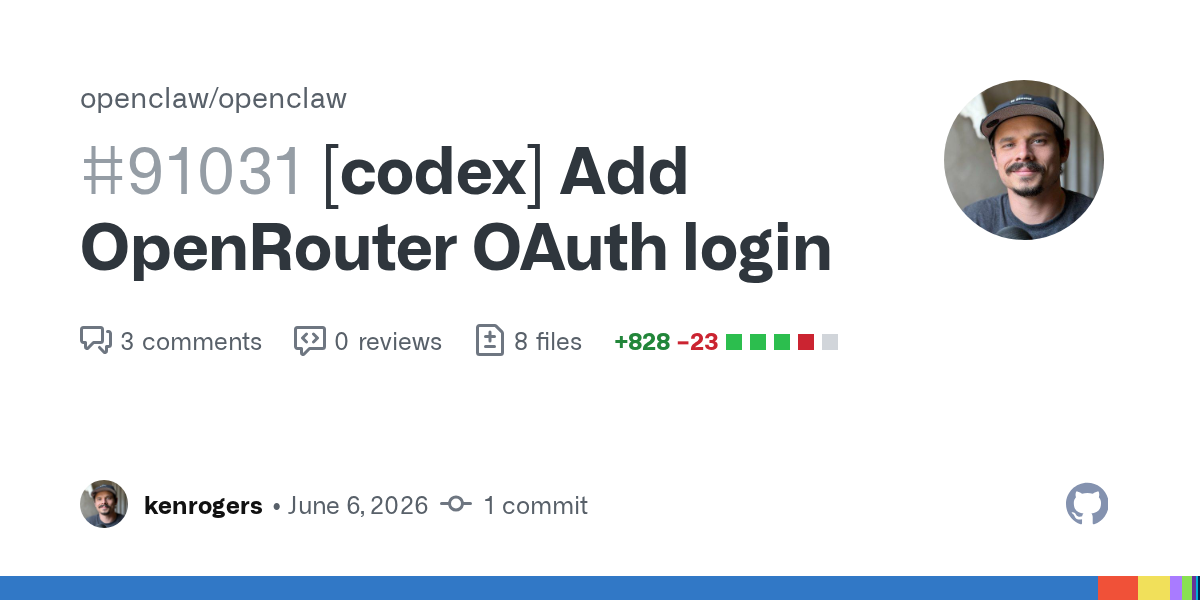
PR #91031, opened June 6 and updated with live proof shortly after midnight UTC on June 7, adds provider-owned OpenRouter PKCE OAuth login to OpenClaw. The flow exchanges the browser authorization code at OpenRouter's auth/keys endpoint and stores the issued credential as the existing openrouter:default API-key profile. That implementation detail is the whole story: OAuth is used as the onboarding and rotation path, while runtime inference continues to consume the credential through OpenClaw's existing provider profile machinery.
The PR is not tiny. It changes eight files with more than 800 additions, including extensions/openrouter/oauth.ts, OAuth tests, docs, manifest auth choices, runtime auth registration, and provider contract API coverage. The live proof is the part reviewers were right to demand. The author tested with an isolated OpenClaw home, Brave signed into OpenRouter, Node v24.14.1, and OPENROUTER_API_KEY explicitly unset. After OAuth, OpenClaw detected the stored openrouter:default profile and successfully ran openrouter/liquid/lfm-2.5-1.2b-instruct:free, returning the expected oauth-ok response.
Model routing is only useful if credentials are boring
OpenRouter sits in an increasingly important part of the agent stack: routing across many models behind one provider interface. That can be useful for cost control, model availability, experiments, and fallback behavior. It can also become an expensive mess if credentials, defaults, and allowed models are treated as personal setup trivia instead of operational state.
OAuth helps because it reduces one fragile step. Users no longer need to manually create a key, paste it into a shell, propagate it into the right config, and remember which profile owns which spend. But this is not magic security dust. The OAuth flow ultimately mints an API key. That means the resulting profile still needs redaction, provenance, rotation, and a clear explanation of what “OAuth” means in this context. Users may hear OAuth and assume refresh tokens, scopes, or revocable bearer sessions. Here, OpenRouter's browser flow produces a key that OpenClaw stores and uses like a normal OpenRouter API key.
That is not a criticism. It is probably the correct design. Creating a second runtime credential path just because the onboarding mechanism changed would add surface area for little benefit. By storing the issued key as openrouter:default, OpenClaw keeps inference boring. The provider auth layer handles login and rotation; the runtime model layer keeps using a credential shape it already understands. Good platform work often looks like declining to invent a new abstraction.
The cost-governance angle is where builders should pay attention. OpenRouter makes it easy to move between models. Easy movement is good when a provider is down or a cheaper model is good enough. Easy movement is dangerous when an unattended agent can fan out into expensive fallback paths, media routes, or subagent runs without a budget boundary. If your OpenClaw deployment uses OpenRouter, you should know which profile owns spend, which models are allowlisted, whether openrouter/auto is acceptable, and how usage is attributed when multiple agents share the same credential.
There is also a policy question hiding under the login button. Provider-owned OAuth shifts trust toward the provider's account flow. That is fine, but it means agent operators should treat provider profiles as managed resources, not developer conveniences. A profile should have an owner, a rotation path, an audit trail where possible, and an explicit relationship to model policy. If an agent can choose models dynamically, the credential is not just a secret; it is the budget and capability boundary.
The review process around the PR is a useful standard. ClawSweeper asked for proof quality, not just green tests. The author responded with redacted live evidence showing the browser flow, credential storage, env-var independence, and successful inference. That is what auth changes need. Unit tests prove state handling. Live proof proves the provider still behaves the way the code assumes it behaves.
For teams building on OpenClaw, the practical move is simple: welcome OAuth because it removes a common setup failure, but do not confuse easier login with complete governance. Pair it with explicit provider profiles, model allowlists, spending alerts, and rotation habits. If OpenRouter is your escape hatch for model availability, make sure it does not also become your unbounded spend path.
The larger trend is clear. Agent platforms are no longer just prompt routers with a few tools attached. They are credential brokers, provider routers, budget surfaces, and policy engines. OpenClaw adding OpenRouter OAuth is a small piece of that transition, but it points in the right direction: make provider auth boring enough that model routing can be governed instead of improvised.
Sources: OpenClaw PR #91031, OpenClaw OpenRouter docs, OpenClaw model provider docs, Qwen Code OpenRouter auth notes