Ox Alpha Is Nearly No. 1—and That Says More About Incentives Than Intelligence

The fastest way to move an AI leaderboard may not be to build the best model. It may be to remove the price tag, hand developers a million-token context window, and decline to say who you are.
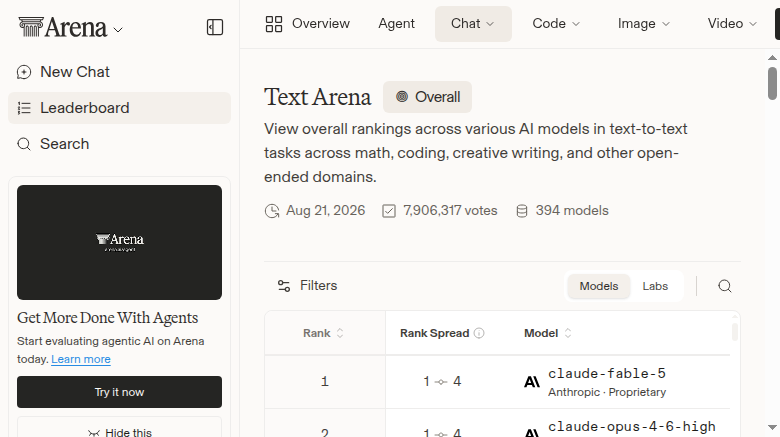
That is the uncomfortable lesson from this week’s OpenRouter rankings. Ox Alpha, a third-party “stealth” model that appeared only days ago, jumped from fourth to second place and processed 11.6 trillion tokens in the trailing week. It is now effectively level with DeepSeek V4 Flash 0731, ahead of Xiaomi’s MiMo-V2.5, and moving more tokens than every named premium model on the chart. Meanwhile, Arena AI’s human-preference leaderboard did not move at all: Anthropic models still occupy six of its top seven positions.
Those results are not contradictory. They are two measurements of two different products. Arena asks which answer a person prefers in a paired comparison. OpenRouter counts prompt and completion tokens developers route after price, latency, context limits, promotions, defaults, and available capacity have entered the decision. One approximates perceived capability. The other captures deployment behavior—with some large caveats.
OpenRouter explicitly says token volume is not a measure of accuracy, unique users, request count, or spend. Its rankings use trailing daily, weekly, or monthly UTC windows, exclude private requests, and separate free variants. Tokenizers and response verbosity also vary between models. A verbose model can register more tokens for the same number of tasks, while a provider with substantial first-party traffic can look artificially small on a third-party router.
Eleven trillion tokens bought attention, not trust
Ox Alpha’s acceleration is nevertheless extraordinary. Its weekly total rose from 6.54 trillion tokens in the previous snapshot to 11.6 trillion, reportedly helped by OpenCode advertising roughly a week of free access and claiming the provider could serve 100 trillion tokens per day. Stripe CEO Patrick Collison called the model “very impressive.” Developers have since tried to fingerprint its output and tokenizer against GLM, MiMo, MiniMax, Qwen, and Microsoft’s MAI family. No attribution theory has graduated from speculation.
That mystery is fun for model watchers and a hard stop for production security. OpenRouter’s model page says the anonymous provider retains prompts and completions, though not for training. Without knowing the processor’s identity, a company cannot conduct meaningful vendor review, negotiate a data-processing agreement, validate residency, assess subprocessors, or plan breach notification. “Not used for training” answers only one narrow question about data handling.
The million-token context window makes that risk sharper. Long context encourages exactly the inputs teams should be most reluctant to disclose: full repositories, incident timelines, contracts, internal wikis, customer-support histories, and production logs. Ox Alpha should be treated like an untrusted public pastebin with unusually good autocomplete. Public code, synthetic fixtures, and deliberately scrubbed evaluation data are reasonable. Secrets, proprietary source, customer records, regulated data, credentials, and live incident evidence are not.
This is the first important practitioner takeaway: a model can pass a capability benchmark and still fail procurement before the first production request. Evaluations need a policy gate alongside a quality gate. If an endpoint cannot identify the legal entity processing the data, the routing layer should block sensitive traffic automatically rather than relying on every developer to remember a warning buried on a model page.
Subsidies are becoming a model feature
Ox Alpha is the loudest example, but not the only evidence that distribution economics now shape model adoption. Xiaomi’s MiMo-V2.5 slipped from second to third only because Ox Alpha passed it; its own usage reached 9.94 trillion tokens, up 162% week over week. Xiaomi released V2.5 and V2.5 Pro weights under the MIT license, provided day-zero vLLM and SGLang support, offered a one-million-token context window, and paired the release with a 100-trillion-token developer incentive program.
That package matters more than a benchmark table alone. Permissive weights reduce lock-in, immediate serving-framework support cuts integration work, long context expands the set of plausible workloads, and subsidized inference lowers the cost of discovering failure modes. Xiaomi is not merely marketing a model; it is paying down four sources of adoption friction at once.
Google is running a more conventional version of the same play. Gemini 3.7 Flash climbed three places to tenth with 1.8 trillion weekly tokens and 340% growth. Its introductory pricing through year-end is $0.75 per million input tokens and $3.75 per million output tokens. Google also reports material coding gains over 3.6 Flash: 65.3% versus 49.0% on DeepSWE v1.1, 43.6% versus 34.4% on FrontierCode 1.1 Main, and a WebDev Arena Elo of 1588 versus 1538.
The migration signal is unusually clean. Gemini 3.7 Flash is already processing 76% more OpenRouter tokens than 3.6 Flash, which fell from fourteenth to seventeenth. This looks less like broad growth across the Gemini family than rapid substitution toward a release that is both stronger on coding tasks and temporarily cheaper.
Claude Opus 5 demonstrates the other side. It dropped four places to thirteenth even as its volume grew 45% to 1.46 trillion tokens. Anthropic describes it as approaching Fable capability at half Fable’s price and says it more than doubles Opus 4.8 on Frontier-Bench at a lower cost per task. Yet strong capability did not stop cheaper and subsidized models from outrunning it on raw volume.
That does not mean Opus is losing where it matters. A premium model can be economical when it solves an ambiguous root-cause analysis in one attempt while a cheaper model burns five retries, triggers unnecessary tools, or produces a plausible failure that escapes automated checks. Conversely, paying premium rates for high-volume extraction, schema transformation, routine test generation, and speculative agent branches is difficult to justify when errors are detectable and reversible.
Route tasks, not brand loyalty
Teams should respond by building a routing evaluation from their own work. Assemble a compact suite containing representative bug fixes, tool-call sequences, long-context retrieval, structured extraction, and recovery from failed actions. Measure task success, p95 latency, tokens consumed, retry count, human review time, and total cost per completed task. Cost per million tokens is an input to that calculation, not the result.
Then split workloads by consequence. Use lower-cost models where outputs can be validated with schemas, tests, diffs, or deterministic checks. Escalate ambiguous work and stubborn failures to premium models. Add explicit data-classification rules so experimental endpoints never receive protected inputs. Finally, rerun the suite when an introductory price or free preview ends. A routing decision built on subsidized inference has an expiration date even when the API name does not change.
The broader lesson is that “best model” has become a badly underspecified question. Best for a blind preference vote, best for a million daily transformations, best under a security review, and best after the promotion expires may be four different models. Trying to compress those dimensions into one magic score hides the decision engineers actually need to make.
Ox Alpha has not proved that anonymous providers are the future. It has proved developers will route astonishing amounts of work toward capable free infrastructure before the provider supplies the paperwork required for real production use. Benchmark it if the data is safe. Do not trust it with anything you cannot publish. And build a routing system that survives the morning the subsidy—and the leaderboard position—disappears.
Sources: OpenRouter Rankings, Ox Alpha model page, Xiaomi MiMo-V2.5 announcement, Google Gemini 3.7 Flash announcement, Anthropic Claude Opus 5 announcement, The Next Web