Ox Alpha’s 23-Trillion-Token Week Is a Privacy Stress Test

Twenty-three trillion tokens can look like a coronation if you squint at the leaderboard and ignore everything that makes production AI difficult. Ox Alpha, an anonymous model offered free through OpenRouter, processed 23.2 trillion prompt and completion tokens in the trailing seven-day window. That is exactly twice the volume of second-place DeepSeek V4 Flash 0731, and 5.7 trillion more tokens than Ox Alpha showed in the previous daily snapshot.
The tempting conclusion is that the market found its new favorite model. The more useful conclusion is that developers found a free, reportedly capable model with a million-token context behind an API they already use. Those are very different findings. One says something about quality; the other says something about distribution, pricing, curiosity, and how quickly repository-scale agents can eat tokens.
OpenRouter is unusually explicit about the distinction. Its rankings aggregate prompt and completion tokens into UTC daily buckets, excluding requests that users or applications mark private. They do not measure accuracy, reasoning quality, unique users, request count, revenue, or successful task completion. Tokenization and verbosity also vary by model, so two systems can perform the same job while producing very different leaderboard footprints.
Free distribution is doing exactly what free distribution does
Ox Alpha's displayed weekly total jumped from 17.5 trillion to 23.2 trillion tokens between daily snapshots, a 32.6% increase in the rolling figure. OpenRouter describes it as a reasoning model for coding, sustained agentic work, and production workloads, developed and operated by an anonymous third party. TechCrunch reported that the free preview launched on August 20 and cited Stripe CEO Patrick Collison calling it “very impressive.”
There is no mystery in the adoption mechanics. Remove the per-token price, advertise a large context window, make the endpoint compatible with an existing routing layer, and give developers a new model to probe. Coding agents then supply the multiplier: a single run may ingest a repository, generate a plan, call tools, read results, revise code, and retry. A million-token context is not merely a feature in that loop; it is a mechanism for producing enormous token totals.
That makes Ox Alpha's lead meaningful, but not in the way a benchmark trophy is meaningful. It demonstrates that the friction between model discovery and massive consumption has become almost negligible. An unknown provider can go from zero to a 23.2-trillion-token week because the distribution, billing, and API integration already exist. The model supplies capability; the router supplies instant reach.
The rest of the chart reinforces the point. DeepSeek V4 Flash 0731 sits second at 11.6 trillion tokens, Xiaomi's MiMo-V2.5 is third at 9.92 trillion, and Tencent's Hy3 follows at 7.16 trillion. Nvidia's free Nemotron 3 Ultra reached 5.4 trillion. Gemini 3.7 Flash climbed from 2.02 trillion to 2.58 trillion in the observed total, while GPT-5.6 Sol rose from 1.40 trillion to 1.51 trillion. These are useful measures of traffic, but every number blends demand with price, context length, output style, integration placement, and whatever workloads happened to be routed that week.
The leaderboard's missing column is trust
Ox Alpha is a rational model to evaluate. It is not rational to treat availability through OpenRouter as a completed security review. A routing relationship does not identify the operator, establish a data-processing agreement, disclose subprocessors, specify retention periods, document training use, or provide the incident-response commitments that a production vendor review normally requires.
That gap is especially important because the model is positioned for coding and sustained agentic work. Those workloads routinely expose more than a carefully composed chat prompt: proprietary source, credentials accidentally committed to history, customer identifiers in logs, internal hostnames, incident reports, architectural diagrams, and unreleased product plans. The model's long context increases its usefulness and expands the blast radius of a careless request at the same time.
Community reaction has centered on precisely this trade. A Hacker News discussion had 263 points when the research snapshot was taken, with practitioners asking who receives the prompt-and-response pairs and what economic objective a free anonymous preview serves. A Reddit review reported an unofficial 80% result on a DeepSWE subset, but that number lacks an audited harness, clearly established sampling, and reproducibility details. It is a lead for further testing, not a procurement artifact.
The first original lesson for engineering leaders is that model gateways now need data policy, not merely routing policy. An allowlist should encode which providers may receive which classifications of data. A request containing secrets, customer records, private repositories, or incident material should be blocked or redirected before it reaches an experimental endpoint. Expecting every developer to remember a fast-changing matrix of provider identity, preview terms, and retention rules is not governance; it is wishful thinking with an API key.
Build an experimental lane that survives the preview
Teams should test Ox Alpha with synthetic tasks, public repositories, scrubbed traces, and a canary suite drawn from real work without real secrets. Record exact prompts and outputs along with latency, tool-call validity, retries, failure modes, accepted-code rate, and wall-clock time. Compare those results against the models already in production, using the same harness and task definitions.
Do not optimize around today's zero-dollar price. Estimate what the workflow costs if preview pricing disappears, and include the cost of retries, longer outputs, human review, and failed agent runs. A verbose free model can dominate token share while completing fewer useful tasks per engineer-hour. When pricing arrives, that inefficiency stops being an academic concern.
The second original lesson is that accepted work is a better unit than tokens for agentic systems. For coding, measure patches that pass tests and survive review. For support, measure correctly resolved cases without escalation. For research, measure claims that remain supported after citation checks. Tokens are an infrastructure input; treating them as an outcome is like ranking databases by bytes read without asking whether the query returned the right answer.
The third is organizational: preserve portability while the provider is unknown. Keep prompts, tool schemas, evaluation cases, and policy checks outside any model-specific wrapper. Capture enough telemetry to replay failed tasks against Claude, GPT, Gemini, DeepSeek, or a self-hosted alternative. If Ox Alpha's operator is revealed, its terms change, or the endpoint disappears, the evaluation investment should remain useful.
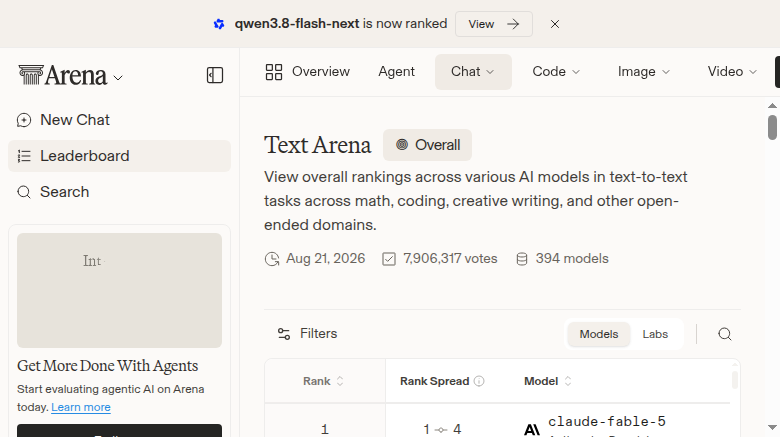
A second leaderboard offers a clean control. Arena AI's text top 20 did not change rank: Claude Fable 5 remained first at 1508 Elo, followed by Claude Opus 4.6 High at 1504 and Claude Opus 4.7 High at 1502. Ox Alpha was not in the observed top 20. That is not proof that Ox Alpha is worse. Arena asks which outputs people prefer in blind comparisons; OpenRouter asks which models processed the most routed tokens. Production teams need a third answer: which model completes their workload reliably under their security, latency, and cost constraints.
Even the bottom of OpenRouter's list shows how unstable the usage race can be. GLM 5.3 entered at number 20 with 803 billion tokens and reported growth above 999%, displacing Gemini 2.5 Flash Lite, which had 730 billion tokens in the prior snapshot. The admission threshold moved in a day. That churn is useful for spotting where experimentation is flowing, but it should make anyone cautious about translating rank into durable market position.
Ox Alpha has earned attention. Processing 23.2 trillion tokens in a week is a distribution achievement and a strong signal that developers find enough capability to keep sending work. It has not earned an exemption from ordinary engineering diligence. Test it aggressively, measure completed work, isolate sensitive data, and keep an exit path.
The market did not crown an anonymous model this week. It proved that “free, capable, and one API call away” can manufacture extraordinary momentum before trust catches up. The first prompt in any serious Ox Alpha evaluation should therefore be a threat model—not the company repository.
Sources: OpenRouter LLM Rankings, OpenRouter Ox Alpha listing, Arena AI Text Leaderboard, TechCrunch, Hacker News discussion, Reddit practitioner review