Phoenix 15.7.0 Shows Agent Evaluation’s Two Hard Problems: Feedback and Injection Bugs

Phoenix 15.7.0 is the kind of release that explains the agent-evaluation market better than a dozen framework comparison posts. On one side, Arize added richer feedback loops: trace-level user feedback annotations, expandable session-turn messages, and session-tagged identifiers for open and axial coding workflows. On the other side, it fixed a prompt-template injection bug that could disclose server environment variables through the applyChatTemplate GraphQL endpoint. That is the category in miniature: better ways to judge agent behavior, sitting on top of plumbing that must be hardened like any other web application.
The product additions are useful. Trace-level user_feedback gives teams a more honest unit for judging agent quality than final-answer correctness alone. A run can fail for reasons that do not fit a single output cell: the agent chose the wrong tool, took an inefficient path, retrieved stale context, ignored a user constraint, hallucinated a source, or produced something technically correct but operationally useless. Positive/negative trace feedback gives teams a signal attached to the whole execution, not just the final message.
PR #13099 implements that feedback path with positive and negative labels, fixed scores, per-user upsert/delete behavior, GraphQL mutations, REST endpoints, seeded categorical annotation configuration when absent, and reserved semantics around user_feedback trace writes. The upsert/delete behavior is not a footnote. Feedback systems become garbage fast when every accidental click or revised judgment is treated as permanent truth. People change their minds after reading the trace. The data model needs to allow that.
Evaluation is becoming qualitative infrastructure
The open and axial coding work in PR #13083 points in the same direction. Open coding stores free-form observations as notes. Axial coding stores structured category labels as annotations. Both share a caller-supplied coding identifier so runs are queryable, reversible, and visible inside Phoenix. That sounds academic until you have debugged enough agent failures. The first pass is almost always qualitative: “planner over-delegated,” “retrieval picked stale docs,” “approval gate fired too late,” “tool arguments were correct but the wrong account was selected.” Eventually those notes need structure. Otherwise the evaluation program becomes a spreadsheet graveyard next to the actual traces.
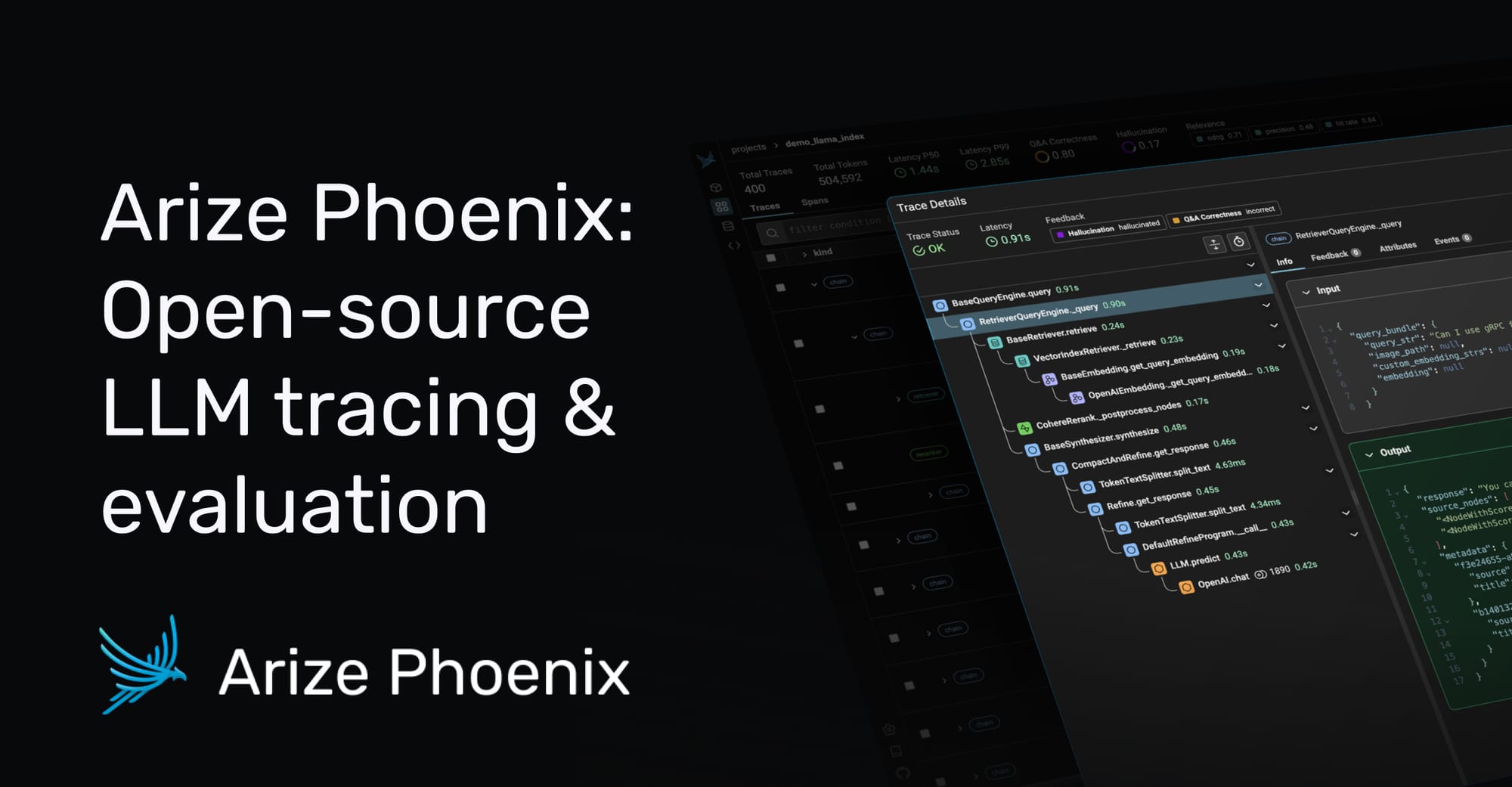
Phoenix’s docs already position tracing around spans that show how agents, tasks, and tools executed, with integrations for CrewAI and OpenInference instrumentation. Its evaluation docs cover accuracy, groundedness, safety, relevance, deterministic evaluators, LLM-as-judge, structured output via tool calling, and support across OpenAI, LiteLLM, LangChain, AI SDK, and more. The interesting shift is that evaluation is moving closer to runtime evidence. It is not enough to run a judge over a sample output. Teams need feedback, annotations, sessions, evaluator traces, and category labels attached to the same execution record operators use for debugging.
That is the right model because agent quality is not a scalar. A single “pass” score can hide whether the issue was planning, retrieval, model reasoning, tool invocation, UI handoff, latency, or policy. Trace-linked feedback lets teams ask better questions: Which categories of failures cluster around a model upgrade? Did the new retrieval pipeline reduce groundedness complaints but increase latency complaints? Are users downvoting runs where the model is technically correct but too eager to call tools? Those are product and engineering questions. They require telemetry that looks more like qualitative research joined with distributed tracing than a benchmark leaderboard.
The template bug is the warning label
The security fix deserves equal billing because it is exactly the kind of bug AI platforms are prone to normalize. PR #13197 fixes FStringTemplateFormatter, which rendered templates with Python’s str.format(). The PR describes traversal paths such as {x.attr} and {x[key]}, including a route from a user-supplied variable through __class__ to __init__.__globals__ and then os.environ, exposing server environment variables and secrets through applyChatTemplate.
That is not “prompt injection” in the fashionable sense. It is old-fashioned injection through template rendering, wrapped in AI product clothing. And it is a good reminder that prompts, chat templates, eval rubrics, and message renderers are executable-adjacent surfaces. If untrusted input can influence a template, and that template renderer can traverse object attributes or indexes, the system is not doing harmless string substitution. It is giving the attacker a reflection API into whatever objects the renderer can reach.
The fix adds a _SafeFStringFormatter that resolves only simple identifiers from a pre-sanitized mapping, keeps braces escaped, rejects invalid field names, and adds regression tests for dunder traversal and secret leakage. That is the boring correct answer. Do not pass rich objects into user-controlled templates. Do not allow attribute traversal. Do not assume a template endpoint is safe because it “only formats prompts.” The entire last decade of web security is standing behind you, tapping the sign.
The lesson for practitioners is broader than Phoenix. Agent platforms are full of formatting layers: prompt templates, tool schemas, chat templates, synthetic-data generators, eval prompts, guardrail messages, and UI renderers. Some of those layers are influenced by users. Some are influenced by models. Some are influenced by external datasets. If any of them use a powerful formatter against rich server-side objects, you should assume they are security-sensitive until proven otherwise.
Builders should audit three things immediately. First, where do users, datasets, or model outputs influence templates? Second, do template renderers operate only on sanitized plain dictionaries, or can they access object attributes, globals, environment variables, request objects, clients, or other rich state? Third, is human feedback attached to trace and session IDs strongly enough to debug changes over time, or is it floating in a separate product analytics system with no connection to the runtime evidence?
Phoenix 15.7.0 also removes the v1 /chat route and associated code, adds expandable session-turn messages, improves UI toasts, and ships with a repo footprint around 9,648 stars, 865 forks, and 520 open issues at research time. The scale is large enough that both sides of the release matter. The feedback additions will help teams measure agents with more nuance. The template fix reminds them that the measurement infrastructure is itself production software.
That is the editorial read: agent evaluation needs richer human feedback loops, but the systems collecting those loops must be hardened with the same skepticism applied to any internet-facing app. AI does not repeal injection bugs. It gives them better branding and more places to hide.
Sources: Phoenix 15.7.0 release, PR #13099, PR #13197, PR #13083, Phoenix tracing docs, Phoenix evaluation docs, OpenTelemetry GenAI semantic conventions