Rack-Scale AI Needs a Scheduler That Understands the Rack

The quiet problem with rack-scale AI is that the rack stopped being furniture.
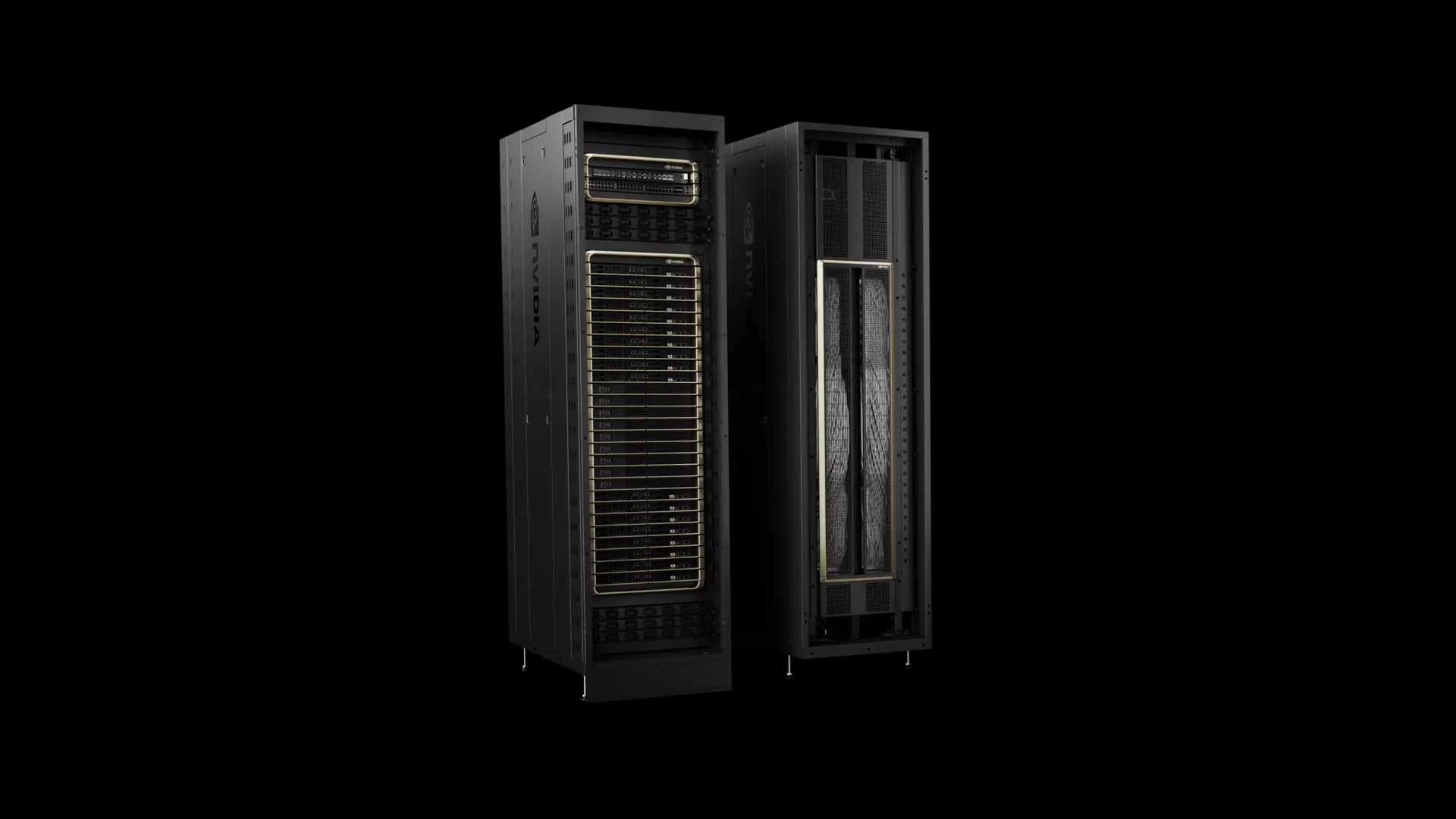
NVIDIA’s GB200 NVL72 is sold as a single rack-scale AI system: 36 Grace CPUs and 72 Blackwell GPUs tied together by a 72-GPU NVLink domain with 130 TB/s of aggregate NVLink bandwidth. That makes for a beautiful slide. It also creates a blunt operational constraint: inside the rack, each GPU can see 1.8 TB/s of bidirectional NVLink throughput; outside that domain, traffic typically falls back to about 50 GB/s, or 400 Gb/s, over InfiniBand or Ethernet. That is not a small penalty. That is the difference between scheduling a job on the machine you bought and scheduling it on a very expensive disappointment.
NVIDIA’s new guidance for Slurm block scheduling is worth reading because it treats this as a scheduler problem, not a motivational poster about “AI factories.” The company is pushing Slurm’s topology/block plugin, introduced in Slurm 23.11 through NVIDIA and SchedMD work, as the mechanism for making NVLink domains visible to the workload manager. Instead of letting the scheduler see a pile of nodes and a generic fabric, administrators define each GB200 NVL72 domain as a block: 18 nodes per rack, four GPUs per node, with one node as the minimum schedulable unit.
That sounds like plumbing because it is. It is also the sort of plumbing that decides whether a Blackwell cluster behaves like a coherent accelerator system or like a lottery.
The scheduler now needs to understand the model recipe
The key feature is Slurm’s --segment argument. Without segmentation, a 16-node job waits for 16 idle nodes inside one NVLink domain. That preserves locality, but it can also strand capacity and inflate queue times. With --segment=4, a 12-node job can be split across three blocks if the workload only needs four-node communication islands. That is a better interface between model parallelism and cluster operations than the old “give me N nodes” API.
This matters because not all distributed AI traffic is the same. Tensor parallelism, pipeline parallelism, data parallelism, and mixture-of-experts routing stress the fabric differently. NVIDIA explicitly calls out tensor parallelism as a case that may work with smaller tight segments, while expert parallelism can need larger segment sizes to keep all-to-all collective operations inside one NVLink domain. The scheduler does not need to know your model architecture in detail, but the job request now has to communicate the locality contract the architecture depends on.
That is the practitioner takeaway: if your team is moving onto GB200 NVL72-class systems, “number of GPUs” is no longer a complete resource request. You need workload profiles. A training recipe should say which parallelism dimensions are latency-sensitive, which collectives cross model shards, and what the smallest acceptable NVLink island is. If you cannot answer that, you are leaving performance to defaults written for less asymmetric machines.
There is a governance problem hiding here too. If users discover --segment and every team starts requesting --segment=18 because “full rack locality” sounds safer, utilization will rot. NVIDIA’s own example of a cli_filter/lua rule that rejects --segment=18 is more than a cute admin trick. It is a warning that topology-aware scheduling turns performance tuning into policy. The successful GB200 shops will publish recipes, set sane defaults, and enforce guardrails. The unsuccessful ones will let every job ask for the moon and then wonder why the queue looks like a procurement committee.
SchedMD ownership makes this more strategic
The Slurm roadmap details are also notable. Slurm 25.05 adds topology.yaml, incomplete block declarations, spare-node support, and the ability to use multiple topology plugins by partition. Slurm 25.11 adds --consolidate-segments and --spread-segments, giving users more control over whether segments are packed or distributed. NVIDIA also recommends enabling SwitchType=switch/nvidia_imex, introduced in Slurm 24.05, so Slurm can allocate NVIDIA IMEX channels per job and provide driver-level isolation inside shared multi-node NVLink domains.
Read that again: topology, placement, isolation, and job-level policy are all being taught about NVIDIA’s rack-scale architecture. That is the upside of NVIDIA owning SchedMD. Slurm is getting first-class semantics for the shape of the hardware NVIDIA is selling. For NVIDIA customers, that is probably good news in the near term. For the rest of the ecosystem, the question is whether these abstractions stay vendor-neutral enough for AMD, Intel, and future accelerator fabrics to benefit instead of becoming CUDA-shaped by default.
That concern should not distract from the immediate engineering point. Rack-scale systems need rack-scale scheduling. The performance cliff between intra-rack NVLink and inter-rack fabric is large enough that best-effort topology awareness is not enough. Slurm’s older topology/tree model tries to minimize switch span, but it can fragment jobs to start sooner. That trade-off is reasonable for many InfiniBand clusters. It is dangerous when crossing a boundary turns a 1.8 TB/s communication path into a 50 GB/s one.
For operators, the near-term checklist is straightforward. Model each NVL72 domain as a block. Make --segment part of the workload onboarding process. Teach users that smaller segments are not “worse” if their communication pattern supports them. Use admin-only flat partitions for troubleshooting. Enable IMEX integration for isolation. Then measure whether the declared locality actually matches observed performance, because model teams are very good at discovering new ways to surprise infrastructure.
The broader shift is that AI infrastructure is becoming less fungible. Cloud buyers used to ask for GPU type, count, memory, and maybe network tier. On GB200 NVL72, placement semantics become part of the product. If your scheduler cannot express the difference between “these four nodes must be close” and “these eighteen nodes must be one NVLink island,” the spec sheet is aspirational fiction.
NVIDIA’s post is not glamorous, but it is the kind of operational detail that determines whether the AI factory metaphor survives contact with production. A 72-GPU NVLink domain is only a coherent system if the scheduler treats it like one. Otherwise, congratulations: you bought the rack-scale future and ran it with yesterday’s placement logic.
Sources: NVIDIA Developer Blog, NVIDIA GB200 NVL72, Slurm topology documentation, NVIDIA IMEX guide