Robotics Foundation Models Just Got Their GPT-3 Moment — But the Hard Part Is Still the Hand

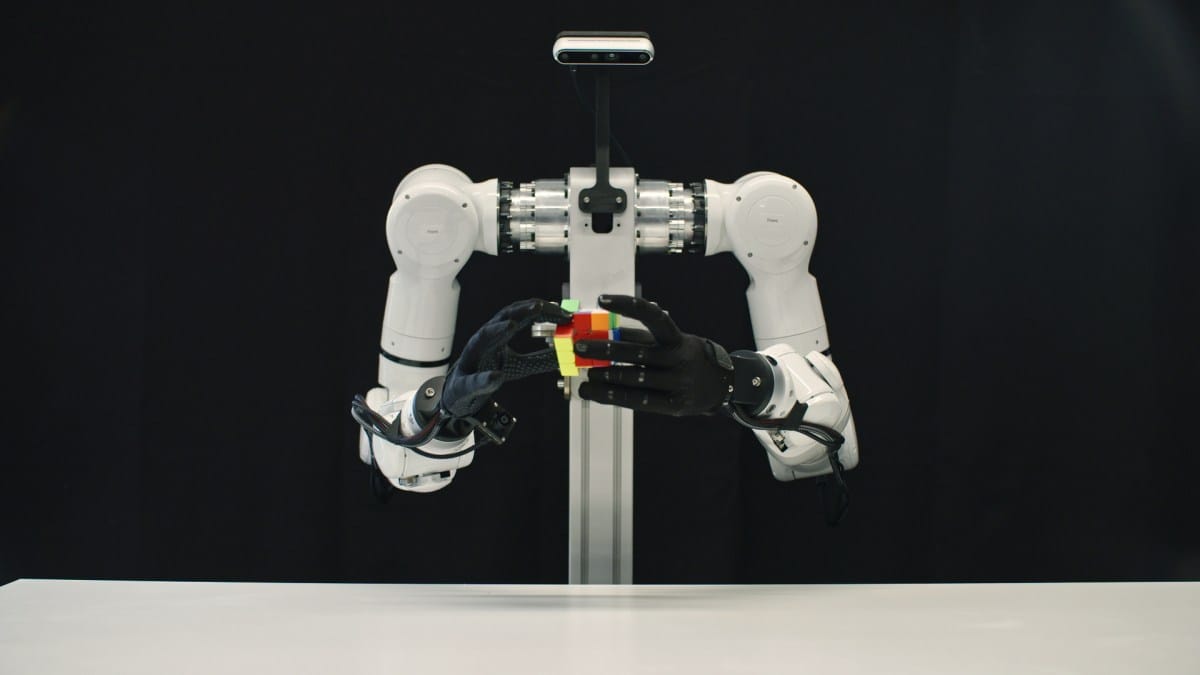
Robotics foundation models are finally hitting the awkward phase every serious AI category has to survive: the demos look good enough to make investors reach for adjectives, but the engineering details are still doing most of the work off camera. Genesis AI’s GENE-26.5 release is interesting precisely because it does not pretend otherwise. The company is selling a “robotic foundation model system,” and that last word is the part worth underlining.
The clean headline is that Genesis has shown a robot performing unusually dexterous manipulation tasks: cooking a 20-step meal, cracking an egg one-handed, slicing tomatoes, pipetting in a lab setup, loading a centrifuge, solving a Rubik’s Cube, handling wire harnesses, preparing smoothies, grasping multiple objects, and playing piano. Genesis says the real-world tasks run at 1× real-world speed using a single model with shared weights, with piano framed separately as a control-system demonstration. That is a meaningful claim in a field where many beautiful robot videos quietly depend on slow teleoperation, constrained setups, or a very patient editing timeline.
But the more important news is not the model alone. Genesis started as a model company and then, according to TechCrunch’s reporting, backed into a full-stack robotics company because manipulation does not separate cleanly into “AI brain” and “robot body.” The model, hand, glove, simulator, control stack, tactile sensors, proprioception, data pipeline, and evaluation loop are all part of the product. That is less convenient for a launch narrative, but much closer to how robotics actually works.
The hand is not a peripheral
Most AI model releases ask you to evaluate parameters, benchmarks, context windows, or price-per-token. GENE-26.5 asks a harder question: what if the hardware is part of the model architecture? Genesis built a proprietary dexterous hand and a sensor glove designed around a claimed 1:1:1 mapping between the human hand, the glove, and the robotic hand. The glove uses EMF-based finger tracking and dense tactile sensing; the company says it is 100× cheaper in hardware cost than typical options and can make data collection up to 5× more efficient than traditional teleoperation in internal testing.
That matters because robotics data is not internet text. You cannot scrape a trillion high-quality examples of “insert flexible wire harness into annoying real-world connector while the cable pushes back.” Demonstrations are expensive, embodied, slow, and tightly coupled to the robot that will eventually execute them. A glove that lets humans generate high-fidelity manipulation data during real work is not just an input device. It is a bet on the scaling law.
Genesis says it has collected more than 200,000 hours of data across modalities: glove data, robot data, egocentric human video, third-person internet video, language, proprioception, tactile sensing, and simulation. That mix is the serious part of the release. A model trained only on video learns what manipulation looks like. A model trained with tactile and proprioceptive signals has at least a chance of learning what manipulation feels like mechanically. The distinction is the difference between watching someone crack an egg and knowing how much pressure turns “crack” into “scramble.”
Simulation is the other scaling bottleneck
The second big systems claim is Genesis World, the company’s simulation platform. Genesis says it can simulate a Franka arm at 43 million frames per second on a single RTX 4090 — about 430,000× faster than real time — while supporting rigid bodies, MPM, SPH, FEM, PBD, stable fluids, ray-traced rendering, URDF/MJCF import, and multiple GPU backends. If that holds up under independent use, it is arguably more important than any single kitchen demo.
Robotics iteration is brutally constrained by evaluation throughput. In language models, you can run a benchmark suite overnight. In robotics, the benchmark suite can involve a physical arm, real objects, safety constraints, lab staff, calibration drift, and a gripper that decides today is the day it becomes a debugging project. Fast simulation does not replace reality — especially for contact-rich tasks where tiny material differences matter — but it can radically change how quickly teams search the policy space before paying the real-world tax.
The danger is the same one that has haunted robotics for years: a demo can be technically real and still operationally narrow. “Human-level manipulation” is a high bar. Genesis’s own technical framing is more careful than the launch language, focusing on axes like spatial precision, temporal composition, contact richness, contact coordination, and tool-mediated interaction. The press release goes much bigger, with “first AI brain” language that should trigger the usual allergy response in engineers. Keep the useful claim; discard the theater.
The data contract is part of the architecture
The unresolved issue is labor. TechCrunch pressed Genesis on whether workers wearing gloves and cameras to train future robots would be compensated. The answer was effectively that those details depend on customers and are not nailed down yet. That is not a side quest. If the scaling path for robotic foundation models depends on workers turning daily labor into training data, compensation, consent, data ownership, and workplace surveillance become part of the technical system.
Practitioners should treat this as a requirement, not a policy afterthought. A factory, lab, or kitchen collecting manipulation data through wearable sensors needs clear rules for what is recorded, who owns it, how it is anonymized, who benefits from derivative models, and how workers opt out. Otherwise the “foundation model” becomes another extraction layer on top of labor the industry would prefer to call data.
For robotics teams evaluating GENE-26.5 or anything like it, the checklist is straightforward. Ask where the supervision comes from. Ask how the embodiment gap is handled. Ask whether the same model weights run across the claimed tasks or whether each demo has hidden specialization. Ask what latency assumptions the control loop requires. Ask whether the simulator is used for training, evaluation, or both. Ask whether closed-loop results can be reproduced outside the vendor’s lab.
The practical takeaway is not that every team should copy Genesis’s humanoid-hand bet. It is that robotics model progress is becoming inseparable from data interfaces and evaluation infrastructure. If your robot’s sensors are weak, your teleoperation pipeline is unnatural, and your closed-loop evaluation is slow, a better transformer will not rescue you. The model can only learn the world your stack lets it observe.
That is why GENE-26.5 is worth watching despite the obvious demo skepticism. Genesis is not just saying “we trained a bigger policy.” It is arguing that manipulation requires a vertically integrated system where hand design, data capture, simulation, and model training co-evolve. That is expensive, messy, and much less scalable on a slide than “robot brain.” It is also probably correct.
Genesis has the funding to try: the company raised a $105 million seed round in 2025 co-led by Eclipse and Khosla Ventures, with backers including Bpifrance, HSG, Eric Schmidt, Xavier Niel, Daniela Rus, and Vladlen Koltun. TechCrunch reports the company is now around 60 people split across Paris, California, and London. The capital is there. The demos are there. The remaining question is whether Genesis can turn impressive manipulation into a repeatable developer platform instead of a portfolio of excellent videos.
My read: GENE-26.5 is less a GPT-3 moment for robots than a reminder that robotics may never get a pure GPT-3 moment. Text models scaled because the interface was already standardized: tokens in, tokens out. Robots do not get that luxury. The interface is fingers, torque, compliance, latency, friction, camera placement, human data rights, and a world that refuses to be tokenized cleanly. Genesis’s strongest claim is that it understands that. Now it has to prove the stack survives contact with customers.
Sources: TechCrunch, Genesis AI, PRNewswire, Genesis World GitHub, The Robot Report