Telnyx Realtime Voice Support Pushes OpenClaw Toward Provider-Neutral Agent Telephony

Voice agents are where orchestration abstractions stop being cute. Text chat can survive a retry, a two-second pause, or a slightly awkward handoff. Phone calls punish all of that immediately.
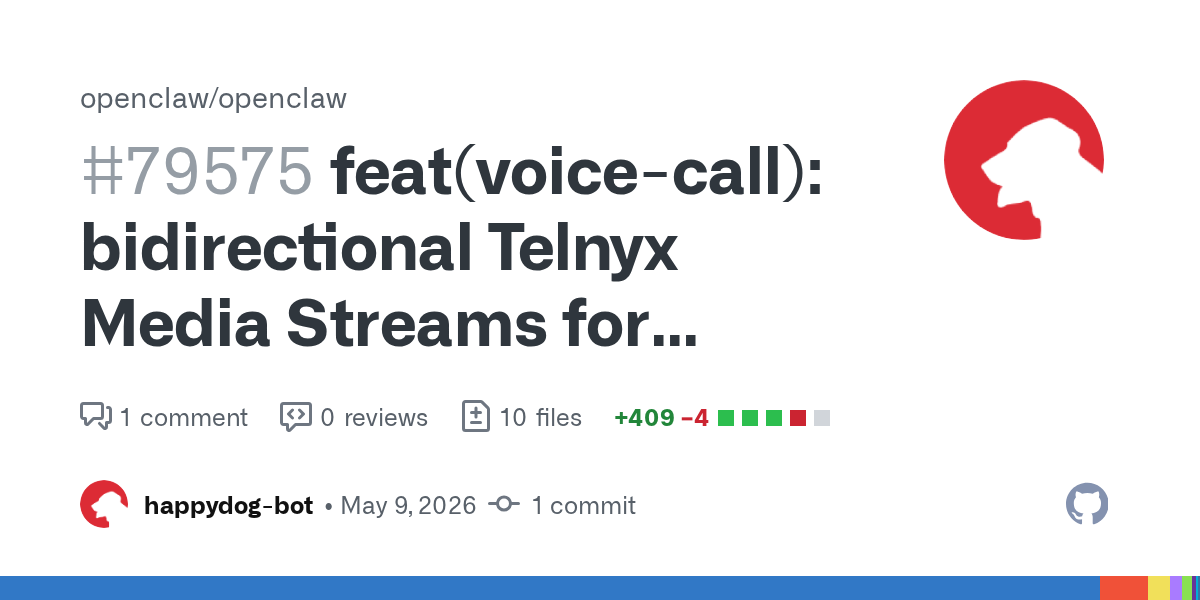
That is why OpenClaw PR #79575 is more interesting than “adds Telnyx support” sounds. The patch adds bidirectional Telnyx Media Streaming to OpenClaw’s realtime voice path, lifting a previous restriction where realtime.enabled: true only worked with provider: "twilio". The important move is that OpenClaw keeps the existing RealtimeCallHandler WebSocket bridge and adds provider-specific transport plumbing around it, rather than forking voice-agent logic per phone vendor.
That is the right abstraction. Twilio and Telnyx both provide media stream events with base64 audio and support concepts like media, stop, mark, and clear. But the details are different enough to hurt if the platform pretends they are identical. Telnyx uses stream_id and call_control_id where Twilio uses streamSid and callSid. Telnyx sends an initial connected frame before start. Starting and stopping streams goes through Telnyx Call Control commands like streaming_start and streaming_stop, not TwiML.
Provider-neutral does not mean provider-blind
The PR appears to thread that needle. OpenClaw validation now accepts provider: "twilio" or provider: "telnyx" when realtime is enabled. Runtime wiring adds setRealtimeStreamStarter, which fires on call.answered for non-TwiML realtime providers. A per-call dedup set prevents duplicate streaming_start calls when Telnyx emits two answered events. The Telnyx implementation defaults to stream_bidirectional_mode: "rtp" and stream_bidirectional_codec: "PCMU", while exposing codec and sampling-rate overrides for later L16 16 kHz paths.
The default codec choice is practical. PCMU 8 kHz mu-law lines up with OpenClaw’s existing audio pacer and classic telephony expectations. Telnyx recommends L16 16 kHz for AI integrations, and that may become the better quality path, but keeping the first integration aligned with the existing bridge reduces moving parts. In realtime voice, fewer moving parts is not boring. It is survival.
The validation story is also stronger than a typical integration PR. The PR lists pnpm test extensions/voice-call extensions/google with 21 test files and 206 tests passing, including six new tests, plus TypeScript project checks and formatting over all changed files. ClawSweeper reportedly says the PR includes live Telnyx runtime proof from a real inbound PSTN call showing stream startup, bridge startup, and an agent consult tool round-trip. That last part matters because voice-agent integrations often pass unit tests while failing in the messy handshake between carrier webhooks, WebSockets, audio pacing, and model sessions.
Telephony-grade latency needs telephony-grade hygiene
The review also surfaced the exact kind of security issue that separates a demo from an operator-safe integration: a sensitive realtime stream URL token was being logged. That is not a nit. Voice-agent paths combine authenticated WebSockets, call-control webhooks, phone numbers, transcripts, realtime model sessions, and tool calls. A bearer-ish stream URL in logs can become a media-plane credential. If your agent can answer calls and invoke tools, that credential deserves the same redaction discipline as API keys.
This is the broader lesson for builders. Voice is not just another channel. Slack and Telegram messages arrive as discrete events; a phone call is a live session with humans waiting in real time. Latency, interruption handling, audio codecs, stream authentication, and replay-safe logging all become product requirements. You cannot bolt voice onto an agent runtime by treating it as chat with a microphone.
The provider-neutral angle is still valuable. Twilio is the default many teams reach for, but Telnyx is common among teams that care about carrier control, programmable voice pricing, SIP/telephony flexibility, or specific call-control behavior. If OpenClaw can support both behind the same realtime handler, teams can evaluate phone providers without rewriting the agent layer. That is the kind of portability that matters: not pretending all vendors are the same, but isolating vendor differences at the edge.
There is also a model-provider implication. A realtime voice stack should be able to sit in front of Gemini Live, OpenAI Realtime, or other low-latency backends without forcing the phone provider and model provider into a fixed pair. PR #79575 pushes OpenClaw toward that shape. Phone provider at one boundary, realtime model provider at another, orchestration logic in the middle. That is how voice agents become infrastructure instead of one-off demos.
For practitioners, the checklist is straightforward. If you adopt this path, verify stream-token redaction, call dedup behavior, codec compatibility, audio pacing under interruption, and tool-call latency during a real PSTN session. Test both happy-path conversation and awkward human behavior: silence, barge-in, repeated “hello,” hangup during tool execution, and provider webhook retries. Voice users will find every race condition because they experience it as dead air.
The editorial take: Telnyx support is not interesting because OpenClaw gets another logo. It is interesting because provider-neutral realtime voice is becoming a real agent-platform capability. But the same patch also shows the cost of entering telephony: latency budgets get tighter, credentials move faster, and logging mistakes become live-call security bugs.
Sources: OpenClaw PR #79575, Telnyx Media Streaming docs, Twilio Media Streams docs, OpenAI Realtime docs