The LLM Leaderboard Is Stable. The Usage Market Is Not.

The useful LLM leaderboard story this week is not that a new champion walked onto the stage. It is that the stage barely moved while the loading dock behind it kept rearranging itself.
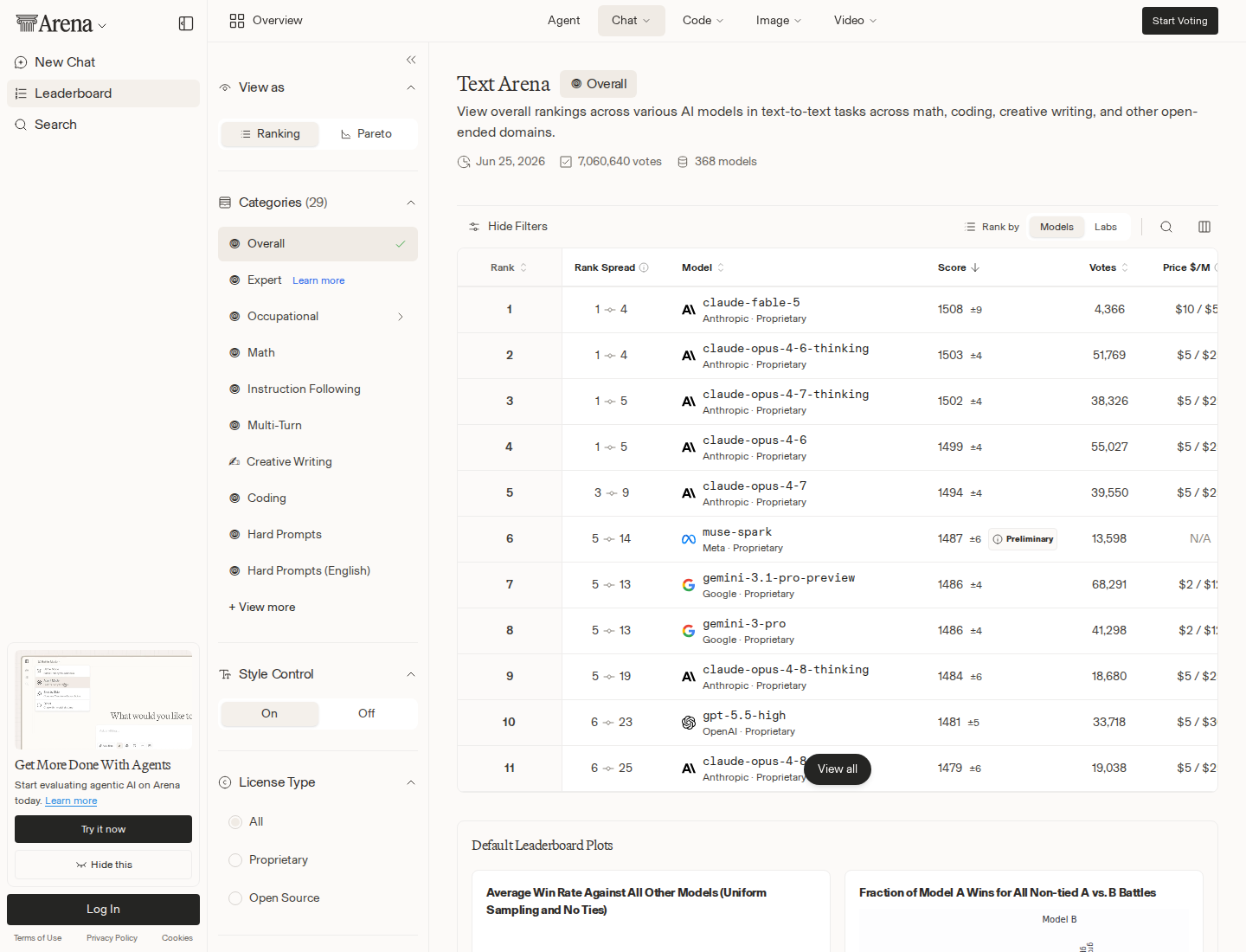
Arena's text leaderboard is stable at the top: Anthropic holds the first five slots with claude-fable-5 at 1508 Elo, claude-opus-4-6-thinking at 1503, claude-opus-4-7-thinking at 1502, claude-opus-4-6 at 1499, and claude-opus-4-7 at 1494. Arena WebDev tells a similar quality story, with claude-fable-5 leading at 1654 Elo and a heavy Anthropic cluster around it. If you only read judged leaderboards, the conclusion is simple: the high-end Claude family remains the model line to beat in preference-style evaluation.
OpenRouter's usage ranking says something more operationally interesting. The top five by weekly token volume are DeepSeek V4 Flash at 4.72 trillion tokens, MiMo-V2.5 at 4.38 trillion, MiniMax M3 at 3.68 trillion, Owl Alpha at 3.55 trillion, and Tencent's Hy3 preview at 3.46 trillion. Anthropic's highest usage entry, Claude Opus 4.7, sits at number six with 2.23 trillion weekly tokens. GPT-5.5 is number twelve at 1.10 trillion.
That gap is the whole story. The models winning controlled preference tests are not the same models absorbing the most routed production traffic. This is not a contradiction. It is the market becoming more honest.
The top of Arena is a prestige market
Arena is still valuable because it measures a kind of quality that teams care about: which answer humans prefer when models are compared head to head. Elo-style boards are especially useful when you are evaluating ambiguous work: planning, writing, code review, multi-step debugging, UX copy, or "make this less wrong" tasks where a cheap token is not always a good token.
The text board's Anthropic-heavy top ten is not subtle. Alongside the top five, claude-opus-4-8-thinking lands at number nine with 1484 Elo and claude-opus-4-8 at number eleven with 1479. OpenAI remains competitive but not dominant in this snapshot: gpt-5.5-high ranks tenth at 1481, gpt-5.4-high is twelfth at 1478, and gpt-5.2-chat-latest-20260210 is fourteenth at 1476. Google has gemini-3.1-pro-preview and gemini-3-pro tied at 1486 in seventh and eighth, plus gemini-3.5-flash at 1476 and gemini-3-flash at 1473.
For engineering teams, this says the frontier tier is compressing but not commoditized. The difference between 1508 and 1473 Elo is meaningful in a leaderboard context, but it is not the same thing as a universal procurement decision. A model that wins vague human preference prompts may be overkill for schema extraction, log summarization, support ticket tagging, or low-risk agent substeps. The practical mistake is treating the Arena top spot as a default model setting.
OpenRouter is where economics leaks into the ranking
OpenRouter's top twenty is noisy in the way production is noisy: price, latency, free tiers, routing defaults, context windows, availability, and app-specific behavior all show up as volume. That is exactly why it is useful.
This week's movement is concentrated in the lower half of the top twenty. Nvidia's Nemotron 3 Ultra (free) moved up one spot to number fourteen with 777 billion weekly tokens, up 34 percent week over week. Poolside's Laguna M.1 (free) jumped two spots to number fifteen with 679 billion tokens, up 24 percent. DeepSeek V3.2 fell two spots to number sixteen with 665 billion tokens, down 31 percent, while Gemini 2.5 Flash Lite slipped one spot to number seventeen with 613 billion tokens, down 10 percent. OpenAI's gpt-oss-120b entered the top twenty at number twenty with 422 billion tokens, up 12 percent.
The word "free" is doing real work there. Free models do not automatically become production winners, because serious applications still pay in latency, reliability, output quality, and downstream failure handling. But free tiers are excellent at finding elastic demand: prototypes, agent experiments, batch transforms, internal tools, and cost-sensitive workloads that would never justify a premium model on every step. When free or low-cost models climb a token-volume chart, the signal is not "best model." The signal is "developers found workloads where this is good enough to run a lot."
That is a different kind of moat from benchmark quality. A model can be slightly worse in judged output and still win huge deployment share if it is fast, cheap, permissive, easy to route, and stable under load. This is the same pattern databases, CDNs, queues, and observability tools have taught for years: production adoption often rewards boring operational fit over peak capability.
Do not choose a model. Choose a routing policy.
The actionable read for builders is to stop arguing about "the best model" as if one answer should cover the whole stack. The leaderboard split is telling you to separate model choice by task class.
Use the judged-quality leaders for high-ambiguity work: architecture critique, code review, customer-facing writing, incident analysis, and agent recovery paths where one bad step can waste a lot of time. Keep those calls visible in your traces and eval them against real examples from your product. For high-volume deterministic-ish work, test the usage-market winners: extraction, classification, summarization, rewrite passes, search query generation, candidate ranking, and speculative agent branches. If the task has a machine-checkable output or a cheap verification step, it probably should not default to your most expensive frontier model.
Teams should also treat public rankings as inputs, not governance. Arena can help you shortlist models for taste and reasoning. OpenRouter can help you notice what the broader developer market is actually running. Neither replaces an internal eval set built from your prompts, your failure modes, your latency budget, your compliance needs, and your willingness to retry.
A simple operating model works better than a religious debate: maintain a frontier lane, a workhorse lane, and an experimental lane. The frontier lane handles unclear or high-value tasks. The workhorse lane handles repeatable volume. The experimental lane gets capped traffic and earns promotion through measured wins, not vibes. Track cost per successful task, not cost per token, because cheap models that require retries may be more expensive than they look.
The new gpt-oss-120b entry at number twenty is worth watching through that lens. Its 422 billion weekly tokens are not enough to declare a market shift, but a top-twenty entry means developers are giving it real traffic. The useful question is not whether it beats Claude on Arena. The useful question is where an open-weight or open-flavored model changes the deployment calculus: local control, customization, data boundaries, fallback routing, and price pressure on hosted proprietary models.
My read: the leaderboard era has split into two markets, and pretending otherwise is now architectural debt. Arena tells you which models win judgment. OpenRouter tells you which models survive repeated use. The best engineering teams will buy both signals, then route around them with their own evals. Everyone else will keep updating a single DEFAULT_MODEL constant and calling it strategy.
Sources: Arena Leaderboard, Arena WebDev leaderboard, OpenRouter Rankings, OpenRouter weekly rankings API, OpenRouter model catalog API