Ultracode Shows the Difference Between a Native Agent Workflow and a Markdown Workflow

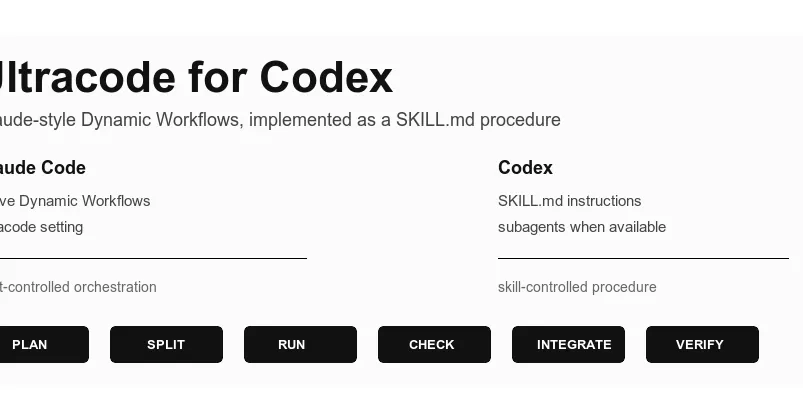
Ultracode is useful precisely because it does not pretend to be magic. It is a small skill that teaches Codex to behave more like a disciplined coding workflow, while admitting the uncomfortable part: a Markdown procedure is not the same thing as a native orchestration runtime.
The new Ultracode skill, introduced in a DEV Community post by PabloNAX, tries to bring the shape of Claude Code Dynamic Workflows into Codex. The workflow sequence is simple enough to write on a whiteboard: plan → split → run independent work → check results → integrate → verify. The important part is not the arrows. It is the refusal to let one confident agent stream blur planning, editing, review, and verification into a single polished answer.
Claude Code has made that workflow native. Codex, in this framing, can approximate the procedure with a skill and use subagents only when the host environment exposes them. That distinction is not pedantry. It is the whole story.
The real feature is evidence
The Ultracode article lays out the problem well. Small tasks do not need workflow ceremony. Fixing a typo, answering a narrow question, or editing one obvious file should stay direct. For larger work — repo-wide bug hunts, migrations, security audits, multi-system changes, or anything that benefits from independent verification — a normal chat loop gets mushy. The model has to plan, search, edit, justify, and verify while preserving the appearance of forward motion. That is how you get a beautiful final answer and no evidence that the dangerous parts happened.
Ultracode’s answer is to force mode selection. Direct mode handles small, clear edits with no workflow folder unless needed. Workflow mode creates local artifacts for non-trivial work: .workflow/ultracode/<run-slug>/plan.md, orchestration.md, state.json, packets/, results/, integration.md, and final-report.md. Delegated mode splits independent packets across native agents when the host supports that, while keeping integration in the parent session.
That artifact tree is more important than the branding. Plans can be inspected. Packets can be scoped. Results can disagree. Integration notes can say what changed and what risk remains. Verification output can be attached instead of merely asserted. If an agent run leaves behind only a triumphant paragraph, the reviewer has to trust the model’s narrative. If it leaves behind plans, packet results, and test output, the reviewer can do their actual job.
The repo’s README makes the same practical claims: define the goal and success criteria, decide between direct/workflow/delegated modes, create workflow artifacts for non-trivial work, use native agents only when useful and allowed, keep integration in the parent session, and verify before answering. It also says the quiet part correctly: “Ultracode Skill does not ship a background service, hidden runner, or required scripts.” The core file is SKILL.md. The host still owns the tools.
Native orchestration beats prompted orchestration
This is where teams need to stay honest. Claude Code Dynamic Workflows are a runtime feature. Claude Code can own workflow lifecycle, session state, effort settings, subagent orchestration, background work, verification loops, cancellation behavior, and integration with its own permission model. A Codex skill can instruct the model to create artifacts, spawn agents if possible, and verify output. It cannot guarantee isolation, scheduling, durable state recovery, file ownership, or consistent cancellation semantics by itself.
That does not make Ultracode useless. It makes it honest. Most teams are not one vendor feature away from sane agentic engineering. They are missing operating discipline: explicit success criteria, bounded packets, independent checks, human-readable state, final verification, and a parent session that owns integration instead of letting workers spray changes across a repo. A skill can help enforce that discipline culturally even when it cannot enforce it mechanically.
The operational boundary matters most when something goes wrong. A native workflow system can record which subagent ran, which workspace it touched, which permissions it had, whether it completed, and how to recover after interruption. A skill-mediated workflow may leave local Markdown and JSON artifacts, but it inherits the host’s actual lifecycle. If the host lacks durable subagent state, the skill cannot conjure it. If the host cannot enforce write scopes, the skill can only ask politely. If the host cannot cancel cleanly, the skill cannot make parallel work safe just by naming it delegated mode.
That is the practitioner lesson: use skills for procedure; use runtimes for guarantees. Confusing those two is how teams build a process that looks rigorous in a README and behaves like vibes under load.
The cost warning is not a footnote
Dynamic workflows cost more because they do more. The DEV post notes that Anthropic warns Dynamic Workflows can use much more than a normal Claude Code session and that the first workflow trigger asks for confirmation. Parallel agents multiply context, exploration, retries, and summarization. That is fine when the task deserves it. It is absurd when the task is a two-line fix.
The right default is not “always use Ultracode” or “never use parallel agents.” The right default is a decision gate. Is the task broad, risky, cross-cutting, or hard to verify? Use workflow mode. Can parts be independently researched or edited without stepping on each other? Delegate. Is the change tiny and obvious? Stay direct. Agent workflow maximalism is just enterprise process cosplay with a token bill.
Teams should make that gate explicit. For example: migrations touching more than five modules require a plan and final verification. Security audits require read-only explorer passes before any edits. Worker agents may only write files assigned in their packet. Parent sessions must run the final test suite or explain why they cannot. Every delegated run must leave a final report with what changed, what passed, and what remains uncertain. None of this requires buying into a specific repo. It requires deciding that “the agent said done” is not a verification strategy.
The useful comparison to Claude Code is not “Codex has Claude workflows now.” It does not. The useful comparison is that workflow discipline is becoming portable across agent environments, while lifecycle guarantees remain host-specific. That is the line architects should draw in procurement, internal tooling, and repo policy.
My take: Ultracode is a good small artifact because it packages a real engineering habit instead of another prompt gimmick. Native orchestration is still stronger, especially for governance and recovery, but a skill that teaches agents to plan, split, integrate, and verify is a material upgrade over free-styling large changes. Copy the discipline. Audit the boundaries. And please do not make every one-line bug fix file a flight plan.
Sources: DEV Community, PabloNAX/ultracode-skill, Claude Code v2.1.154 release, Claude Code skills docs, HN discussion