Vera Rubin’s Real Pitch Is Predictable Agent Latency at Rack Scale

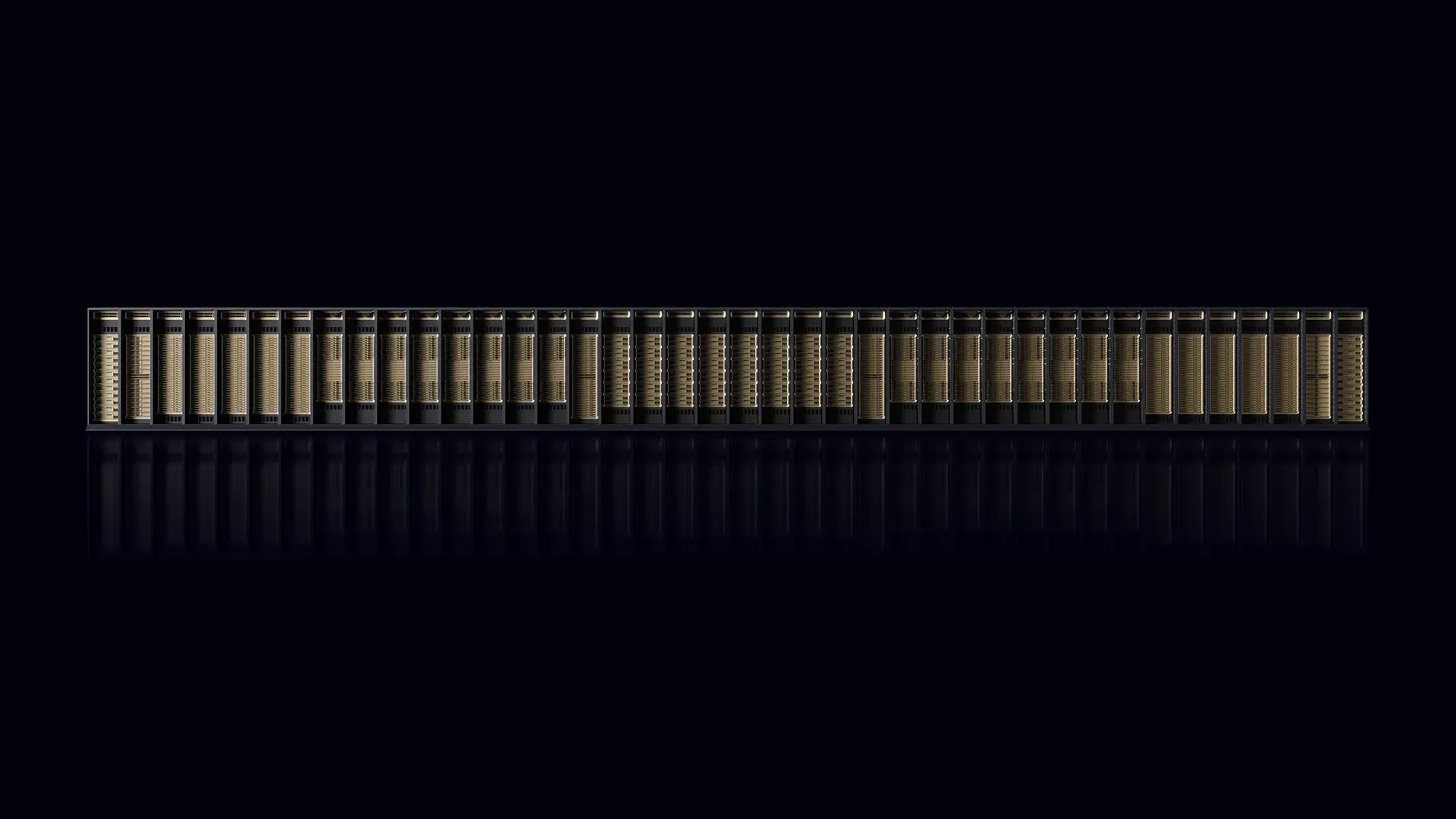
The headline numbers on NVIDIA’s Vera Rubin platform are large enough to make the usual launch-post immune system kick in: 3,600 PFLOPS of NVFP4 compute per rack, 20.7 TB of HBM4, 1.6 PB/s of memory bandwidth, and a roadmap claim of one-tenth the cost per million tokens versus Blackwell for highly interactive deep-reasoning agents. Fine. The industry has never suffered from a shortage of enormous accelerator numbers.
The more interesting pitch is smaller and more operational: predictable latency. NVIDIA’s Vera Rubin story is really about the moment agent workloads stop behaving like ordinary batch inference. Users want trillion-parameter MoE quality, 400K-token context, long chains of tool calls, and hundreds of tokens per second. But agents do not arrive as one nice dense batch. They arrive as jittery, stateful, small-batch loops where latency compounds with every model call.
That is why the platform architecture matters more than the brochure math. NVIDIA is proposing a heterogeneous serving path: Rubin GPUs handle throughput-heavy prefill, attention, long context, and concurrency; Groq 3 LPX handles deterministic, low-jitter FFN and MoE decode; Dynamo orchestrates the transfers and scheduling between them. Strip away the product names and the pattern is familiar from every mature systems domain: when one engine cannot serve every hot path well, split the workload by phase.
Agents turn tail latency into product latency
Conventional inference benchmarks tend to hide the agent problem. Aggregate throughput is useful when many independent requests can be packed together. But an interactive agent session is full of dependencies. A tool call waits on a model turn. A subagent waits on another subagent. The main agent waits on all the branches before it can synthesize. A final answer may depend on dozens or hundreds of previous calls, each adding queueing delay, cache movement, scheduling variance, or decode jitter.
NVIDIA’s own adjacent trace work makes the case better than any PFLOPS number. A Claude Code-style session lasted 33 minutes, spanned 283 requests, included 58 main-agent turns and 225 subagent invocations, and grew context from 15K tokens to 156K before compaction back to roughly 20K. That is not a single inference request. It is a distributed workflow with a language model in the critical path far too often.
In that world, “average latency” is a comfort metric. The user feels the tail. If one decode stream stalls during a branch of work, the final synthesis waits. If a subagent fan-out causes cache misses, the main path gets slower. If the runtime optimizes for aggregate utilization at the expense of per-user consistency, the agent feels unreliable even when the cluster is technically busy. This is why deterministic serving suddenly matters.
The Groq 3 LPX piece is NVIDIA’s answer for the latency-sensitive slice. The claimed rack configuration includes 256 LPU accelerators, 315 PFLOPS of inference compute, 128 GB of total SRAM, 40 PB/s of on-chip SRAM bandwidth, and 640 TB/s of scale-up bandwidth. Each Groq 3 LPU exposes 96 chip-to-chip links at 112 Gbps, or roughly 2.5 TB/s of scale-up bandwidth per LPU. More importantly, communication is scheduled as 320-byte vectors at compile time, with route selection and synchronization resolved statically instead of relying on runtime network arbitration.
That is a very specific bet: the low-jitter part of agent inference benefits from compiler-scheduled data movement and near-synchronous execution. NVIDIA describes the LPX C2C protocol as plesiosynchronous, canceling clock drift and aligning many LPUs into a near-synchronous execution surface. Translation: reduce defensive buffering, reduce variance, and make the decode loop less hostage to networking behavior.
The phase split is the useful lesson
Most LGTM readers will not procure Vera Rubin NVL72 racks. That does not make the post irrelevant. The architecture pattern is the takeaway. Agent workloads split into phases with different bottlenecks. Long-context prefill wants memory capacity and bandwidth. Attention over an accumulated KV cache wants the right locality strategy. Sequential decode wants stable per-token latency. MoE FFNs want a different communication profile than attention. Subagent fan-out wants routing and cache affinity. One accelerator can run all of that, but at scale the compromise becomes visible.
NVIDIA’s heterogeneous AFD loop puts Rubin GPUs on decode attention over the accumulated KV cache while LPX accelerates FFN execution, with intermediate activations moving each token through Dynamo-orchestrated transfers. NVIDIA claims the combined stack can deliver 400 tokens per second per user on trillion-parameter MoE models with 400K-token context, up to 35x higher throughput per megawatt than GB200 NVL72, and up to 10x more revenue opportunity for agentic workloads.
Those numbers should be treated as vendor claims until independent benchmarking arrives. NVIDIA itself flags some Vera Rubin product-page numbers as projected and subject to change. But the direction is credible because it matches the workload shape. The bottleneck is no longer “can the model run?” It is “can the system run the model repeatedly, interactively, and predictably while context grows and branches?”
For smaller teams, the same reasoning applies without exotic hardware. If your bottleneck is long-context prefill, optimize prompt structure, chunked prefill, prefix caching, context compaction, and memory bandwidth. If your bottleneck is tail decode latency under small batches, measure p95 and p99 per-user tokens per second instead of celebrating total throughput. If your bottleneck is subagent fan-out, trace branch concurrency, cache locality, queue depth, and session affinity. If your bottleneck is tool latency, stop blaming the model and fix the tool path.
This is where many agent deployments are still unserious. They benchmark a model on a neat prompt, then deploy it into a workflow with tool calls, subagents, long context, retries, compaction, and mixed-priority requests. When it feels slow, they ask whether a bigger GPU would help. Sometimes it will. Often the first fix is a better trace.
AI factories are becoming runtime systems
Vera Rubin also reinforces a broader shift in NVIDIA’s platform story. The company is no longer selling “more GPU” as the whole answer. It is selling rack-scale systems where the accelerator, network, memory hierarchy, compiler, serving stack, and orchestration layer are co-designed around the workload. That should make software teams both interested and cautious.
Interested, because the workload really did change. Agentic systems are turning inference into a runtime-systems problem. A usable stack has to understand cache retention, priority, phase placement, typed request blocks, prefill/decode disaggregation, and lifecycle hints. Dynamo’s role in the Vera Rubin story is not decorative; it is the control plane that lets the hardware split become operational instead of just architectural.
Cautious, because vertically integrated performance stories can become vendor-shaped gravity wells. The more the best latency depends on proprietary scheduling hooks, rack fabrics, and compiler assumptions, the harder it becomes for buyers to compare alternatives cleanly. That does not make the design wrong. It means engineering teams should separate the durable lesson from the procurement pitch.
The durable lesson is this: agent serving is becoming phase-aware. The future stack has a capacity engine, a latency engine, an orchestration layer, and a cache fabric. Today NVIDIA names that Rubin, Groq 3 LPX, Dynamo, and NVLink-era rack infrastructure. Tomorrow another vendor may implement the same split differently. The systems principle will survive the SKU.
For practitioners, the immediate action is to stop using average request latency as the north star. Build traces that follow an entire agent session: main turns, subagent calls, tool waits, context growth, compaction, cache hits, prefill time, decode time, queue time, and branch joins. Then decide which phase is actually hurting the product. Agent latency is a chain. Optimizing the wrong link just gives you a shinier bottleneck.
The LGTM take: Vera Rubin matters less as “bigger AI hardware” and more as proof that low-jitter agent serving is now a first-class infrastructure market. Agents made latency compounding visible. NVIDIA is answering with a rack that treats inference less like a stateless API call and more like a distributed runtime. That is the right direction, even if the biggest numbers still deserve a raised eyebrow.
Sources: NVIDIA Developer Blog, NVIDIA Vera Rubin NVL72 product page, NVIDIA on Groq 3 LPX, NVIDIA on agentic systems co-design, NVIDIA Dynamo