A New No. 4 Exposes the Gap Between LLM Taste and LLM Traffic

The most useful thing about this week’s model rankings is that they disagree.
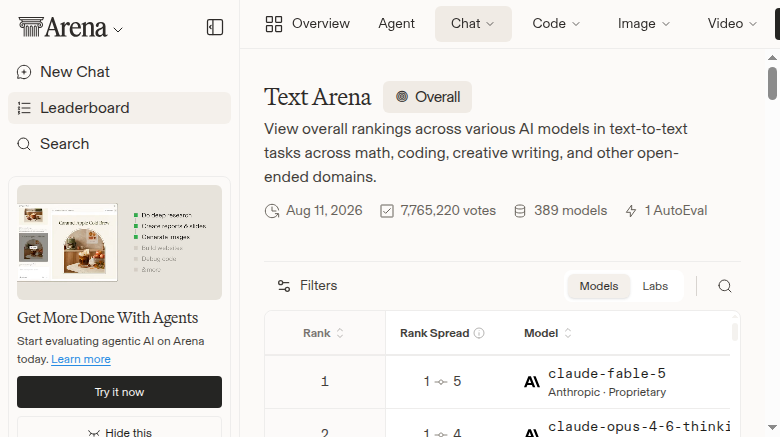
Meta’s muse-spark-1.2 (xHigh) has landed at No. 4 on Arena’s text leaderboard, interrupting what would otherwise be an Anthropic sweep of the first eight positions. Meanwhile, OpenRouter’s usage chart barely moved: its first 18 places stayed fixed, DeepSeek V4 Flash 0731 remained No. 1, and OpenAI’s GPT-5.6 Sol entered only at No. 19. If you want a single answer to “which model is winning,” these tables are uncooperative. That is a feature, not a bug.
Arena measures pairwise human preference. OpenRouter counts tokens routed through one marketplace. The first is evidence about which answers people choose in blind comparisons; the second is evidence about which models developers are willing to exercise at scale under real budget constraints. Collapsing those signals into one league table is like ranking databases by combining a design-award ballot with AWS bandwidth bills. Both reveal something real. Neither answers the same question.
Meta cleared the taste test; Anthropic still owns the room
A debut at No. 4 is not a routine shuffle. Muse Spark 1.2 xHigh entered behind claude-fable-5, claude-opus-4-6-thinking, and claude-opus-4-7-thinking, but ahead of every non-Anthropic model in the table. Its arrival pushed qwen3.8-max from No. 5 to No. 9 and helped knock gpt-5.4-high out of the top 20. The eye-catching newcomer matters, but the concentration above and around it matters more: Anthropic still holds seven of Arena’s top eight slots.
That concentration suggests Anthropic’s current advantage is not confined to one lucky checkpoint or one serving configuration. Thinking and non-thinking variants occupy the top tier, which is harder to dismiss as a leaderboard-specific accident. Meta’s entry is therefore best read as a credible challenger clearing the broad usability bar immediately—not as proof that it has matched Anthropic across tool use, latency, structured output, long-context retrieval, or failure recovery.
Arena’s own methodology is built around pairwise comparisons and model scores derived from those preferences. That makes it useful population evidence. It does not make its prompt distribution your prompt distribution. A user selecting the more satisfying response to an open-ended question may reward clarity, confidence, style, or completeness; a production agent needs to emit valid JSON, call the right tool once, preserve state, and stop. Pleasant prose cannot compensate for a duplicated refund or a malformed deployment manifest.
There is another reason to avoid over-reading the exact placement. Arena’s rendered table exposed the rank order in this snapshot, but not reliably separable Elo and vote fields. Those values should remain blank rather than being reverse-engineered from concatenated page text. Rank four is a strong candidate-generation signal. Without clean uncertainty bounds, it is not a precise estimate of the performance distance between places three, four, and five.
Nine trillion tokens can still be the cheaper choice
OpenRouter tells a very different story. DeepSeek V4 Flash 0731 grew from 8.83 trillion to 9.39 trillion weekly tokens, a gain of 560 billion. Tencent’s Hy3 added even more—890 billion—to reach 8.94 trillion, shrinking the gap between first and second from 780 billion tokens to 450 billion. DeepSeek V4 Flash 0423, Xiaomi’s MiMo-V2.5, and OpenAI’s GPT-5.6 Luna complete the top five.
GPT-5.6 Sol’s new No. 19 position is much less dramatic than the word “debut” makes it sound. Its 653 billion tokens put it only 26 billion ahead of No. 20 Gemini 2.5 Flash Lite. That is enough to enter the table and displace Ling-3.0-flash, but it is not evidence of category dominance. The sober interpretation is that Sol has acquired meaningful initial traffic while the market’s existing routing habits remain remarkably sticky.
Token volume is not job volume, customer count, revenue, or completed work. OpenRouter defines its total as prompt plus completion tokens and warns that providers use different tokenizers, so a token from one model is not guaranteed to represent the same amount of text as a token from another. Workload shape distorts the chart further. OpenRouter’s analysis of more than 450 trillion DeepSeek tokens found that agentic requests consumed about 15 times as many tokens per request as human usage, and V4 Flash handled 70% of DeepSeek’s agentic token flow by the end of May.
That means a model adopted by coding agents can climb through long contexts, tool transcripts, retries, and reasoning traces even if it completes fewer discrete tasks. Cheap inference amplifies the effect. OpenRouter quoted DeepSeek V4 Flash at $0.09 per million input tokens and $0.18 per million output tokens, compared with $5 and $30 for GPT-5.5. At those prices, teams can tolerate longer traces, more speculative calls, and broader fan-out. A token-share leaderboard is therefore demand multiplied by verbosity and pricing—not a clean census of successful production outcomes.
This also explains why the Arena and OpenRouter leaders can diverge without either table being wrong. Premium models win tasks where a marginal quality improvement pays for itself: difficult planning, ambiguous code review, high-stakes synthesis, or final verification. Cheaper models absorb classification, extraction, first drafts, repetitive transformations, and retry-tolerant agent steps. The market is not choosing one champion. It is building a model portfolio.
Stop selecting models; start promoting them
For engineering teams, the right response is a promotion pipeline rather than a leaderboard switch. Use Arena to discover candidates that appear broadly capable. Use OpenRouter traffic to identify systems receiving enough real-world exercise that obvious serving and integration failures are less likely to remain hidden. Then make every candidate earn production traffic on your workload.
Start with 50 to 200 representative production traces, scrubbed of sensitive data and versioned like test fixtures. Define success before running the models: exact-answer correctness where possible, rubric-scored quality where necessary, schema validity, tool-call choice, argument correctness, latency percentiles, and total cost per accepted result. For agents, add attempts per completion, loop rate, recovery after a tool error, and tokens per successful task. A cheap model that needs five tries is often the expensive model wearing a discount sticker.
Next, separate tasks by consequence. Route high-volume, reversible work toward low-cost models; reserve premium systems for expensive mistakes or genuinely hard reasoning. Shadow promising newcomers such as Muse Spark 1.2 against live traffic before letting them act. Record both model and configuration—reasoning level, system prompt, tool schema, temperature, and fallback policy—because a model name alone is not a reproducible deployment unit.
Finally, install regression gates. Rankings change daily; production defaults should not. Promote a model only when it clears your acceptance threshold across multiple runs, then ramp traffic gradually with an observable fallback. Watch cost per successful task and error severity, not raw token savings. The mature architecture is not a single global default chosen from a public table. It is task-aware routing with measured fallbacks and a test suite strong enough to say no to the model of the week.
Meta’s new No. 4 deserves an evaluation slot. DeepSeek’s 9.39 trillion weekly tokens deserve respect as evidence of serious adoption. Neither number deserves your production traffic automatically. The rankings are doing their job when they tell you what to test next; they become dangerous only when teams mistake them for the test itself.
Sources: Arena text leaderboard, Arena-Rank methodology, OpenRouter rankings, OpenRouter token dataset documentation, and OpenRouter’s DeepSeek V4 adoption analysis.