AgentScope 2.0.1 Turns Alibaba’s Agent Framework Toward Teams, RAG, and Provider Reality

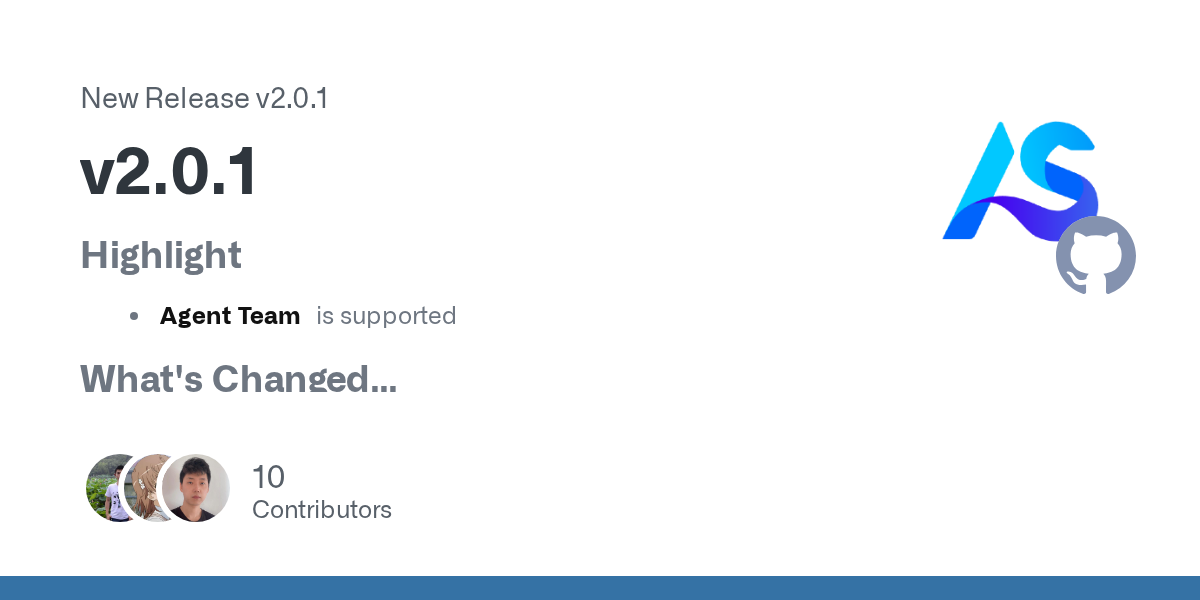
AgentScope 2.0.1 is a patch release with a strategic tell: Alibaba’s agent framework is moving from “build an agent” toward “run a team of agents without losing the plot.” The headline in the release notes is short — “Agent Team is supported” — but the surrounding changes are more revealing: service refactoring, permission-system work, RAG middleware primitives, model-card YAML for DashScope/Qwen and other providers, MCP tool-name sanitization, explicit thinking controls, workspace locks, Redis expiry, Web UI fallback models, and tool middleware improvements.
That list is not launch-event material. It is framework-infrastructure material. Good. Agent frameworks are now competing less on architecture diagrams and more on whether they can survive integration with real providers, real tools, real state, and real teams. The hard part is no longer showing one agent calling one function in a notebook. The hard part is making agent behavior inspectable, permissioned, recoverable, and portable across provider quirks.
The release, v2.0.1, was published on GitHub at 2026-06-05T12:13:50Z. The compare from v2.0.0 shows 25 commits ahead, 0 behind, and 251 files changed. At capture time, AgentScope had roughly 26,268 stars, 2,925 forks, 293 open issues, and an Apache-2.0 license. Tongyi Weekly described AgentScope 2.0 as a “production-ready, easy-to-use agent framework with essential abstractions that work with rising model capability and built-in support for finetuning.” That is vendor language, but the 2.0.1 diff gives builders something more useful than positioning: implementation edges to test.
Agent teams multiply the failure modes
PR #1776, the Agent Team change, is large: 12,016 additions, 2,425 deletions, 154 files changed, and 29 combined comments/review comments. The checklist says it refactors the agent service, adds unit tests, updates documentation, and debugs frontend behavior. The scale of the change is the story. Supporting multiple cooperating agents is not a decorator. It changes the service model.
A single agent can hide a lot of ambiguity inside one transcript. A team of agents cannot. Once roles split across workers, reviewers, retrievers, planners, executors, and UI-facing assistants, the framework needs identity, routing, permissions, state isolation, cancellation, observability, and an explanation of who did what. Otherwise “multi-agent” becomes a nicer name for concurrent confusion.
This is where AgentScope’s own tagline — “Build and run agents you can see, understand and trust” — has to earn its keep. Teams evaluating the framework should not start by asking whether Agent Team looks elegant in the example. They should ask whether a human operator can inspect the task graph, trace which agent selected which tool, see how state moved between agents, and stop one misbehaving worker without corrupting the whole run.
Permissions are not optional once agents become services
The companion permission-system work in PR #1767 matters because service-oriented agents need policy boundaries. The PR is not fully explained in the terse release notes, but it lands with 1,729 additions, 595 deletions, and 10 files changed. That is not cosmetic. Permissions become more important exactly when a framework moves from local demo scripts into multi-session, multi-tenant, Web UI, and team-agent surfaces.
Agent permissions are easy to under-specify. A tool permission is not just “can call bash.” It may need to account for user identity, workspace, tenant, model, agent role, tool arguments, retrieved context, and whether the call is part of an automated fallback. A human-in-the-loop approval system that works for one chat session can fail when three agents act concurrently or when a Web UI user delegates work into a long-running service.
AgentScope 2.0.1 does not prove those questions are solved. It does prove the maintainers are working in the right part of the stack. Builders should test permission policy with adversarial scenarios: read-only agents, retrieval-only agents, sensitive MCP tools, Web UI fallback paths, and long-running team tasks that cross session boundaries.
The provider layer is where frameworks quietly fail
PR #1731 adds 15 model-card YAML files across 5 providers: Anthropic models including Claude Opus and Sonnet variants, DashScope models including qwen-max, qwen-max-2025-01-25, qwen-turbo, and qwen-long, OpenAI Chat and Responses models, and xAI’s Grok models. The PR reports 469 passed, 147 skipped, and 0 failures in tests.
Model cards sound like metadata housekeeping. They are more than that. Agent frameworks increasingly need a provider catalog that captures supported I/O types, context limits, labels, status, and parameter overrides. The DashScope/Qwen cards are the bridge back to the Alibaba AI beat: AgentScope sits in the broader surface where Qwen models, DashScope APIs, ModelScope distribution, and agent infrastructure meet. The caveat is obvious: stale model metadata is worse than no abstraction because it fails confidently.
PR #1784 is a good example of why provider reality matters. It changes thinking_enable from a boolean defaulting false to bool | None. None means “use the model default,” while explicit True or False is forwarded. For Gemini Flash variants, False sends thinking_budget=0; for Pro models that cannot disable thinking, the wrapper surfaces a clear API error instead of silently continuing.
That is the right shape. “Disable thinking” is not a universal API contract. Some providers support it, some ignore it, some require budget fields, and some reject it. A framework that silently keeps reasoning enabled when a developer asked otherwise can blow latency, cost, and behavior assumptions. Explicit false should either work or fail loudly. Defaults should mean defaults, not secretly imposed policy.
MCP compatibility is made of tiny sharp edges
PR #1787 fixes MCP tool-name incompatibility with OpenAI-style APIs by replacing characters outside [a-zA-Z0-9_-] with underscores when composing MCPTool.name, while preserving the original tool name for the actual MCP server call. This is exactly the kind of dull compatibility change that determines whether a framework feels solid.
MCP servers come from normal software ecosystems, and normal software uses dots, slashes, namespaces, and naming conventions that LLM provider schemas may reject. Builders should not have to rename every tool in a server because one provider’s regex is stricter than another’s. The release also adds locks around MCP and skill operations in LocalWorkspace, protecting shared .skills index and skill-folder state from concurrent corruption.
RAG is becoming middleware, not a sidecar
PR #1746 adds basic RAG module primitives by introducing on_compress_context and list_tools methods in MiddlewareBase. This is early work, but it points in the correct direction. Retrieval in agent systems is not simply “query vector database, paste chunks, answer question.” In long-running agents, retrieval has to interact with context compression, tool discovery, budget management, state expiry, and observability.
Most RAG demos hide those details because the demo only needs one answer. Agent services need to keep running after the context window fills, after stale documents age out, after a tool becomes unavailable, and after a fallback model has different context limits. Middleware hooks are not enough by themselves, but they give teams a place to make retrieval behavior explicit instead of embedding it in one-off prompt glue.
Other changes reinforce the same pattern. Redis message lists now expire. The builtin Read tool cleans file cache. Services can provide extra tools and middlewares. The Web UI can select fallback models. These are paper-cut fixes, and paper cuts are where frameworks bleed credibility.
The comparison set is crowded: LangGraph, AutoGen, Semantic Kernel, and Microsoft’s newer Agent Framework are all trying to own slices of agent orchestration. AgentScope’s pitch is visibility, understandability, trust, and service-ready abstractions. Version 2.0.1 makes that pitch more credible because it focuses on the substrate: teams, permissions, provider metadata, MCP compatibility, RAG hooks, and state hygiene.
The cautious read is still warranted. A patch release is not a production architecture. Permission improvements need concrete policy tests, fallback models can create compliance surprises, and workspace locks prevent one class of corruption, not every state bug. Treat 2.0.1 as a reason to evaluate AgentScope seriously, not as a reason to standardize on it sight unseen.
If AgentScope is on your shortlist, build a harness around the messy edges. Run two or three cooperating agents. Wire one MCP server with names containing dots. Use one DashScope/Qwen model and one non-Alibaba provider. Test explicit thinking on, off, and default. Add a RAG middleware path that compresses context. Stress concurrent skill add/remove operations. Use Redis-backed session storage. Trigger Web UI fallback routing and verify where prompts went. Then measure inspectability: can you tell which agent acted, which tools were available, why a model was selected, what got compressed, and whether permission policy actually fired?
Frameworks should make the hard parts visible. If they do not, they are just hiding complexity under a nicer import path. AgentScope 2.0.1 is useful because it moves into the unsexy parts that decide whether agent frameworks survive production contact.
Sources: GitHub release: AgentScope v2.0.1, release compare, Agent Team PR #1776, permission-system PR #1767, MCP tool-name compatibility PR #1787, thinking-control PR #1784, RAG middleware PR #1746, Tongyi Weekly