LLM Rankings Have Split Into Prestige Models and Workhorse Models

The most useful LLM ranking this week is not the one with the cleanest number one. It is the gap between the rankings.
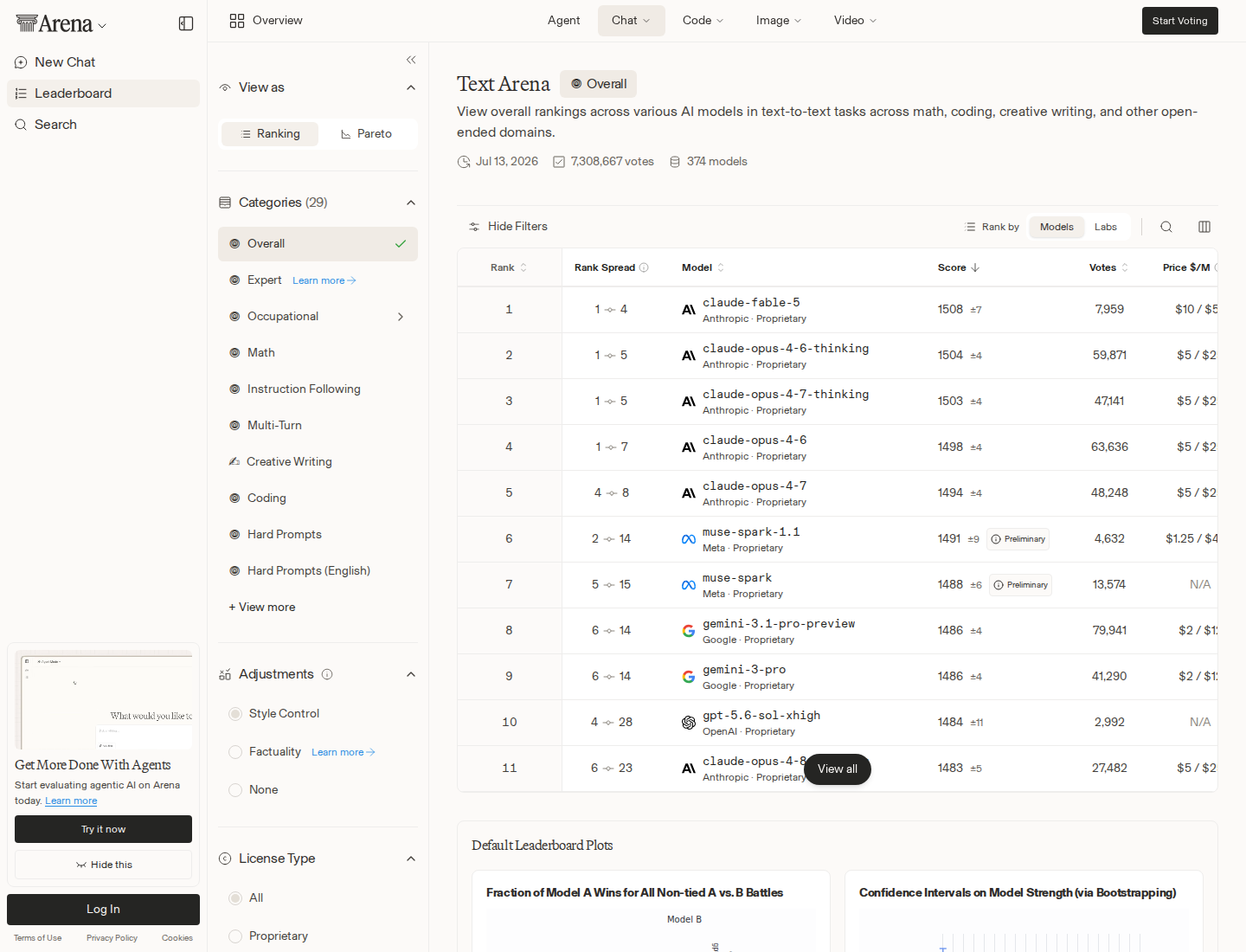
Arena's Text leaderboard still looks like a prestige table: Anthropic occupies the entire top five, with claude-fable-5 at 1508 Elo, claude-opus-4-6-thinking at 1504, claude-opus-4-7-thinking at 1503, claude-opus-4-6 at 1498, and claude-opus-4-7 at 1494. That is not subtle. In a judged environment where users compare answers and the leaderboard turns preference into Elo, Claude is still the brand with the most gravity.
OpenRouter's usage rankings tell a different story. The top five by weekly token volume are Tencent's Hy3 free tier at 8.25 trillion tokens, up 791% week over week; Xiaomi's MiMo-V2.5 at 7.31 trillion, up 64%; DeepSeek V4 Flash at 5.26 trillion; MiniMax M3 at 4.13 trillion; and GLM 5.2 at 3.14 trillion. The models winning usage are not simply the models winning taste tests. They are the models that make sense when a developer has a routing layer, a budget, and a batch of work that does not require the most expensive brain in the room.
That is the actual rankings story: the market has split into prestige models and workhorse models. Treating those as the same buying decision is how teams end up with religious arguments in architecture review and surprise invoices at the end of the month.
The leaderboard is stable, which is the signal
The Arena Text board barely moved at the top. Gemini 3.1 Pro Preview climbed two spots to rank eight with 1486 Elo, landing alongside Gemini 3 Pro at the same score. OpenAI's gpt-5.6-sol-xhigh slipped two places to tenth at 1484, while gpt-5.2-chat-latest-20260210 inched up one place to fifteenth at 1476. Those are real movements, but they are not regime changes.
The WebDev board is similarly calm. OpenAI's gpt-5.6-sol-xhigh (codex-harness) sits first at 1631 Elo, just one point ahead of claude-fable-5 at 1630. Z.ai's glm-5.2 (max) is third at 1581, followed by Anthropic's claude-opus-4-8-thinking and claude-opus-4-7-thinking at 1559 and 1557. For coding and web development, the top end is still a knife fight between frontier vendors, harness design, and task distribution.
Stability matters because it changes how engineers should read the board. If the top ten were thrashing every day, the right response would be caution: wait for more samples, check confidence intervals, and avoid overfitting your stack to yesterday's spike. But when Arena is mostly stable and OpenRouter is moving beneath it, the more interesting question is not "which model is smartest?" It is "which model class is becoming cheap, reliable, and available enough to carry production traffic?"
OpenRouter is showing production behavior, not model virtue
OpenRouter's top movement this run happened inside the top ten: Nemotron 3 Ultra free rose to sixth with 2.73 trillion weekly tokens, up 181%; DeepSeek V4 Pro slipped to seventh with 2.57 trillion; Claude Opus 4.8 rose to eighth with 2.20 trillion; and Claude Opus 4.7 fell to ninth with 2.10 trillion. That is a useful cluster because it mixes free-tier economics, low-cost MoE economics, and expensive frontier capability in one neighborhood.
Nemotron 3 Ultra is listed as a 550B-total, 55B-active NVIDIA mixture-of-experts model with a hybrid Transformer-Mamba architecture and a 1 million-token context window. The OpenRouter variant in the ranking is priced at $0 for both prompt and completion tokens. You do not need a complicated theory of developer behavior to understand why a free model with a million-token context window can pull traffic. It creates a playground for long-context workflows that would otherwise be too expensive to test casually.
Hy3's surge is the louder version of the same lesson. OpenRouter lists it as a 295B-parameter Tencent MoE model with 21B active parameters, 192 experts using top-8 routing, a 262,144-token context window, and pricing of $0.20 per million input tokens and $0.80 per million output tokens before cache discounts. A model like that does not need to be the best at everything to become operationally important. It needs to be good enough across a wide band of tasks, cheap enough to route aggressively, and fast enough that developers stop babysitting it.
DeepSeek V4 Pro sits in the same workhorse category, though with a different profile: 1.6T total parameters, 49B active, a 1,048,576-token context window, and roughly $0.435 per million input tokens and $0.87 per million output tokens. That is an enormous context window at pricing that makes document-heavy agent flows plausible outside of a lab budget. If you are building retrieval-heavy tools, compliance review, customer support analysis, codebase exploration, or multi-step extraction pipelines, that matters more than whether the model can beat Claude on a preference arena prompt.
Claude Opus 4.8 being eighth on OpenRouter is interesting for the opposite reason. It is listed with a 1 million-token context window and pricing of $5 per million input tokens and $25 per million output tokens. That is not giveaway economics. If developers are still routing 2.20 trillion weekly tokens through it, they are paying for capability, trust, or failure recovery. Expensive models do not need to be default models anymore; they need to be escalation models that justify themselves when the cheap path gets uncertain.
The right default is no longer one default
The old model-selection habit was simple: pick the best model you can afford, make it the default, and revisit when a launch or a benchmark forces the issue. That worked when model catalogs were shallow and the quality gap between first place and fifth place was obvious. It is increasingly the wrong abstraction.
Teams should now route by task class. Use frontier models for high-ambiguity planning, architectural reasoning, difficult code review, complex customer escalations, and any place where a wrong answer is expensive to detect. Use cheaper MoE models for extraction, transformation, summarization, classification, reranking, draft generation, synthetic test data, and speculative agent steps. Keep a small number of models in each lane and measure them against your own workload, not a public leaderboard prompt distribution.
This is where many teams still underinvest. They will spend weeks arguing over a public benchmark and then ship without a local eval set for their own tasks. That is backwards. Arena can tell you which model wins pairwise judgments across broad open-ended prompts. OpenRouter can tell you what other developers are routing at scale. Neither can tell you whether your internal incident summarizer preserves the one sentence your SRE team actually needs, whether your coding agent edits the right file in your repo, or whether your support classifier fails gracefully when a customer sends screenshots and sarcasm in the same ticket.
A practical setup is not complicated. Build a small eval pack with examples from real traces: easy cases, known failures, long-context cases, adversarial formatting, and tasks where latency matters. Score outputs with a mix of exact checks, rubric-based review, and human spot checks. Track cost per successful task, not just cost per token. Then build routing rules that can change: default cheap, escalate on uncertainty, fall back on provider incidents, and log enough metadata that you can tell whether a model is helping or merely being fashionable.
The more subtle point is that long context is becoming a product feature and a cost trap at the same time. A 1 million-token window lets teams remove retrieval complexity in prototypes, but it also tempts them to dump entire corpora into prompts because the model accepts it. The better pattern is selective context first, huge context when necessary. Cheap long context is useful; lazy long context is still lazy.
There is also a vendor-risk lesson hiding in the rankings. Arena's judged-quality board is concentrated around Anthropic, OpenAI, Google, and a few strong challengers. OpenRouter's volume board is much more geographically and economically diverse: Tencent, Xiaomi, DeepSeek, MiniMax, Z.ai, NVIDIA, Anthropic, Google, OpenAI, Poolside. If your product architecture assumes one provider is always available, always cheap, and always best, the market is already telling you that assumption is stale.
The boring conclusion is the useful one: rankings are no longer a crown ceremony. They are input data for a routing strategy. Claude can dominate judged preference while Hy3 and MiMo dominate token volume. OpenAI can lead WebDev while DeepSeek and Nemotron become the models developers use to chew through long, repetitive work. None of that is contradictory. It is what a maturing market looks like when buyers stop asking for "the best model" and start asking which model should do which job.
For practitioners, the move this week is to review your defaults. If every request goes to one frontier model, you are probably overpaying. If every request goes to the cheapest high-volume model, you are probably hiding quality risk in places where users will eventually find it. The teams that win will not be the ones with the most confident leaderboard screenshot in their pitch deck. They will be the ones with clean evals, observable routing, and enough taste to know when "good enough" is exactly right and when it is how bugs reach customers.
Sources: Arena Text Leaderboard, Arena Leaderboard, OpenRouter Rankings, OpenRouter weekly rankings API, OpenRouter model catalog API, OpenRouter public models API.