LLM Rankings Are Splitting Into Prestige Models and Workhorse Models

The most useful LLM ranking this week is not the one where the “best” model changed. It is the one where the most-used model changed.
OpenRouter’s weekly rankings now have MiMo-V2.5 at number one with 5.40 trillion tokens routed over the last week, just ahead of DeepSeek V4 Flash at 5.21 trillion. Hy3 (free) is the louder signal, though: Tencent’s model moved into third place with 5.00 trillion weekly tokens while the older Hy3 preview collapsed to fifteenth after a 79% week-over-week drop. That is not a normal leaderboard shuffle. That is a market telling you it has learned to arbitrage model access.
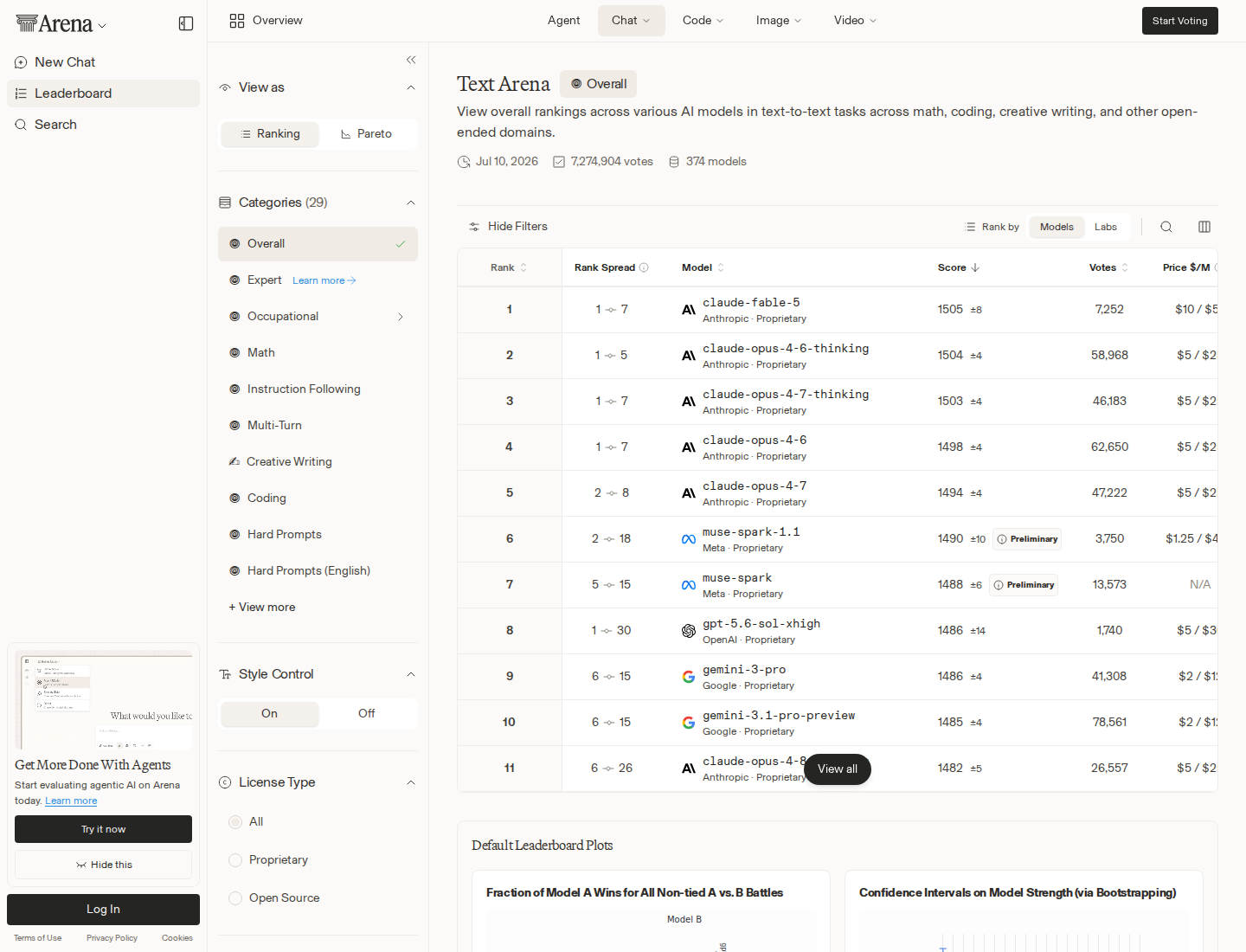
Arena AI tells a calmer story. Its Text leaderboard is basically frozen at the top, with Anthropic’s claude-fable-5 still first at 1509 Elo, followed by claude-opus-4-6-thinking at 1504, claude-opus-4-7-thinking at 1503, claude-opus-4-6 at 1498, and claude-opus-4-7 at 1494. Arena WebDev is similarly stable: claude-fable-5 leads at 1649 Elo, OpenAI’s gpt-5.6-sol-xhigh in a codex harness sits second at 1636, and GLM 5.2, grok-4.5, and claude-opus-4-8-thinking round out the top five.
So the headline is not “MiMo beat DeepSeek.” The headline is that public LLM rankings have split into two increasingly different products: prestige boards that measure judged answer quality, and routing boards that expose what developers actually run when price, latency, context length, free quotas, SDK defaults, and workflow fit all hit production at once.
Usage is becoming the more honest benchmark
Human preference leaderboards are still valuable. A model that consistently wins blind comparisons is probably doing something real. But judged rankings are clean-room instruments. They remove the mess that engineers actually live inside: quota limits, cold-start latency, context-window pressure, output cost, tool-call reliability, retry behavior, rate limits, and procurement friction.
OpenRouter’s chart includes all that mess by implication. Nobody routes 5.40 trillion weekly tokens through MiMo-V2.5 because a leaderboard badge looked nice. They do it because, for a large enough slice of work, the model is clearing the practical bar: cheap enough, fast enough, available enough, and capable enough. That combination is now strong enough to move the top of a market even when Arena’s preference rankings do not move at all.
The top five makes the pattern obvious. MiMo-V2.5 is first at 5.40 trillion tokens and up 25% week over week. DeepSeek V4 Flash is second at 5.21 trillion, down 3%. Hy3 (free) is third at 5.00 trillion. MiniMax M3 is fourth at 4.30 trillion, up 7%, and GLM 5.2 is fifth at 3.21 trillion, up 27%. That is a lot of non-Western, cost-sensitive, high-throughput capacity sitting above most of the models that dominate boardroom conversations.
This is where many teams get public rankings wrong. They treat “number one” as a purchase recommendation. It is not. Arena’s number one says something about judged quality. OpenRouter’s number one says something about workload gravity. Benchmarks say something about controlled task clusters. None of those knows your application’s failure modes.
The right move is not to crown MiMo, DeepSeek, Hy3, Claude, or Gemini as a universal default. The right move is to stop having a universal default.
Hy3 is a free-tier stress test, not a finished procurement decision
Tencent’s Hy3 is the week’s clearest example of ranking distortion. On paper, the technical profile is serious: 295 billion total parameters, 21 billion active parameters, 192 experts with top-8 routing, a 256K context window, Apache 2.0 weights, and an FP8 checkpoint. Reported benchmark numbers are also credible enough to earn attention: 78.0 on SWE-Bench Verified, 57.9 on SWE-Bench Pro, 71.7 on Terminal-Bench 2.1, and 90.4 on GPQA Diamond. Tencent’s own reliability claims say hallucination rate dropped from 12.5% to 5.4%, while multi-turn issue rate fell from 17.4% to 7.9%.
That is the “evaluate this seriously” case. The “do not confuse this with permanent demand” case is the pricing. OpenRouter lists Hy3’s free route at $0 per token, with the free window scheduled to end July 21, 2026. A free long-context MoE model arriving on a convenient router is almost designed to inhale experimental traffic, batch jobs, coding-agent side quests, and opportunistic workloads that would not survive a normal margin review.
That does not make the 5.00 trillion-token number fake. It makes it specific. Hy3 is currently proving that developers will throw enormous real work at a capable free model. It is not yet proving that those same developers will keep routing the same volume once the free tier closes, latency normalizes under heavier sustained use, and procurement teams ask whether the model’s quality and support posture justify a paid slot.
The collapse of Hy3 preview is the useful warning. The preview route fell to 713 billion tokens and fifteenth place, down 79% week over week, exactly as the free Hy3 route moved into the top three. That is not a quality verdict so much as a routing migration. In production terms, it means you should treat public usage spikes around free or promotional models as demand discovery, not architecture.
If your team is testing Hy3, the checklist is straightforward. Measure it against your own tasks before July 21. Capture latency distribution, not just median latency. Test tool calls and structured outputs under retry pressure. Compare full-context performance against the smaller context windows you actually need. Build an exit route so a pricing change does not become an incident. Free capacity is useful; accidental dependency is how future-you gets paged by a spreadsheet.
The boring architecture is now the smart one
Arena’s stability should not be ignored just because OpenRouter moved. Anthropic still owns the top of the judged Text board, and claude-fable-5 leads both Text and WebDev. For tasks that require judgment, recovery, planning, code review, architecture tradeoffs, or high-stakes reasoning, that matters. A model that wins preference battles consistently is still the model you want in the loop when the cheap worker gets stuck.
But the OpenRouter board is a reminder that “use the best model everywhere” is increasingly lazy engineering. The economic gap between premium reasoning and bulk model labor is too large. A one-model architecture either overspends on easy work or hides quality regressions in hard work. Neither is a strategy.
The practical architecture is a router with lanes. Put premium, high-Elo models on planning, review, final synthesis, sensitive customer-facing answers, and recovery from failed automation. Put high-volume OpenRouter winners on extraction, classification, summarization, draft generation, search-query expansion, embedding-adjacent preprocessing, speculative code transforms, and low-risk agent subtasks. Put free or promotional routes behind explicit experiment flags, caps, and fallbacks.
That sounds obvious until you inspect real production systems and find a single environment variable named something like DEFAULT_MODEL doing all the work. That variable is where money goes to die. It is also where subtle product regressions hide, because teams rarely know whether a bad answer came from the model, the prompt, the retrieval layer, the tool contract, or the task being assigned to the wrong lane.
Engineers should use this week’s rankings as a prompt to build a small internal eval harness. It does not need to be a research lab. Start with four sets: high-risk reasoning cases, code-edit cases, extraction and summarization cases, and latency-cost traces from real production traffic. Run candidate models through the same prompts, same tool contracts, same output validators, and same retry policy. Then map public rankings onto your own operating model.
That last part matters. Public rankings are not wrong; they are incomplete. Arena is telling you which models humans prefer in controlled comparisons. OpenRouter is telling you where developer traffic is flowing at scale. BenchLM-style comparisons are telling you which benchmark clusters appear favorable, with all the caveats that come with partial evidence. Your evals tell you whether any of that survives contact with your product.
So yes, MiMo-V2.5 taking the top OpenRouter slot is worth noting. Hy3’s free route entering the top three is worth testing. Nemotron 3 Ultra jumping to ninth on a 76% week-over-week gain is worth watching. But the durable lesson is bigger than any one model: model selection has become infrastructure.
The teams that benefit will not be the ones refreshing leaderboards and swapping defaults every Monday. They will be the ones that turn leaderboards into signals, signals into eval candidates, and eval results into routing policy. Prestige models still matter. Workhorse models increasingly matter more. The win is knowing which one is on the critical path before the invoice, outage, or customer complaint tells you.
Sources: OpenRouter Rankings, OpenRouter rankings API, Arena Text leaderboard, Arena WebDev leaderboard, Tencent Hy3 research page, Simon Willison on Tencent Hy3, MarkTechPost Hy3 technical summary, BenchLM DeepSeek V4 Flash vs MiMo-V2.5 comparison