Kimi K3 Shows Why LLM Rankings Are Splitting Into Two Markets

The most interesting thing in this week's LLM rankings is not that another model moved into the top 10. That happens often enough now that it barely qualifies as news. The interesting part is that the model doing it, Moonshot's Kimi K3, looks more impressive on the coding leaderboard than on the general text leaderboard, while the models developers are actually pushing tokens through on OpenRouter are mostly somewhere else entirely.
That gap is the story. AI leaderboards have split into two products: prestige boards for frontier capability, and usage boards for what teams can afford to run in anger. If you are buying models, routing traffic, or deciding which vendor gets wired into your agent stack, treating those as the same signal is how you end up with a beautiful benchmark chart and an ugly cloud bill.
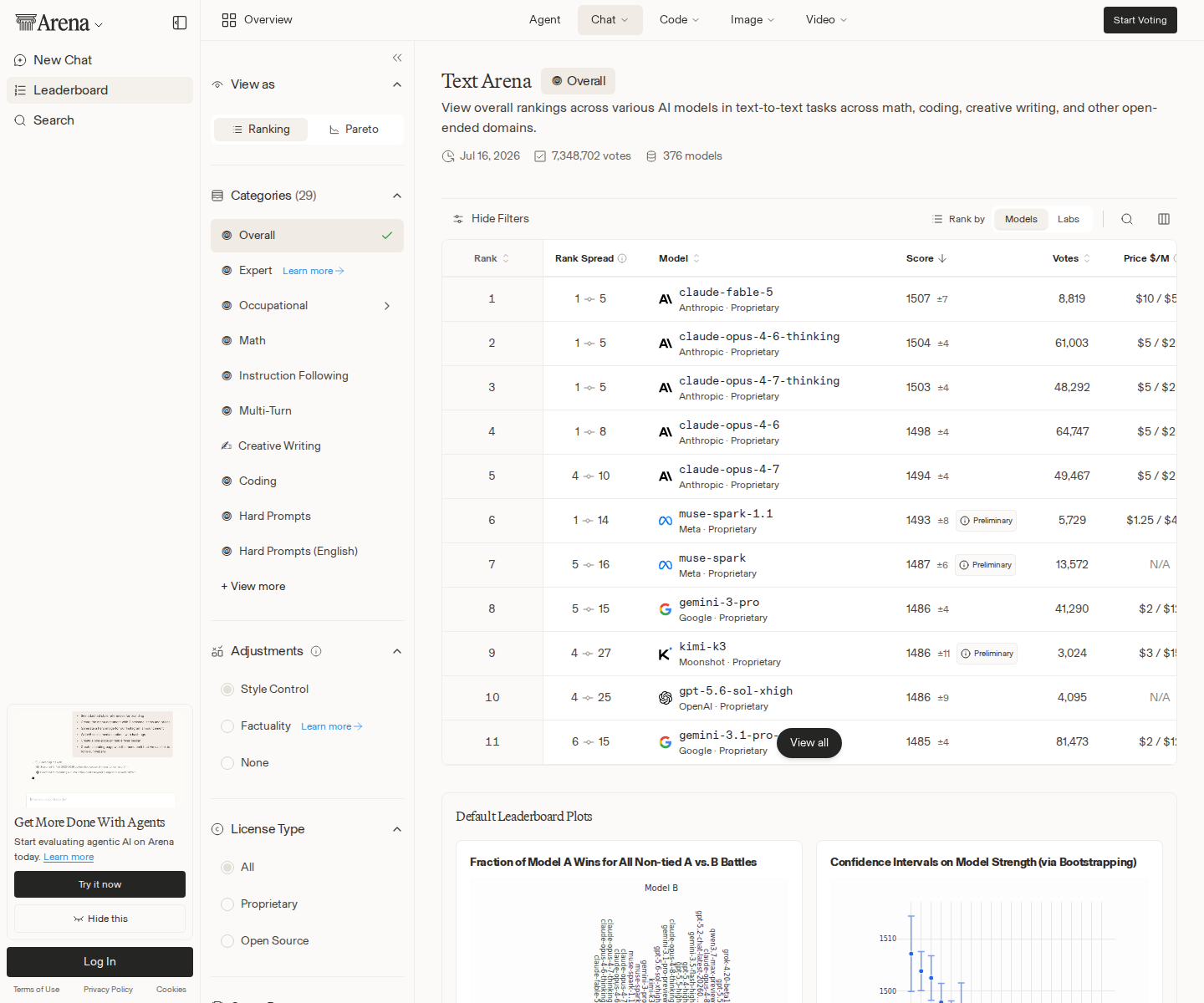
Arena's July 16 text snapshot has Kimi K3 entering at #9 with a 1486 Elo score, wedged into the same score band as Gemini 3 Pro and OpenAI's GPT-5.6 Sol xhigh. That is a real result, but it should be read with the right amount of friction. The leaderboard reports 7,348,702 votes across 376 models, while Kimi K3's own placement is still marked preliminary and backed by 3,024 votes. In Arena terms, that is a promising signal, not a settled law of physics.
The top of the text table is still Anthropic-heavy. Claude Fable 5 remains #1 at 1507 Elo on 8,819 votes, followed by Claude Opus 4.6 Thinking at 1504, Claude Opus 4.7 Thinking at 1503, Claude Opus 4.6 at 1498, and Claude Opus 4.7 at 1494. Meta's Muse Spark family occupies #6 and #7, Google has Gemini 3 Pro at #8, and then Kimi K3 arrives at #9. OpenAI's GPT-5.6 Sol xhigh sits at #10, also at 1486.
That top 10 is tightly packed. The difference between #8 and #10 is effectively rounding-distance on a public preference leaderboard, especially when the newer entrant has fewer votes than established models. The correct engineering response is not "Kimi is now better than GPT" or "Anthropic has been dethroned." It is: add Kimi K3 to the eval matrix and see whether its strengths match your workload.
The coding board is louder than the text board
The Arena Code/WebDev leaderboard is where Kimi K3 stops looking like a curiosity and starts looking like a model teams should actively test. In that category, Kimi K3 is #1 with a 1679 Elo score on 1,757 votes, ahead of Claude Fable 5 at 1631 and GPT-5.6 Sol xhigh, listed with a codex-harness entry, at 1618.
That does not mean Kimi K3 should replace your current production coding model tomorrow morning. The vote count is smaller, the model is new to the tracked table, and WebDev leaderboards can reward a specific kind of polished front-end generation that does not always translate to multi-file maintenance work. But it does mean the model belongs in serious coding evals now, especially if your product depends on UI generation, repository edits, long-context planning, or agentic tool use.
The model's published shape makes that worth investigating. OpenRouter's model catalog describes Kimi K3 as a 2.8 trillion-parameter open-weight multimodal reasoning model from Moonshot AI, with a 1,048,576-token context window. The listed pricing in the Arena brief is $3 per million input tokens and $15 per million output tokens. That is not bargain-bin inference, but it is also not priced like a purely ornamental research trophy. The 1M context window is the important operational feature: for coding agents, the difference between summarizing a repo and actually carrying a repo in context can show up as fewer wrong edits, fewer repeated questions, and less brittle planning.
Still, long context is not automatically useful context. Teams should test whether Kimi K3 can use the extra window with discipline: preserving local conventions, avoiding broad rewrites, locating the right file without being spoon-fed, and making edits that survive tests. A large context window that encourages the model to skim everything badly is not an upgrade. It is just a bigger place to get lost.
OpenRouter is voting with tokens, not taste
The OpenRouter rankings tell a different story because they measure platform usage rather than pairwise preference. The top model by weekly token volume is Tencent's Hy3 free at 9.76 trillion tokens, up 241% week over week. Xiaomi's MiMo-V2.5 follows with 8.68 trillion tokens. DeepSeek V4 Flash is third at 5.24 trillion, followed by MiniMax M3 and GLM 5.2.
That is not the same leaderboard as Arena's text table. It is not even trying to be. OpenRouter usage is shaped by cost, free tiers, latency, availability, default router behavior, application mix, and developer habit. A free or cheap model that is "good enough" for high-volume extraction, classification, summarization, or background agent chatter can consume vastly more tokens than a prestige model reserved for hard reasoning steps.
This is the part practitioners should not hand-wave away. Most production AI systems are not one-model systems anymore. They are routing systems. The expensive model handles planning, hard synthesis, or failure recovery. Cheaper models handle transformation, ranking, filtering, drafts, retries, and all the boring work that quietly dominates token volume. In that world, a model can be #1 in developer spend or traffic without being #1 in public Elo, and both facts can be true at once.
OpenRouter's internal movement reinforces that point. Step 3.7 Flash slid from #10 to #13, while Gemini 3 Flash Preview moved into #10. Claude Sonnet 4.6 and Claude Sonnet 5 each moved up one slot to #11 and #12. Laguna M.1 free climbed to #17. These are not dramatic frontier announcements; they are routing-market signals. Developers are constantly rebalancing around price, speed, quotas, and "does it fail in a way my product can tolerate?"
That last phrase matters more than leaderboard rank. For production systems, model quality is not a scalar. A model that makes rare but catastrophic instruction-following errors may be worse than a slightly weaker model with boring, predictable failure modes. A model that is excellent at WebDev demos may be a poor fit for compliance-heavy summarization. A model with a million-token context window may still lose to a smaller model if your task is latency-sensitive and only needs 8,000 tokens.
What teams should do this week
The practical move is to stop asking "which model won?" and start asking "which model wins this lane?" For coding-agent teams, Kimi K3 should be added to evals immediately. Test it against Claude Fable or Opus, GPT-5.6 Sol xhigh, Gemini 3 Pro, and at least one cheaper OpenRouter traffic leader. Do not just compare pass rate. Compare pass rate per dollar, median latency, retry rate, test-failure recovery, and how often a human has to intervene.
For front-end and WebDev workloads, make the eval realistic. Give the model an existing repo, a design constraint, a bug report, and a failing test. Measure whether it preserves the project's style and architecture, not whether it can generate a pretty isolated component. The Arena WebDev signal is a reason to test Kimi K3 there first, but production coding assistance is mostly maintenance work, not fresh canvas work.
For long-context tasks, resist the temptation to dump everything into the prompt and call it architecture. Build a harness that varies context size: minimal relevant files, retrieved context, whole-module context, and maximum-window context. If Kimi K3 improves as the context window grows, that is useful. If performance flattens or degrades, the 1M-token headline is marketing until proven otherwise.
For application teams already using OpenRouter, the usage rankings are a reminder to audit routing assumptions. If your router sends too much work to premium models, you may be buying quality nobody needs. If it sends too much to cheap models, you may be accumulating silent defects. The right answer is usually tiered: fast/cheap for low-risk transformations, stronger reasoning models for planning and user-visible synthesis, and explicit escalation when confidence drops.
There is also a vendor-risk angle here. The top of Arena's text board still looks like a familiar Anthropic-Google-OpenAI contest with Meta and now Moonshot forcing their way into the frame. OpenRouter's usage board, by contrast, is packed with Tencent, Xiaomi, DeepSeek, MiniMax, Z.ai, Nvidia, and other providers that are winning on distribution and economics. If your company strategy assumes the model market consolidates neatly around three Western frontier vendors, the usage data is quietly arguing back.
My read: Kimi K3 is not a coronation, but it is no longer optional homework. The text ranking says it belongs in the frontier conversation; the WebDev ranking says builders should test it now; the OpenRouter table says the real market is already more fragmented than the prestige rankings imply. The teams that benefit will be the ones that treat leaderboards as inputs to their own evals, not substitutes for them.
The old model-selection habit was to pick the smartest model you could afford. That is too blunt for where the market is going. The better habit is to build a routing bench, keep it current, and let each model earn a lane. Kimi K3 just earned a serious tryout. Whether it earns production traffic is the question your own workloads need to answer.
Sources: Arena Text Leaderboard, Arena Code/WebDev Leaderboard, OpenRouter rankings, OpenRouter model catalog