Android’s Fake-Call Detection Is the Right Anti-Deepfake Move: Authenticate the Channel, Not the Voice

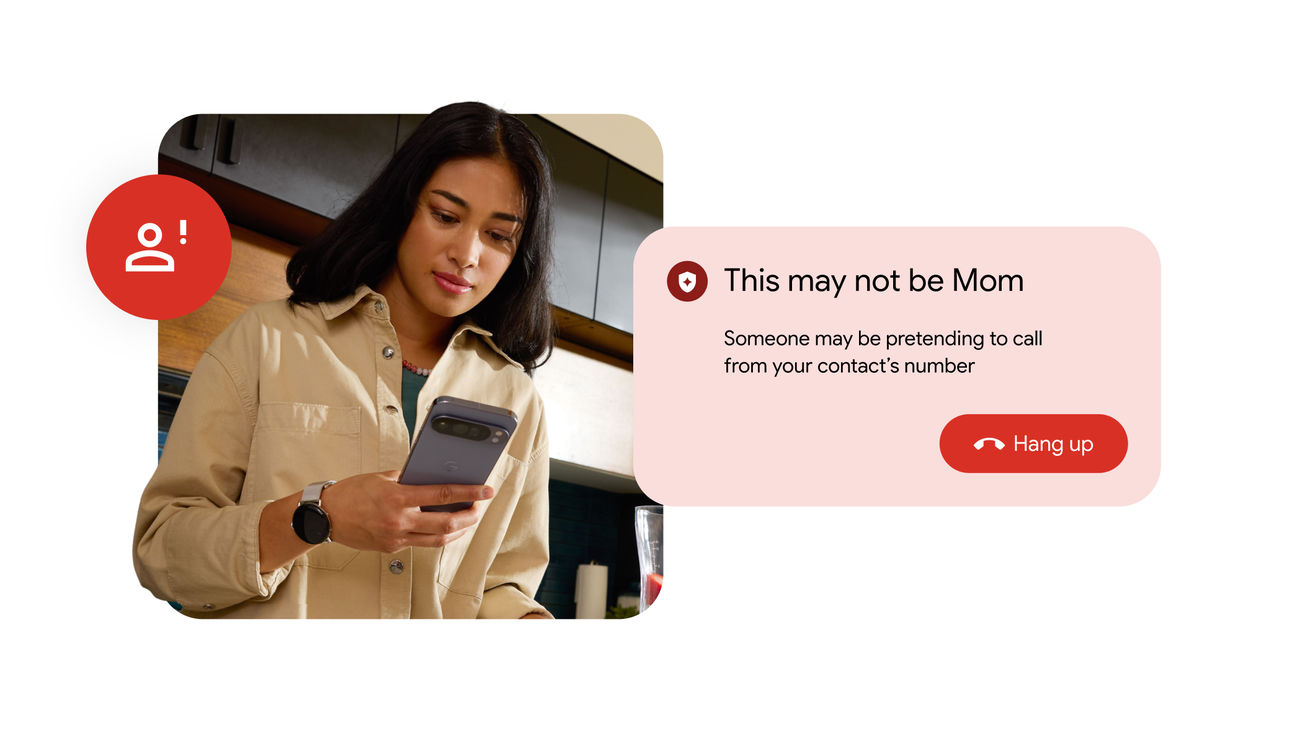
The useful part of Google’s new Android fake-call detection is not that it uses AI. It is that it refuses to make the user do AI forensics in the middle of a panic call.
That is the right instinct. The worst version of deepfake defense asks ordinary people to become audio analysts while a scammer is manufacturing urgency: your kid is in trouble, your boss needs a transfer, your bank account is locked, your parent is stranded, hang up and you will regret it. Google’s new feature, announced Tuesday for Phone by Google, takes a better route. It treats the phone call as an identity problem before treating the voice as a content problem.
Fake call detection is designed for a specific but increasingly ugly scam pattern: an attacker spoofs the phone number of someone already in your contacts, then uses AI voice cloning to sound like that person. Caller ID says “Mom.” The voice sounds plausible enough. The pressure is immediate. For years, the advice was basically “be suspicious,” which is not a control; it is a vibes-based incident response plan.
Google’s implementation is more interesting than that. When a contact calls and both people are using Phone by Google, the caller’s device sends a silent confirmation signal in real time to the recipient’s device. Google describes it as a “digital handshake” built on end-to-end encrypted Rich Communication Services, or RCS. If the confirmation signal is missing, the recipient’s phone pings the actual contact’s device. If that device reports that it is not currently placing the call, the recipient gets an on-screen warning advising them to hang up.
That is a much stronger security model than “listen harder.” It changes the question from “does this voice sound real?” to “is this call actually originating from the device I associate with this contact?” Caller ID has been a broken trust primitive for years. Voice is becoming one too. Device-origin verification is not perfect, but it moves the defense to a layer attackers have a harder time faking cheaply.
The threat is not synthetic audio. It is broken identity plus urgency.
Deepfake scams make headlines because the synthetic voice is creepy. But the exploit chain is more mundane: spoofed identity, social pressure, and an irreversible ask. AI just lowers the cost of making the deception emotionally convincing.
The numbers justify treating this as real infrastructure, not a novelty feature. Google points to INTERPOL’s 2026 Global Financial Fraud Threat Assessment, which warns that AI-enhanced fraud is 4.5 times more profitable than traditional methods and that “agentic AI” systems can plan and execute complete fraud campaigns, from reconnaissance to ransom demands. INTERPOL also says fraud-related Notices and Diffusions have increased 54% since 2024, and that it has supported more than 1,500 transnational fraud cases involving $1.1 billion in lost assets. The FTC, meanwhile, says business and government impersonation scams resulted in $2.95 billion in consumer losses in 2024.
Those figures matter because they reframe the product decision. This is not Google adding another safety badge to Android because deepfakes are trendy. It is Google responding to a shift in adversary economics. If attackers can cheaply combine leaked personal context, number spoofing, cloned audio, and scripted urgency, then platforms need to bind trust to something stronger than a number and a familiar voice.
The launch also sits inside the June Android Drop, alongside more consumer-friendly features like Circle to Search “Find the Look,” Google Photos wardrobe tools, Play Books insights, expanded Quick Share support, and children’s Personal Safety updates. The fake-call system is the standout because it is not just another assistant surface. It is a security architecture pattern hiding inside a platform update.
RCS as a control plane is more interesting than RCS as messaging drama
RCS is usually discussed through the least interesting lens possible: iPhone bubble politics, read receipts, and whether messaging finally feels modern across devices. Here, RCS is doing something more useful. It becomes a private control plane for call verification.
That matters. Security products work when they meet users where the risk happens. In this case, the risky moment is not after the call, when a fraud report is filed. It is not during some separate app flow where the user might check a warning page. It is the exact moment the phone rings and the user sees a trusted name. By making the verification happen behind the scenes and showing a warning in the dialer, Google puts the control at the decision point.
The privacy claim is also important. Google says the handshake uses end-to-end encrypted RCS technology and works automatically behind the scenes. That is the right direction, because a call-authentication system that required centralized visibility into everyone’s contact graph and call state would create a different problem. The details will still deserve scrutiny: metadata handling, offline behavior, warning copy, false positives, fallback paths, abuse resistance, and what happens when one device is compromised. But the high-level design is sound: verify device state without asking the user to become a lie detector.
There is a practical limitation, and it is not small. Fake call detection depends on both sides participating in Google’s phone and messaging stack. Google says the rollout is global this month for Android 12+ devices, starting with Pixel, and requires Phone by Google. The broader feature path also depends on Contacts, Google Messages, and RCS capability. Ars Technica correctly notes that calls involving another dialer or unsupported stack may not get the same verification path. In other words: this is not a universal phone-network fix. It is an overlay that works when the endpoints cooperate.
That does not make it useless. A lot of practical security ships this way. Coverage starts imperfect, incentives form around safer defaults, and then standards or competitive pressure expand the pattern. Google says it built the feature on RCS, an open standard, so other apps and manufacturers can adopt the approach. They should. Carrier-level authentication and stronger STIR/SHAKEN enforcement still matter, but endpoint verification is where platforms can move faster than telecom governance.
Builders should copy the pattern, not the product
The broader practitioner lesson is straightforward: stop treating AI fraud as a media-classification problem. Yes, detection, watermarking, provenance, and model-side mitigations matter. But if your user is being manipulated into authorizing a payment, resetting credentials, granting support access, approving a deployment, or sharing sensitive data, the control you need is not “does this voice/photo/video look synthetic?” It is “is the request coming through an authenticated channel, from a verified session, with a risk-appropriate approval path?”
For engineering teams, that means boring work. Bind sensitive actions to signed requests. Require out-of-band confirmation for high-risk flows. Make approvals specific, revocable, logged, and reviewable. Use verified sessions instead of trusting display names or phone numbers. Put warnings at the point of action, not in a documentation page. Add hold-to-confirm or delay windows for irreversible operations. Treat voice, video, and chat as user interfaces, not identity systems.
This also applies to AI agents. The same failure mode exists when a believable “assistant,” “coworker,” or “support bot” asks for tool access or action approval. A plausible natural-language request is not a security boundary. If the industry learned anything from the last year of agent-tool security incidents, it should be that authentication, authorization, provenance, and audit logs matter more when the interface gets more conversational, not less.
Google’s fake-call detection will not end impersonation scams. It will miss unsupported configurations. Attackers will adapt. Some users will ignore warnings because scams are emotional systems, not purely technical ones. But the architecture points in the right direction: authenticate the channel before judging the content. That is the move platforms should make more often.
Deepfake defense does not get better by asking humans to be less human under pressure. It gets better when products make the trustworthy path visible, automatic, and hard to spoof. Android’s new feature is limited, but the principle is LGTM: verify the thing that can be verified, and stop pretending a realistic voice should ever be treated as proof.
Sources: Google Security Blog, Google Android Blog, INTERPOL, FTC, Ars Technica